


Minimising the human intervention is the best way to preserve Kerala’s Silent Valley
BeyondHeadlines News Desk
Silent Valley is the best assurance that a forest can speak through human beings.” said the environmentalist MK Prasad. The tourists and visitors to Silent Valley cannot disagree with him because Silent Valley gives an unusual experience of silence while in the midst of nature. It gives one the rarest of the rare experience of being with nature, becoming one with it.
Silent Valley National Park is located in the Nilgiri Hills, Palakkad District in Kerala. The park is one of the last undisturbed tracts of South Western Ghats rain forests and tropical moist evergreen forest in India. It is the core of the Nilgiri International Biosphere Reserve and is part of The Western Ghats World Heritage Site.
The area is locally known as “Sairandhrivanam” literally, in Malayalam: Sairandhri’s Forest. In local Hindu legend, Sairandhri is Draupadi. The Pandavas during their exile wandered into Kerala and came upon a magical valley where rolling grasslands met wooded ravines, a deep green river bubbled its course through impenetrable forest, where at dawn and twilight the tiger and elephant would drink together at the water’s edge, where all was harmonious and man unknown.
Botanist Robert Wight in 1847 made the first English investigation of the watersheds of the Silent Valley area.
The British named the area Silent Valley because of the perceived absence of noisy cicadas. Another story attributes the name to the anglicisation of Sairandhri. A third story, refers to the untouched nature of the valley, i.e., without human noises.
Silent Valley is home to the largest population of Lion-tailed Macaque, an endangered species of Primate.
The Silent Valley National Park is a unique preserve of natural rainforests. It houses a rich mosaic of varied habitats. Out of these springs the amazing variety of life forms some of them endemic to the Western Ghats.
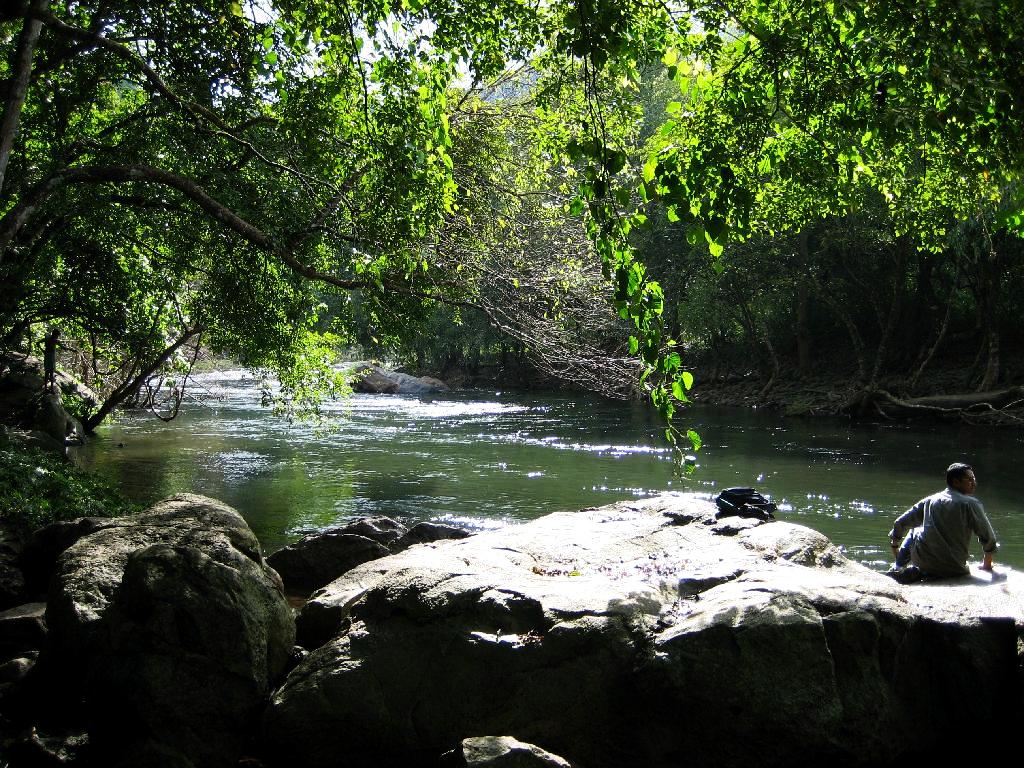
The Kuntipuzha River drains the entire 15 km length of the park from north to south into the Bharathapuzha River. The river is characterized by its crystal clear and perennial nature. The number of tree species computed for the Silent Valley (118 vascular plants of 84 species in 0.4 ha) is very high compared to a range of 60 to 140 species that characterise the other known tropical forests.
The Mudugar and Irula tribal people are indigenous to the area and they live in the adjacent valley of Attappady Reserved Forest. Also, the Kurumbar people occupy the highest range outside the park bordering on the Nilgiris.
The limited studies of the fauna of Silent Valley reveals that its rich resources as rare and unique – rare because many species which originally inhabited the entire belt of the Western Ghats have been lost due to destruction of their habitat by human beings or for other reasons. These faunal resources however are still available in Silent Valley, because of the relatively little human intrusion. It is unique because what little has been collected and studied has already proved to be of immense scientific interest from the taxonomic, zoo geographic and ecological points of view.
A number of species, which were available in the Western Ghats 50 to 100 years ago still exist in Silent Valley. They include insects, fishes, amphibians, reptiles and mammals.
Up to 1970 it was an unknown forest area, unexplored and untouched. Announcement against a hydroelectric project proposed in the area resulted in the creation of the park in 1984.
Since then, a long-term conservation effort has been undertaken to preserve the Silent Valley ecosystem. In order to ensure better protection of the area the buffer zone of the Park was created and made an integral part of Silent Valley National Park.
Now there are two zones for silent valley. The core zone (89.52 sq.km) and buffer zone(148 sq km). The core zone is protected and wild life is undisturbed. Only forest department staff, scientists, and wildlife photographers are allowed.
The story of Silent Valley National park is the struggle and thought for environmental protection in the country. The struggle for protecting the valley proved that human beings still care for nature. (Courtesy: Sopan Step)