


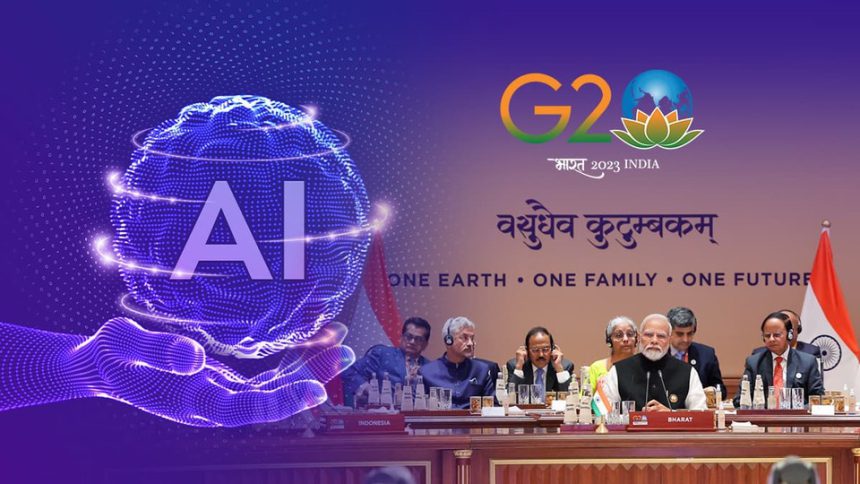
When India hosted the G20 Summit in 2023, Prime Minister Narendra Modi’s message was direct: “AI for All.” He argued that artificial intelligence must benefit everyone, not just those with power and access. The summit became a stage for India to assert its role in global tech governance, not merely as a user of technology but as a contributor to its rules.
India’s domestic efforts include initiatives like the RAISE Summit (Responsible AI for Social Empowerment) by MeitY, which brought together global experts to explore AI applications in healthcare, education, and agriculture. But challenges persist. India still lacks comprehensive data protection legislation. Surveillance technologies, such as facial recognition, have been used during protests without proper legal safeguards, drawing sharp criticism from civil society. These gaps not only expose citizens but also undermine India’s global credibility.
Yet, these shortcomings also offer an opportunity for reflection and reform. Updating outdated IT laws, enforcing robust privacy protections, and integrating ethics into tech design can bridge the gap between India’s domestic reality and its international ambitions.
India has long positioned itself as a voice for the Global South. A Takshashila Institution report notes how India champions open digital infrastructure like Aadhaar and UPI, while navigating difficult questions around surveillance and inclusion. The Paris Peace Forum commended India’s G20 presidency for fostering consensus rather than dominance. Similarly, ORF lauded India for highlighting digital challenges—from affordability to algorithmic fairness—faced by developing countries.
India’s evolving role in shaping AI governance is becoming more pronounced on global platforms. In 2024, India took a leadership role within the Global Partnership on AI (GPAI) by chairing working groups on data governance and AI for social good. The IndiaAI Mission, launched the same year, pledged ₹10,000 crore to foster homegrown foundational models and establish an AI Safety Institute to set audit and risk standards. At the UN Internet Governance Forum, Indian representatives advocated for non-Western benchmarks on AI ethics and accessibility. India also co-authored a proposal at UNESCO pushing for the inclusion of indigenous and multilingual datasets in global AI standards. These moves reflect a growing confidence in defining AI rules not just for India, but in coalition with developing economies that remain data-rich but institutionally underrepresented.
But India’s AI journey is not shaped by diplomats alone. It is also unfolding in university labs, start-up ecosystems, and activist networks. Open-source initiatives like AI4Bharat, supported by IIT Madras, are building AI tools for India’s 22+ official languages, helping decentralise innovation. Civil society organisations such as the Internet Freedom Foundation, the Centre for Internet and Society (CIS), and the Software Freedom Law Centre (SFLC.in) are pushing for algorithmic accountability, particularly in surveillance and law enforcement.
For instance, SFLC.in revealed in a 2023 report that facial recognition technology had been deployed in over 100 public places across India without a clear legal framework or transparency mechanisms. Their legal advocacy and RTI findings prompted calls for parliamentary scrutiny and increased public awareness. Similarly, the Centre for Internet and Society obtained documents through RTI requests showing that facial recognition systems were used during Mumbai protests without legal sanction, sparking debate in Parliament and the media.
AI from Below – India’s People-Powered Push for Fairer Tech
| Initiative | Description | Why It Matters |
| AI Safety Institute (2024–25) | Established under MeitY’s IndiaAI Mission to define audit and safety norms. | Reflects India’s ambition to shape global norms with local accountability. |
| AI4Bharat (IIT Madras) | Builds open-source Indic language models for 22+ languages. | Tackles the linguistic digital divide, countering English-dominated AI. |
| SFLC.in & CIS | Civil society groups are investigating AI misuse in policing, hiring, and surveillance. | Strengthens democratic checks on opaque technologies and fosters public trust. |
If India truly seeks to lead on AI, it must not only build the tech but also build trust. A fairer global conversation begins at home: by safeguarding rights, engaging citizens, and designing technologies that reflect India’s democratic ethos. The world is watching. And so are millions of Indians.
Mohammed Affan is an Indian student of Political Science & International Relations at Istanbul Sabahattin Zaim University. An Erasmus Scholar, he recently completed a semester at the University of Wrocław, Poland. He writes on global affairs, AI Governance, MENA, EU, and South Asia.