


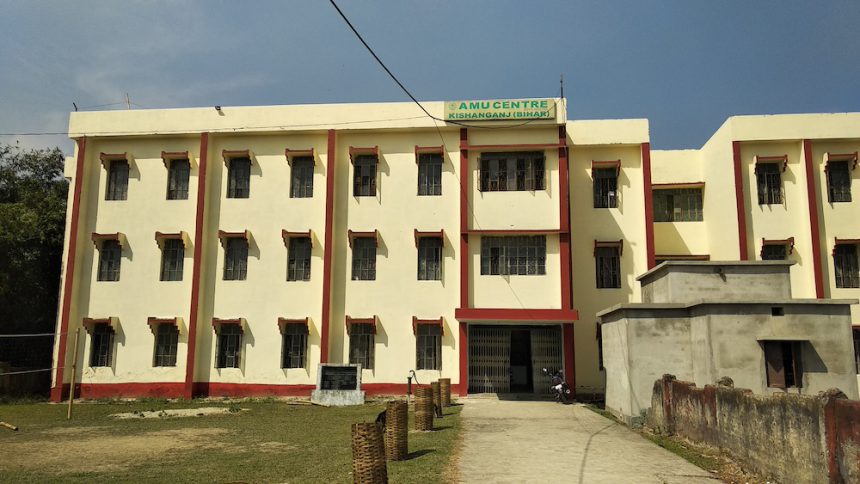
The Kishanganj Center of Aligarh Muslim University (AMU) has become entangled in political controversy. The land allocated for the center lies along the banks of the Mahananda River, where significant erosion has rendered a large portion of the site unusable. As a result, no substantial construction has been initiated despite funds being allocated for the project. Recently, the National Green Tribunal (NGT) has ordered a halt to all construction activities at the site.
In a conversation with BeyondHeadlines, the current acting director of the center, Dr. Hasan Imam, said, “The center does not yet have its own building. The land provided by the Bihar government has been placed under a construction ban by the National Green Tribunal (NGT).” Dr. Imam assumed office on October 15, 2019.
When asked about the reason behind the NGT’s order, he explained, “Someone filed a complaint with the NGT claiming that construction of the AMU Center would pollute the Mahananda River. But that is not true. Only 68 acres of the land lie within the river belt; if that portion is excluded, the rest of the site is quite far from the river. Moreover, we are not undertaking any work on those 68 acres. If the NGT wanted to restrict construction, it could have limited the ban to that area — instead, it has halted all construction across the entire land.”
It is worth noting that the Bihar government’s APJ Abdul Kalam Agricultural College operates on the banks of the same Mahananda River, and construction of this college began after the AMU Center became functional. The college stands right next to the river.
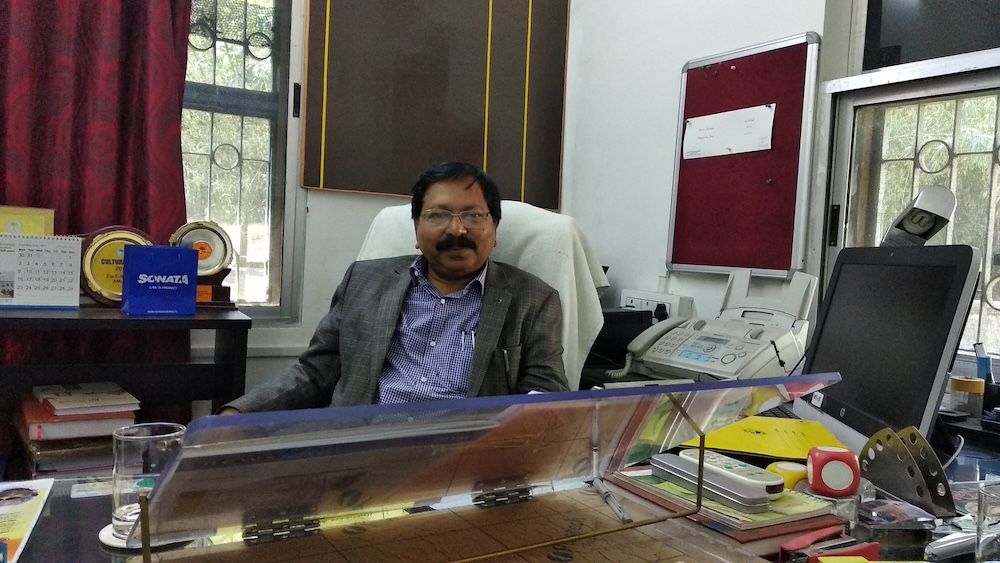
Dr. Hasan Imam had also presented the issues faced by the centre to the Chief Minister in December 2019. Describing that meeting, he said, “We informed Nitish Kumar about the centre’s activities and challenges, and requested that an additional 10 acres of land be allocated adjacent to our boundary so that at least an academic block could be built. The Chief Minister seemed receptive to the idea, but it has not yet been implemented.”
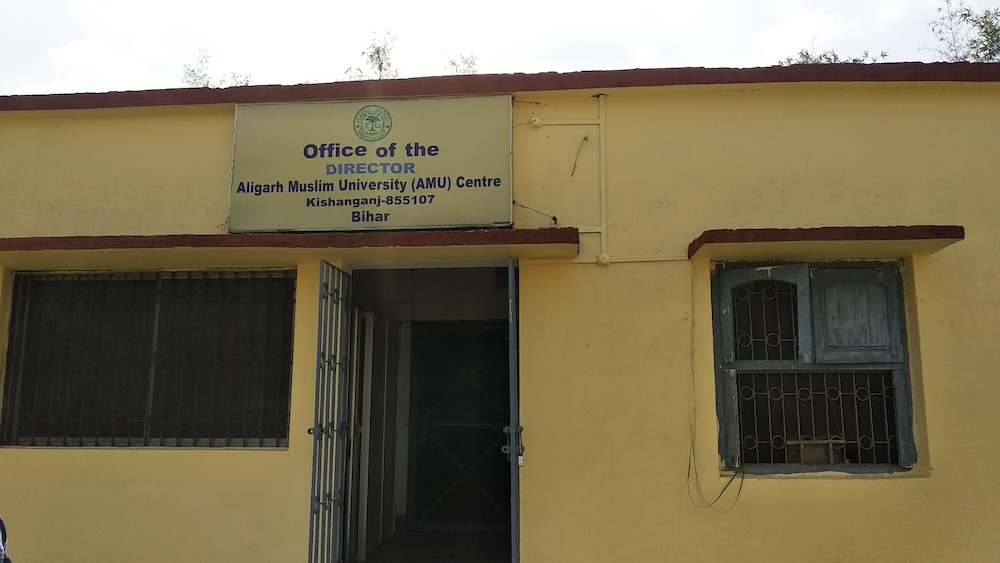
At present, the Kishanganj Center of AMU is functioning merely as a guest house. In the absence of a dedicated building, students are being accommodated in a hostel originally constructed by the Bihar government for minority students. This means that the center neither has a permanent campus nor any immediate prospect of one. The entire project is increasingly being viewed as a temporary arrangement — one that could be discontinued at any time under one pretext or another.
We also visited the site where the proposed AMU Center is to be built. Surprisingly, much of the boundary wall surrounding the 224-acre plot has collapsed or disappeared, and there appears to be no serious effort by the authorities to rebuild it. Local residents claim that the project has now fallen victim to what they describe as the central government’s anti-Muslim politics.
It is worth noting that Educational Consultants India Limited (EdCIL), a Government of India enterprise, has advised the central government that constructing buildings on this site would be impractical.
Meanwhile, in October 2017, the National Green Tribunal (NGT) issued a strict order to the District Magistrate to halt all construction activities at the AMU Kishanganj Center, which is located on the banks of the Mahananda River. The NGT’s directive came in response to an appeal filed by a resident named Abhin Besi from Manjhi Pargana, who argued that the boundary wall being constructed at the AMU Center was illegal as it altered the natural flow of the river and posed risks to the river and the surrounding environment.
Dr. Hasan Imam, Director of AMU Kishanganj, said that the primary reason the center has not yet become operational is the lack of funding. The central government has not released the required funds, which remains the biggest obstacle.
It is worth noting that on January 30, 2014, then UPA Chairperson Sonia Gandhi announced a grant of ₹136.82 crore while laying the foundation stone for the center. However, after the change of government at the Center, progress stalled. Despite repeated efforts, only ₹10 crore has been received so far from the Modi government, which was spent on building the boundary wall and related site work. This amount was allocated through the University Grants Commission (UGC) during the 2015–16 financial year.
Only Two Courses Offered — One Already Discontinued
The AMU Kishanganj Center was established with support from Aligarh Muslim University’s Kerala campus. Initially, two programs — B.Ed. and MBA — were introduced, each with an intake of 60 students. However, in 2017, admissions to the B.Ed. program were suspended after the National Council for Teacher Education (NCTE) declined to grant approval.
Currently, the MBA program continues with only 46 students across the first and second years combined. In other words, the entire center is functioning for just 46 students. To support them, there are seven teaching and twelve non-teaching staff members, even though not a single official post has been sanctioned by the government. All staff currently serve on an ad hoc basis.
Following the closure of the B.Ed. course, a delegation met with AMU Vice-Chancellor Tariq Mansoor in December 2019. The Vice-Chancellor stated that the university had filed a writ petition in the Patna High Court challenging the NCTE’s decision to withhold approval for the B.Ed. program, and that further action would depend on the court’s directions.
Discontent Among Locals
Local residents express deep frustration with the Bihar government over the stalled AMU Kishanganj Center project. Many believe that the Nitish Kumar government has remained largely indifferent after allocating 224 acres of idle land along the banks of the Mahananda River. According to them, the issue surfaces during every election but never sees any concrete action. The local Member of Parliament and Member of the Legislative Assembly, they claim, have also remained silent, making little difference whether they intervene or not.
Residents also voice dissatisfaction with the way the center itself is being managed. They allege that entrance examinations are deliberately conducted in Patna instead of Kishanganj, which discourages local students — especially girls — from applying. According to them, only a token number of students from Kishanganj are actually enrolled at the center. Many also argue that priority should have been given to establishing a degree college and a polytechnic institute for girls, as educational opportunities for women are particularly limited in the region. “Boys can go outside to study,” they say, “but for girls, access to local education is crucial.”
Responding to these concerns, Director Dr. Hasan Imam said that, due to their efforts, an entrance test center has now been established in Kishanganj. He added that a request has also been submitted to the AMU administration to set up a distance education center to expand access for local students.
Local Politicians and AMU Share Responsibility
Ghulam Shahid, who has campaigned for the establishment of the AMU Kishanganj Center from the beginning, expresses strong frustration with local politicians. In a conversation with BeyondHeadlines, he said that the main responsibility lies with these politicians, who, he claims, have consistently treated this important issue as a political tool. “If they were sincere,” he said, “they would have set aside their politics and worked together to establish the center. Instead, everyone has focused on their own gains. This is why the dream of the center remains unfulfilled.”
According to Shahid, the movement to establish the AMU Kishanganj Center began at his own Crescent Public School and gradually attracted more supporters. His second criticism is directed at AMU itself. He questions whether the university lacks the authority to acquire land for its projects, emphasizing that confidence and initiative would have ensured success. “There are people in Kishanganj ready to do anything to overcome the area’s backwardness and promote education,” he said. “AMU could have started a B.Ed. college. Yet, the university did not make the necessary efforts, even to save the existing B.Ed. course. In this sense, AMU also bears responsibility.”
Shahid also sees the governments’ indifference as part of a broader, organized neglect that keeps the region underdeveloped and deprived of educational opportunities. He points out that local residents continue to petition the central government and meet public representatives, yet no significant action has been taken. “Perhaps this center is not a priority for the Modi government,” he added. “Perhaps it has been left in limbo as a promise on paper. Today, the AMU Kishanganj Center teeters on the brink, caught between political maneuvering and unfulfilled government assurances.”
Uproar in Parliament
The condition of the AMU Kishanganj Center has also been a topic of concern in Parliament. On January 9, 2019, Rajya Sabha MP Kakhashina Parveen highlighted the poor state of the center, and on February 7, 2019, Rajya Sabha MP Ahmed Ashfaq Karim questioned its funding. The response indicated that the University Grants Commission (UGC) had released ₹10 crore to the center during the 2015–16 financial year.
Media reports also note that in July 2017, a team from the Ministry of Human Resource Development (MHRD), led by Punjab Central University Vice-Chancellor Professor R.K. Kohli, visited the under-construction AMU campus in Kishanganj to inspect the site. The team reportedly met with the local Member of Parliament, all Members of the Legislative Assembly, and officials, including the District Magistrate and Superintendent of Police, at a private hotel. The delegation assured public representatives that every possible effort would be made to improve the AMU center. However, observers question what construction work could have been reviewed, given that little or no activity had taken place on the ground.
Opposition parties have also raised concerns in the Rajya Sabha about alleged government interference in AMU’s autonomy. During one session, the uproar forced the house to be adjourned. Samajwadi Party MP Javed Ali Khan stated that of the five AMU centers planned outside its main campus, three had been established while two were yet to open. He added that the university’s Vice-Chancellor claimed the Human Resources Minister had declared these centers illegal and threatened to withdraw financial support.
He also clarified that the President of the university serves as its Visiting Fellow, and without his approval, neither the Academic Council nor the Executive Committee can make any decisions. In 2008, both the President and the governing bodies jointly decided to establish five centers outside the main campus under Section 12 of the AMU Act. Given this, he questioned how the Ministry of Human Resource Development could block the grants allocated to these AMU centers.
It is also important to note that following the presentation of data on minority backwardness in the Sachar Committee report, the then UPA government formulated a policy to address these issues. Under this policy, AMU decided to open five centers outside its main campus. Three of these centers were established in Malappuram (Kerala), Murshidabad (West Bengal), and Kishanganj (Bihar), while the remaining two are yet to be opened. However, the current BJP government has reportedly questioned this decision and withheld funding for the three operational centers.