

Ramzy Baroud
The global boycott movement (BDS) and other related campaigns were aimed at exposing Israeli transgressions against the Palestinian people and galvanizing international solidarity. What is so uplifting to see now is how their achievements have far surpassed these initial aims. The campaigns have animated, accentuated and actually legitimized Palestinian civil society – a notion that long stood outside the official paradigm acceptable to Israel, and which had very little space within the restrictive realm of the Palestinian Authority (PA).
Now civil society has been incorporated into the overall political equation as a leading factor in the Palestinian struggle for rights and freedom. The society is also increasingly filling the vacuum created by the PA’s localization of the Palestinian struggle, and Israel’s constant attempt at downgrading any genuine alternative to the PA’s leadership.
The articulation of the rise of Palestinian civil society came loud and clear on July 09, 2005, when 171 Palestinian civil society organizations representing Palestinians living in the occupied territories, Israel, and the Diaspora called “upon international civil society organizations and people of conscience all over the world to impose broad boycotts and implement divestment initiatives against Israel similar to those applied to South Africa in the apartheid era.”
They further stated: “We appeal to you to pressure your respective states to impose embargoes and sanctions against Israel. We also invite conscientious Israelis to support this call, for the sake of justice and genuine peace.”
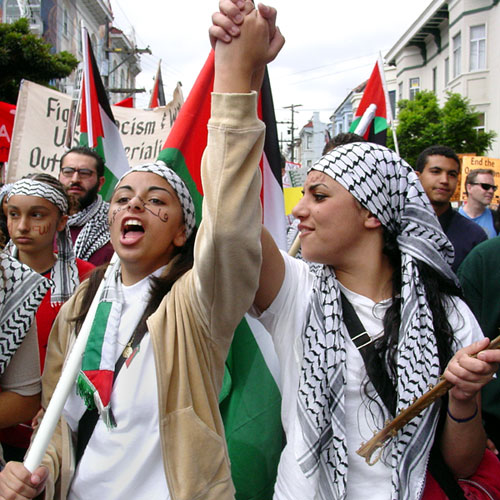
The statement won the approval of most Palestinians, and it inspired numerous representatives of civil society from around the world. Several tangible actions were taken, and the call for Boycott, Divestment and Sanctions finally became a real strategy. In Israel too, a growing number of Israeli Jewish and Arab activists became committed to undermining the long held notion that the conflict was exclusively racial, ethnic or religious.
Cleary the Israeli definitions of old are no longer appealing to an increasingly determined international civil society. In the last few years, for instance, we have seen the Gaza Freedom March, the heroism aboard the Mavi Marmara, and the tireless efforts of enumerable organizations and individuals working to bring Israeli war criminals to trial and to end the Gaza siege.
The involvement of international civil society in aiding Palestine is actually as old as the conflict itself. However, it was not until the Second Intifada, or uprising, in 2000 that the involvement of international civil society became somewhat ‘institutionalized’ through clearly marked channels. The International Solidarity Movement (ISM) was a particularly meaningful example. The ISM seemed like a model of the International Brigades that went to defeat Fascism during the Spanish Civil War (1936-39). The ISM used a non-violent method of resistance, and its recruits of civil society activists were the very activists whose video footage, blogs, photographs, public presentations and even books helped to change international public opinion and challenge mainstream representations of the conflict that were so shamefully biased towards Israel.
The Palestine Liberation Organization (PLO), despite past shortcomings, served as a unifying platform, centralizing Palestinians efforts and defying Israel’s diligent attempts at dismissing the very existence of a Palestinian collective. Former Israeli Prime Minister Golda Meir mirrored the attitude of many Zionist Israeli leaders when she stated: “There is no such thing as a Palestinian people…It is not as if we came and threw them out and took their country. They didn’t exist.”
The significant role of the PLO, however, was overshadowed by that of the PA following Arafat’s signing of the Oslo accord in 1993. The PA had long served an extremely detrimental role in Palestine and the Palestinian people’s struggle. One of its worst long-term legacies was depriving the Palestinian people from the sense of national cohesion. Although it was Israel that largely supported and propped up this new non-representative Palestinian body, it was also this very party that decried that it had no peace partner, thus de-legitimizing its own creation.
With the elected Palestinian government, Hamas, under physical siege in Gaza, and an even greater political siege regionally and internationally, the issue of representation is all the more pressing. Representation is a prerequisite for unifying and guiding the Palestinian people through future phases of their struggle.
Still, it is heartening to note that such a political vacuum had its own benefits. It has revitalized civil society in Palestine, and, by extension, global civil society. This has helped to maintain a sense of centralization in Palestinian political discourse, one that is capable of juggling both national priorities and international solidarity.
The concept of civil society is often used as a meeting point between other forces, including a healthy and fully functional state. In the Palestinian scenario, however, with the occupation, siege and regular assassinations and imprisonments of political leaders, such a state is missing. This reality has skewed the traditional balance, resulting in a political void engineered by Israel to de-legitimize Palestinian demands and rights. It is most impressive, to say the least, that representatives of Palestinian civil society have managed to step up and fill the void.
This success would have never been possible without individuals from international civil society, including Rachel Corrie, the Turkish heroes aboard the Mavi Marmara, and the many Israeli activists and organizations who are currently being targeted by the rightwing government of Benjamin Netanyahu and Avigador Lieberman.
Israel has shown alarm over the growing importance of civil society by reacting on many fronts. In Palestine, it has imprisoned Palestinian non-violent resisters. In Israel, it has cracked down on funds received by Israeli human rights groups. And internationally, it has pushed forward a media campaign of defamation.
These Israeli efforts must be challenged on all fronts as well. Continuing to de-legitimize the illegal Israeli occupation can partly be achieved through supporting Palestinian civil society, including their call for boycott.
Israel’s actions have not been limited to de-legitimizing Palestinian rights and dismissing their existence. Israel has also worked hard to defragment any sense of political or national cohesion, through many creative means, separation walls notwithstanding. Yet, it is the Israeli occupation that is now being de-legitimized, its own government that is being isolated, and its own country’s reputation that is constantly compromised. The power of civil society has indeed surpassed that of military hardware, archaic and exclusivist historical discourses, propaganda and political coercion.
Indeed, Lieberman, the Israeli government and their supposedly powerful lobbies have every reason to be worried.
Ramzy Baroud is an internationally-syndicated columnist and the editor of PalestineChronicle.com. His latest book is My Father Was a Freedom Fighter: Gaza’s Untold Story.
The views expressed in this article are the author’s own and do not necessarily reflect BH’s editorial policy.