

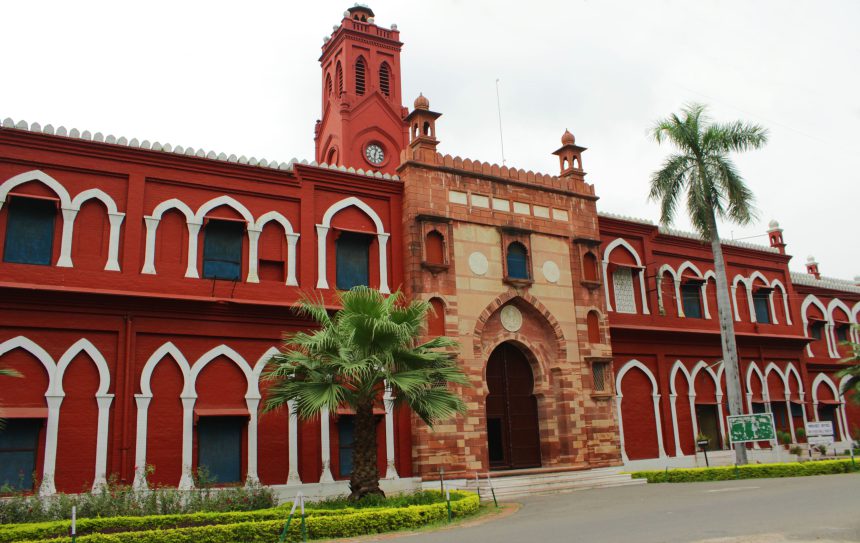
The decade of the 1990s marked a profound structural, political, and moral crisis for India’s largest residential Aligarh Muslim University (AMU). Situated at the intersection of sweeping national political upheavals—most notably the rise of aggressive majoritarian nationalism following the demolition of the Babri Masjid in 1992 (the 1980s had competitive communalism), and the onset of economic liberalization—AMU became a microcosm of the anxieties, contradictions, and institutional degeneration confronting minority education in post-colonial India. Within the campus, this period was characterized by the breakdown of administrative coherence, the rise of regional and sub-regional student criminalization, and alarming erosion of academic standards. Yet, amidst this institutional decay, there emerged a parallel counter-movement driven by student idealists seeking to reclaim the University’s historical mission through democratic engagement and ideological renewal. Understanding the decade requires examining the unraveling of administrative authority, the emergence of alternative democratic student politics, and the broader structural forces that reshaped minority institutions at the turn of the century.
The institutional evolution of the university during this decade unfolded through three distinct phases: an initial era of administrative drift and rising lumpenization during the tenure of the VC (1990–1994), Prof. M. Naseem Faruqi (d. 2012); a subsequent bureaucratic tenure (1995-2000) of an IAS officer Mehmoodur Rehman (1935–2017), marked by security-centric governance and state-aligned patronage; and alongside a brief but significant democratic upsurge between 1994-1999 (more visible during 1997-99) driven by progressive student movements, which culminated in the landmark election in Feb 1999 and swift administrative subversion of the Aligarh Muslim University Students’ Union (AMUSU) on 23 June 1999.
The 1980s Carry-Over: The Roots of Communal Polarization
The profound ideological and communal polarization that crippled AMU in the 1990s cannot be understood in isolation from the turbulent socio-political developments of the preceding decade. The 1980s had left a deeply fractured legacy for India’s Muslim communities, catalyzed most decisively by the Shah Bano controversy (1985–1986)—over the un-Quranic Instant Triple Talaq (divorce; ITT) and more importantly, right to maintenance under criminal law—and the concurrent escalation of the Ram Janmabhoomi movement centered around the Babri Masjid dispute in Ayodhya. These events served as critical turning points that deeply communalized the Indian civil society and polarized the middle classes.
For a centrally funded, Muslim majority, residential institution like AMU, historically positioned as the intellectual and cultural heartland of [North?] India’s Muslims, these developments generated an intense siege mentality. The conservative and traditionalist leadership within and outside the campus capitalized on the community’s mounting insecurities, whipping up reactive religious passions and pulpit politics. This 1980s carry-over created an environment where rational, secular, and modernist discourses were systematically sidelined in favor of defensive communal insularity. When the demolition of the Babri Masjid occurred on Sunday, 6 December 1992, it acted as a traumatic crescendo, validating the worst fears of marginalization and thrusting the campus into a deep twilight terrain of despair and reactionary posturing that heavily conditioned the political battles of the 1990s.
Patronage, Criminalization, and Administrative Paralysis
The early part of the decade under Vice Chancellor (1990–1994) Prof. M. N. Faruqi (d. 2012) laid bare the deep-seated institutional vulnerabilities of AMU. Prof. Faruqi, a distinguished technocrat from IIT Kharagpur, entered the AMU amidst warm student receptions, yet his tenure quickly succumbed to severe administrative paralysis. Faruqi’s well-intentioned but overly permissive governance style—characterized by democratic accessibility and personal leniency—was systematically exploited by campus cliques, land mafias, and opportunistic student factions. Academic appointments and promotions were increasingly decoupled from merit, compromised by patronage quotas and informal influences.
Simultaneously, the campus experienced an alarming escalation in violence and lumpenization. Student mobilizations abandoned substantive ideological debates in favour of narrow regional and sub-regional polarizations, transforming residential halls—such as S.S. Hall, Sulaiman Hall, S.Z. Hall, M.M. Hall, and R.M. Hall—into territorial strongholds for rival armed groups. The introduction of homemade firearms (katta) and explosive devices (bombs) into routine disputes signaled a dangerous shift in campus culture. These armed groups exercised informal control over academic appointments, department selection committees, and admission quotas. While Faruqi introduced key infrastructural modernizations—such as campus computerization, professional programs (B.Tech in Computer Engineering, Master of Finance & Control, Master of Tourism Administration), and the Institute of Agriculture—the pervasive lawlessness eclipsed his long-term vision, ultimately forcing his premature resignation in 1994.
This dynamic aligns with broader academic observations on state-supported higher education in developing nations during political transitions. As institutional sociologists like Joel Migdal (State Power and Social Forces, Cambridge University Press, 1994) note, when central administrative authority weakens, informal “strongmen” and local boss networks step in to capture institutional resources, converting academic public goods into private patronage. At AMU, this resulted in an administrative vacuum where academic integrity was sacrificed to preserve fragile political equilibrium.
Following Faruqi’s exit, the Indian state attempted to restore order by appointing a bureaucrat, Mehmoodur Rehman (1995–2000), a former advisor of the Governor, Jagmohan, in Jammu & Kashmir. However, Rehman’s administration substituted academic governance with authoritarian state security logics. Rather than dismantling the criminal-administrative nexus, the administration co-opted loyal student faction while publicly vilifying the university community—most notoriously through public statements claiming the campus was “bristling with ISI agents” (Times of India, April 1997). This securitized posture alienated the general student body and further entangled the Muslim majority university management with national political (majoritarian) alignments.
The Justice Mathew Report (1998): Documenting Institutional Rot
While contemporary press reports and memoirs like Prof. Faruqi’s memoir, My Days at Aligarh hinted at widespread irregularities, the full extent of AMU’s administrative decay during this period was officially catalogued in the Justice Mathew Report of 1998. Commissioned to investigate systemic malpractices, the report meticulously documented extensive corruption, financial mismanagement, and arbitrary administrative decisions spanning governance, fund allocations, and crucially, institutional admissions and faculty recruitments-promotions. Instituted by the VC Mehmoodur Rehman, but shelved it to drag and complete his tenure (and attempted to get another term) by blackmailing and co-opting the clout-members indicted in the Mathew Report.
The findings revealed how the VC’s nomination quotas and administrative discretion had been systematically abused to favor incompetent applicants, bypassing established academic standards and rewarding political patronage. However, true to the culture of bureaucratic opacity that characterized the era, the report was suppressed and kept away from the public gaze. It only surfaced years later following the enactment of the Right to Information (RTI) Act in 2005, retroactively validating the exposes made by teacher-activists and journalists regarding how deeply the academic core of the university had been compromised by entrenched oligarchies during the 1990s.
Emergence of the Forum for Democratic Rights (FDR) and Alternative Student Activism
In reaction to both internal degeneration and external political hostility, a distinct ideological intervention took shape on campus in 1994 with the formation of the Forum for Democratic Rights (FDR). Emerging in the traumatic aftermath of the 1992 Babri Masjid demolition and the rise of majoritarian Hindutva politics, the FDR sought to steer Muslim political consciousness away from reactionary, pulpit-driven emotionalism toward secular modernism, democratic rights, and institutional self-criticism.
The FDR established its work across three core dimensions: foundational ideology, campus reforms, and national political alignment. On an ideological level, it prioritized secularism, modernism, and systemic self-criticism, drawing intellectual inspiration from a diverse range of thinkers. The writings of Ali Shariati, Edward Said, Noam Chomsky, Asghar Ali Engineer, Ziauddin Sardar, and Maulana Abul Hasan Ali Nadwi were read and debated alongside classic texts on secularism. In terms of campus reforms, the movement actively opposed the conventional, lumpenized electoral culture dominated by empty slogans such as “Tempo High Hai”, taking up concrete student grievances including fee-hike struggles and advocating for democratic union elections. Nationally, the group sought solidarity with progressive, secular, and Left forces—such as the All India Students Association (AISA)—framing campus activism within broader anti-caste, anti-communal, anti-corruption, and pro-democratization struggles across India.
This ideological framework stood in stark contrast to the conventional student factions of the early 1990s. Where traditional factions relied on regional and sub-regional hall loyalties, the FDR built a cross-regional, inter-disciplinary cadre of students. Where conventional groups deployed money power, physical intimidation, and slogan-driven campaigns, the FDR focused on issues-based activism, public candidate screenings, and reflective pamphlets. While older factions sought patronage from administrative figures and maintained a symbiotic nexus with local land mafias, the FDR offered a systemic critique of administrative corruption, state securitization, and elitist communal politics, advocating instead for socio-economic empowerment and secular integration.
The political philosophy of the FDR mirrored what political theorist Nancy Fraser (Fortunes of Feminism, Verso, 2013) describes as a shift from simple “identity politics” to a dual politics of “redistribution and recognition.” Rather than seeking protection through communal insulation or state patronage, the FDR advocated for proportional representation, democratic empowerment, socio-economic development, and alliances with broader progressive subaltern movements.
The FDR’s activism manifested in several key practical campaigns. In 1993, progressive student groups had introduced mandatory question-and-answer sessions for candidates contesting AMU Students’ Union (AMUSU) elections, forcing contenders to defend their political platforms publicly. Following VC Mehmoodur Rehman’s 1997 statements to the national press regarding “ISI agents,” the FDR published detailed interrogatives exposing the administrative flaws of the claim. Students organized protests, performed Eid prayers wearing badges asking, “Are we ISI agents?” and boycotted official administrative receptions. Furthermore, the group had actively organized events on gender justice, including seminars on “Women’s Liberation: The Road Ahead” on International Women’s Day 1997, and campaigned vigorously against steep fee hikes and food contract corruption in residential halls.
The 1999 AMUSU Revival, Electoral Triumph, and Systemic Backlash
The culmination of this democratic struggle occurred in early 1999. After a fifteen-month period during which the administration operated an ad-hoc, nominated student council—which faced widespread condemnation for complicity in police actions against junior doctors—student pressure forced free elections on January 28–30, 1999. The administration-sponsored hoodlums had burnt the ballots moments before counting of ballots had to resume, and students’ agitation extracted re-election, in no time. (This burning of ballots was done to ensure that the elected students’ representatives won’t be there in the AMU-Court meeting).
In a historic departure from decades of Union leadership (at times lumpenized, un-elected, foisted ad hoc by the VC) the students elected Nadim Asrar, a Masters student in Mass Communication associated with progressive student politics, as President of the AMUSU on January 30, 1999. Asrar’s campaign eschewed traditional financial expenditure and armed intimidation, relying instead on articulate political critique, accessible governance, and a platform focused on university democratization and Muslim political empowerment.
Between February and May 1999, the newly elected Union initiated a series of progressive measures. The leadership successfully led an anti-fee-hike agitation, enforced strict financial retrenchment within the Union, rejected personal administrative privileges, and began preparing for a national convention in New Delhi on “Muslim Empowerment”.
However, these initiatives met immediate administrative resistance. The university administration, working in tandem with displaced campus oligarchs, systematic patronage networks, and regional political figures, executed a concerted strategy to undermine the Union. Official communication channels were closed to the elected President while non-elected faction leaders were granted direct administrative access. The administration systematically isolated the President by co-opting other executive office-bearers through patronage and administrative concessions, while active student organizers faced threats, academic suspensions, and Proctorial harassment.
On June 23, 1999, after barely five months of the Union’s tenure, Vice Chancellor Mehmoodur Rehman abruptly dissolved the AMU Students’ Union. The explicit justification cited administrative necessity, but the underlying political rationale was tied to national electoral dynamics. The AMUSU leadership was preparing to convene an all-party national convention on Muslim empowerment on the eve of the 13th Lok Sabha general elections (1999). By framing minority rights around constitutional equity, internal reforms within the Muslim dominated institutions, proportional governance, and structural development rather than patron-client electoral protection, the student leadership directly challenged both established communal politicians and majoritarian political formations.
The premature dissolution of the Union illustrated what political scientist Mahmood Mamdani (Citizen and Subject, Princeton University Press, 1996) identifies as the tension between “clerk-dominated institutional autocracy” and democratic citizenship in post-colonial spaces. When marginalized constituencies attempt to transform spaces of symbolic representation into sites of structural political demand, conservative institutional leaderships frequently resort to arbitrary administrative power to enforce compliance.
Global Contexts and the Post-Colonial Institutional Crisis
The trajectories of Aligarh Muslim University in the 1990s were not isolated anomalies; they reflected broader global trends affecting public higher education across the Global South during the final decade of the twentieth century. The convergence of neoliberal structural adjustment, state withdrawal from social sectors, and the rise of identity-based political movements created similar institutional disruptions across Asia, Africa, and Latin America.
In Sub-Saharan Africa, universities like Makerere University in Uganda and the University of Ibadan in Nigeria underwent near-identical crises during the 1990s, as documented by Akilagpa Sawyerr (Challenges Facing African Universities, African Studies Review, 2004). Under World Bank structural adjustment mandates and fiscal austerity, state withdrawal severely eroded academic infrastructure. This generated chronic underfunding, prompted staff moonlighting, and facilitated the rise of violent student groups—such as the armed “cults” in Nigerian universities—that operated as enforcement arms for administrative factions and external political patrons.
Similarly, in the Middle East and South Asia, institutions like Cairo University in Egypt and the University of Karachi in Pakistan experienced intense polarization between state-appointed university administrations and radicalized student movements following state economic openings, as analyzed by Mona El-Ghobashy (The Metamorphosis of the Egyptian Muslim Brothers, Cambridge University Press, 2012). When formal democratic union channels were suppressed by state-aligned officials, campus politics in these institutions bifurcated into violent regional or religious lumpenization on one hand, and highly organized ideological resistance on the other.
At AMU, this global crisis of the public university manifested as a dual challenge. The UGC’s Punnayya Committee Report [on retrenched funding of the universities] had come out in 1993. This was sought to be implemented by the VC, Mehmoodur Rehman, in AMU, in the late 1990s. Materially, state withdrawal from social expenditure forced the university to introduce professional, market-driven courses and fee-hikes, generating social anxiety among working-class and first-generation Muslim students who relied on AMU as an accessible ladder for social mobility. Ideologically, the university was caught between state-sponsored securitization—which viewed minority institutions through the lens of national security—and internal traditionalism, which sought safety in insular, non-confrontational feudal politics.
Legacy of a Turbulent Decade
The 1990s at Aligarh Muslim University remain a pivotal study in the fragility and resilience of post-colonial educational institutions. The decade exposed the profound dangers of unprincipled governance, administrative patron-client networks, and the unchecked growth of hoodlums on the campus. By permitting local mafias and sub-regional factions to capture academic resources, the University suffered severe reputational and structural damage.
At the same time, the decade demonstrated the capacity of student-led movements to generate internal reform. The Forum for Democratic Rights (FDR, 1994-1999) and the democratic upsurge proved that even within an environment dominated by muscle power and administrative authoritarianism, a short-lived but committed student body could articulate a sophisticated, secular, and progressive vision for minority empowerment. While the premature dissolution of the 1999 AMUSU (and many other factors) halted this reform project in the short term, it established an intellectual precedent for viewing minority politics not as passive reliance on state protection, but as an active, democratic assertion of constitutional rights.
[Next Part, for Subsequent Decade will Follow]
Mohammad Sajjad is a Professor of History at Aligarh Muslim University.