

Ronak D. Desai
A special war crimes tribunal in Bangladesh sentenced an American citizen to death last month after convicting him in absentia for perpetrating crimes against humanity during the country’s 1971 war of independence from Pakistan. Established in 2010 by the governing Awami League, the Bangladesh International Crimes Tribunal (ICT) was tasked with trying alleged war crimes, which occurred during the 1971 war, and bringing to justice those individuals responsible. The ICT ostensibly would play a crucial role in facilitating national reconciliation by confronting the savage atrocities that marred the country’s independence and created bitter divisions within Bangladesh that persist today.
Unfortunately, the tribunal is unlikely to achieve this critically important goal. Afflicted with a host of procedural and substantive defects since its inception, the proceedings have fallen far short of governing standards of international law. The special court appears to have become politicized, with the ICT’s prosecutions widely regarded as a mechanism for the Awami League to target political enemies. The flawed proceedings have raised difficult but familiar questions about whether a relatively nascent state can administer international justice in a fair and neutral manner. The tribunal’s record in this regard has been troubling so far, threatening to deny Bangladesh the justice it has sought since its founding.
It is indeed difficult to overstate the horror that accompanied Bangladesh’s struggle to achieve independence more than 40 years ago. Between March and December 1971, the central government in West Pakistan unleashed a brutal military campaign against the country’s eastern wing in an effort to crush Bengali claims of self-determination. Conservative figures estimate that West Pakistani forces, in conjunction with local collaborators, killed 300,000, raped 200,000, and forced 10 million refugees to flee across the border to India for safety. A host of evidence suggests that Pakistani forces and local militia specifically and systematically targeted large portions of East Pakistan’s male population, intelligentsia, and Hindu minority, leading many to conclude that genocide had been perpetrated against the Bengali people.
Shortly after achieving independence, Bangladesh’s new leaders raised the prospect of trying suspected war crimes arising from the 1971 war by enacting the International Crimes (Tribunal) Act in 1973. Led by the country’s founding father, Sheikh Mujibur Rahman, the government jettisoned these plans, however, after granting a general amnesty to all participants in the civil war as part of a broader reconciliation campaign. His daughter’s Awami League party resurrected the idea nearly four decades later, sweeping into power during general elections in 2008 after promising to establish a war crimes tribunal that would prosecute crimes against humanity and other violations of international law that occurred during the country’s bloody war for independence.
Initial expectations surrounding the historic proceedings were high. Officials in Dhaka solicited advice from Western governments and international law experts, includingAmbassador Stephen Rapp, the United States Ambassador-at-large for War Crimes Issues, to help ensure a fair administration of international justice. Bangladeshi leaders pledged a trial process that would be impartial, transparent, and consistent with governing standards of international criminal law. The country’s Minister for Law declared that the tribunal would be “exemplary for the world community… working with full independence and complete neutrality.”
Unfortunately, the chasm between rhetoric and reality has proven profound. A growing consensus has emerged that the tribunal’s legal and trial processes are grossly deficient. Most of the accused are members of Jamaat-e-Islami, an Islamist group closely aligned with the country’s main opposition party. This has compelled many to conclude that the war crimes trials are politically motivated and represent a blatant attempt to weaken Prime Minister Sheikh Hasinsa’s electoral opponents. The tribunal’s judges have been accused of colluding with the court’s prosecutors. Brazen government interference with the court’s deliberations has been extensively documented. Reports of defense counsel and witnesses being harassed, intimidated, and even arrested have become increasingly commonplace. The court’s rules of evidence are inconsistent with international standards, skewed heavily against the defense. Although the ICT has issued 10 guilty verdicts to date — eight of which carry death sentences — the glaring deficiencies plaguing the proceedings strongly suggest that the accused have been deprived of the most basic requirements of due process.
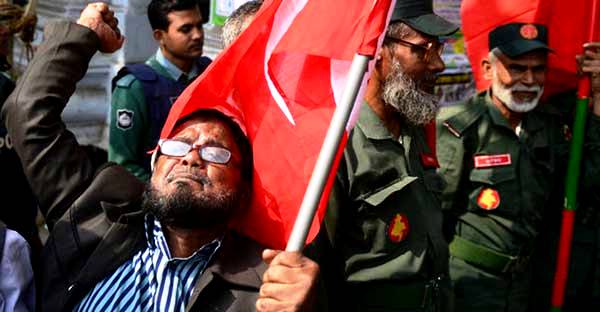
The defective proceedings have polarized the country. Contrary to serving as the unifying force government officials trumpeted it would be, the tribunal has instead exacerbated existing tensions, pitting mostly middle-class secularists, who support the prosecutions, against Islamists who denounce them as political theater. Deadly riots have accompanied virtually every decision issued by the ICT, as police clash with demonstrators protesting the guilty verdicts.
Beyond Bangladesh, however, the acute problems daunting the ICT have once again provoked enduring but complex questions about whether developing countries like Bangladesh can adequately deliver international justice, or whether they should allow international tribunals like the International Criminal Court at the Hague to do so instead. Special tribunals and commissions established in developing countries like Cambodia, Iraq, and Sri Lanka to prosecute or investigate mass killings within their borders have generated more controversy than closure for victims and their families. For those hoping that it would serve as a model for similarly situated nations wishing to achieve both accountability and reconciliation through war crimes prosecutions at home, Bangladesh’s so-called “international” tribunal constitutes a profound disappointment.
Born in bloodshed, Bangladesh seeks a justice long overdue. Regrettably, the very judicial body responsible for delivering that justice instead threatens to further deny it.
For Academic Citation: