


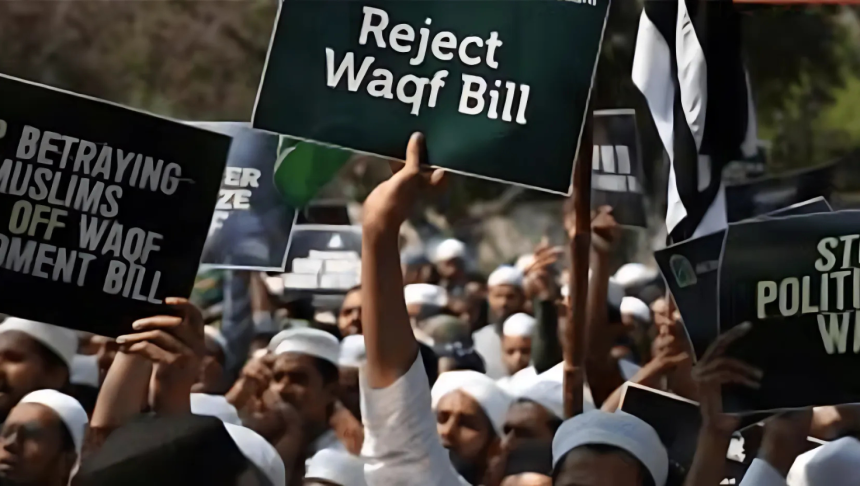
The recently enacted Waqf (Amendment) Act 2025—officially titled the United Waqf Management Empowerment, Efficiency and Development Act (UMEED)—has ignited significant controversy across India. The government insists the reform is designed to modernize the Waqf system, minimize legal disputes, and increase administrative efficiency. Critics, however, argue it undermines religious freedoms and erodes constitutional protections. The legislation is currently under judicial scrutiny in the Supreme Court of India.
Amidst these discussions, what do social workers, academics, lawyers, and journalists—who work closely with Waqf—think about the law? To explore this, BeyondHeadlines is launching an interview series.
In the first segment, we speak with Muhammad Ghazali Khan, a veteran journalist and translator based in London since 1983. Khan has a deep interest in the Middle East and South Asia, particularly Indian Muslims, as well as topics related to history, media, culture, religion, and Waqf.
A native of Deoband in India, Khan holds an LLB (Hons.) from Aligarh Muslim University and an MA in International Journalism from City University, London. His professional affiliations include Impact International (a Muslim current affairs magazine), Radio Asia, Iqra TV, and public institutions such as Islington Council, Transport for London, and Age UK. As a freelance translator, Khan has also worked with the BBC and Channel 4, and has served as an elected parent governor at two London schools.
In an exclusive interview with BeyondHeadlines, he shared his insights on the Waqf controversy. Here are some highlights from the discussion:
 You’ve been in journalism for a long time and have closely followed issues concerning the Muslim community in India. How do you assess the approach of Muslims, particularly Muslim organizations, toward the Waqf issues?
Frankly, the role of Muslim organisations has been quite disappointing—not just on the Waqf issue but across the board. They tend to react only when the situation becomes dire, when the water is already neck deep. We are all aware of the rampant corruption plaguing the Waqf Boards. While the current Hindutva-led government portrays these boards as being Muslim-run, the reality is that they are statutory bodies where Muslim organisations have no real control. Yet, these institutions are fundamentally Muslim in nature.
Despite this, there has been no serious initiative from Muslim organisations to consult among themselves and engage with even past “secular” governments of the past to push for reform in what is a potentially resource-rich but practically impoverished institution.
The government claims that the Waqf Act 2025 has been introduced for the welfare of Muslims. If that is the case, where does the problem lie? In your view, how and why could this Act pose a threat to the interests of the Muslim community?
One only has to look at this government’s track record to question how sincere it is about the welfare of Muslims. Can a law that effectively seeks to strip a community of its own resources really be seen as beneficial? The Waqf Act 2025, far from being empowering, poses serious risks to the autonomy and integrity of Waqf properties. The fact that the Supreme Court has already taken note of the two most contentious provisions speaks volumes about the potential threat this Act poses.
In your opinion, what steps should Muslims, particularly the youth, take in response to the current situation?
Unfortunately, Muslim youth are limited in what they can do on their own at the moment. For now, they have little choice but to follow the current leadership; however, flawed it may be. But for the future, they must invest in strengthening themselves both educationally and morally.
Some voices within the community suggest moving away from the usual “defeat the BJP” electoral strategy, but I believe the opposite is needed—Muslims should double down on this goal, with a well-thought-out and strategic approach. I’ve never been a supporter of the Congress party, and I’m not one now, but given the current political climate, it remains the only national party taking a firm stand against the fascist tendencies of the ruling regime. Caste-based census is a crucial tool for weakening the BJP’s hold, and so far, only the Congress has committed to it.