


Forty-five-year-old Muhammad Ibrahim Ali stands before the ruins of what was once his house in Assam’s Sonitpur district. His eyes well up as he speaks softly, “I came here from Tezpur to lead prayers as an Imam. For years, I saved every rupee I could and built this shelter from straw. But on December 5, they demolished it, saying I was a Bangladeshi.”
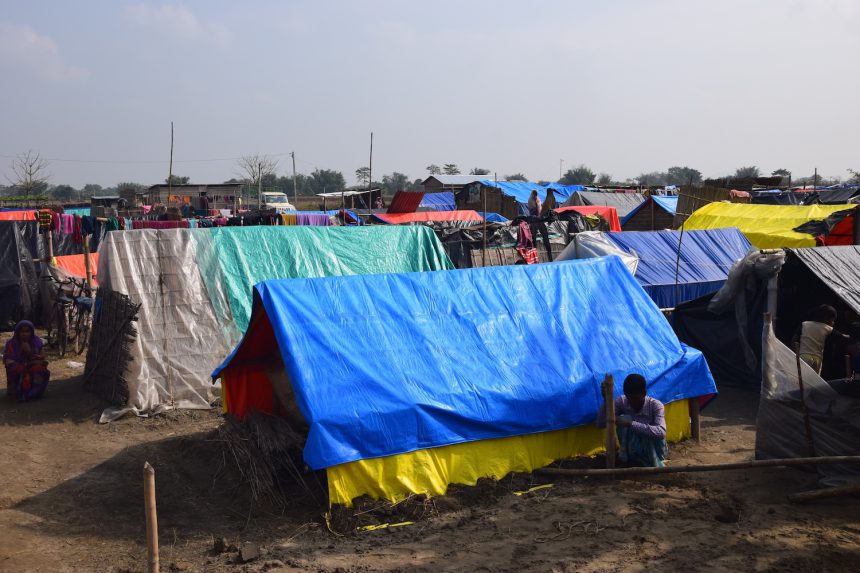
Ali breaks down mid-sentence. His story, however, is not his alone. It mirrors the ordeal of 426 families in Assam’s Sonitpur district whose homes were razed under similar accusations of being “illegal infiltrators.” Over 2,500 people now sleep under open skies in the biting cold — their makeshift camps in Makwa, Sirowani, and Behiya villages standing as silent testimony to the violence of dispossession.
Most of those displaced hail from Degoli Chapuri, Bali Chapuri, Laltup, Bati Mari Bhairavi, and Langi Bazar — villages that now exist only in memory. Residents allege they possess land records, Aadhaar cards, and names on the National Register of Citizens (NRC), yet their homes were bulldozed under the orders of BJP MLA Padma Hazarika. Their fault, they say, is that they were not voters of his constituency.
“They brought elephants and bulldozers,” recalls Ali. “They crushed our mud houses with elephants and ran bulldozers over brick ones. A huge police force stood guard. We weren’t even allowed to speak or show our documents.”
Holding a crumpled file of papers close to his chest, Ali adds quietly, “I was born in India. My father and grandfather were born in this area. Our names were in the 1951 NRC and also in the latest one. I have every document. But still, I don’t know on what basis Padma Hazarika calls me a Bangladeshi.”
Sixty-five-year-old farmer Akash Ali spent his entire life building a modest three-bedroom home in his village. Today, he wanders a makeshift camp, clutching a red bag containing his Indian citizenship papers.
We followed him to his village in Batimari Bhairavi. The moment he saw his shattered home, tears welled up in his eyes.
“I have lived here for over 15 years, after being displaced from my native village by floods. I am a genuine citizen of Assam, and my name is on the NRC,” he said, his voice trembling.
But citizenship, he says, has offered no protection. “My only fault is that I am not registered as a voter in the Sotiya assembly constituency, where my village is located. I have a vote in the neighboring constituency. BJP MLA Padma Hazarika, with the help of the administration, evicted me and over 400 families like mine — simply because we do not vote for them.”
Ali claims the evictions are part of a larger strategy, “The aim is to settle Hindu Bengalis here who will act as a permanent vote bank for the BJP.”
Since the passage of the Citizenship Amendment Act (CAA), tensions in Assam have intensified. Many residents fear that granting citizenship to migrant Hindu Bengalis will erode their ethnic identity. For Assam’s Muslims in particular, there is a growing sense of anxiety and vulnerability, as they perceive themselves to be the primary target of the BJP’s majoritarian politics in the state.
The story of Tohra Khatun mirrors that of countless others. She has returned from the camp, standing silently before the ruins of her home, lost in thought. After a long pause, she explains in Assamese that her vote is registered in Sonitpur. Because she could not vote for BJP MLA Padma Hazarika, her house was demolished.
Wahid Ali, 60, recounts a similar fate. He had lived in Naugaon before moving to the area twelve years ago. His voter ID is still registered in Naugaon, where he travels to cast his vote. Now, his house has been destroyed because he did not vote locally.
When asked why he did not transfer his voter ID, he responds in broken Hindi: “You do not belong to Assam, that is why you are asking. It is not easy to transfer voter IDs here. Many people have been removed from the voter list in this cycle. And with the NRC process, it has become even harder.”
Anger and fear simmer among the women and children living in these open-air camps. Many women speak of a bleak future, haunted by the constant worry that agents of the MLA might attack their camps or violate their dignity.
Education on Hold: Childhoods Lost in the Camps
For many children in Assam’s displacement camps, schooling has become a distant dream.
Nineteen-year-old Muhammad Omar, who passed his tenth standard, had hoped to join the Indian Army after completing school. Now, he says, his future is uncertain. “Father is sick. We were displaced from above. In such a situation, I don’t know what will happen to me.”
Ziaur Rahman, a young man, speaks with anger and frustration, “Whose parents don’t want their children to read, write, and earn? But how can we get an education in the camp? Since we have been branded Bangladeshi, we cannot even think about going to school. People are losing hope — some are even thinking about suicide. Our homes were taken away. Before, we could grow grains or vegetables and earn small wages in nearby villages. Now, with the NRC and the Citizenship Amendment Act, we are trapped. There is no work anywhere. Everyone is idle. Life feels hopeless.”
For younger children, the obstacles are equally stark. Simon Nisha, an eighth-grade student who dreams of becoming a doctor, laments: “The school is very far from the camp. How will I get there?”
Neha, also in eighth grade and wearing her school uniform, shares the social toll: “Everyone in school considers me Bangladeshi.”
In these camps, education is not just interrupted — it is weaponized, as children grow up under the weight of displacement, stigma, and fear, their futures increasingly uncertain.
What Do the MLA and District Officials Say?
BeyondHeadlines also spoke with BJP MLA Padma Hazarika, who denied all allegations.
“These people are D-voters and were occupying the land here. That is why we removed them,” Hazarika said.
When asked whether she would demolish the homes of all D-voters, she referred the question to the district administration: “Whatever you want to discuss regarding this, do it with the district administration.”
Deputy Commissioner Manvendra Pratap Singh justified the evictions by saying the people had occupied government land: “That is why they were removed.”
When pressed about residents holding documents proving ownership, Singh responded: “If they have papers, they must have bought the land from an illegal occupant, because it is government land.”
Asked why only some houses were demolished while neighboring homes remained untouched, he said: “We will remove everyone soon. We plan to set up an industrial park here, and some land will be allocated to Tezpur University for a postgraduate medical sciences college.”
Singh also denied the existence of any camps in the district: “There is no refugee camp in the area.”
Yet residents of the camps allege otherwise, claiming that the government intends to demolish their shelters as well, leaving them increasingly vulnerable.
Voices from the Ground
Ashfaq Hussain, a social activist affiliated with Jamaat-e-Islami Hind, highlights the compounding injustices faced by displaced families: “First, nature was unjust to them. The Jaya Bharoli river swallowed their land. And now the government is snatching what little remains. What could be more unjust than this? Everyone here knows how the river takes people’s land.”
Hussain adds, “If these people are really Bangladeshis, the government should arrest them immediately and send them there. If it does not, then they are Indians, and the state should provide proper housing. Children living in the camps are at risk of losing their education. And how long will they be forced to live like this? Once the rains come, even the camps will become uninhabitable.”
Jamaat-e-Islami Hind and its affiliated organizations are currently providing relief to residents of the three camps.
Abdul Qadir, another social activist, criticized government policies in Sonitpur: “The Sutiya assembly constituency shows how Muslims are being oppressed in Assam, how their human rights are violated, and how the government is promoting a Hindutva agenda.”
Among the residents, 26-year-old Shah Jamal points to divisions within the community: “The real problem is the lack of unity among Muslims. Many from this area are with the BJP and Padma Hazarika. She herself prepared the list of those not registered to vote in this constituency. But she forgot — today she breaks their houses, tomorrow their numbers may be next.”