


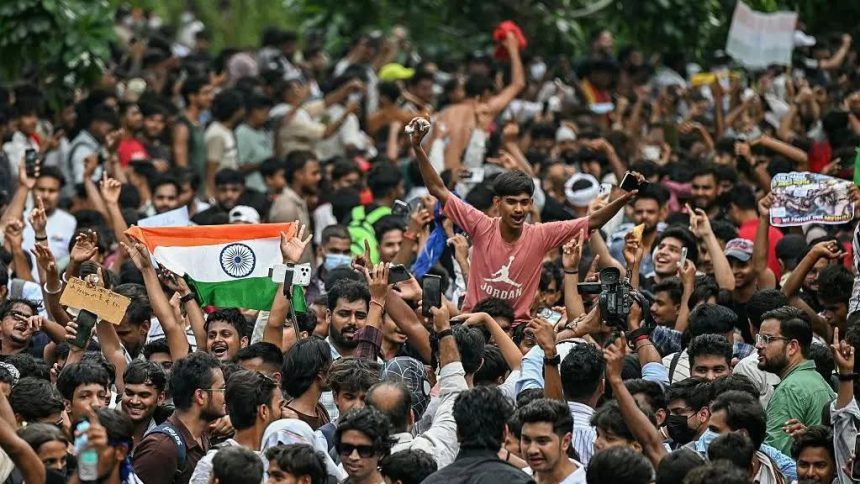
Something shifted in India this summer. The protests that began at Jantar Mantar in June 2026 — led by the Cockroach Janta Party, the satirical Gen Z movement that took an insult and turned it into a banner — did what a decade of conventional opposition could not. Over the NEET paper leak and the marking scandals that followed, a generation dismissed as apolitical and distracted walked onto the street and refused to leave. When Sonam Wangchuk began his hunger strike and the education minister’s chair began to wobble, a tired, frightened public was reminded that India’s democratic, secular and liberal instincts were not dead — only waiting for someone brave enough to act on them.
A few days have passed now; the crowds have thinned, and the harder question arrives — what happens after a victory? To that whole generation, across every community, I offer my gratitude. But this letter is for one part of it in particular: you, the young Indian Muslims, who carried a heavier bag to the very same protest.
Be honest about the India you have grown up in. For more than a decade, under a BJP government and the Hindutva ecosystem that powers it, the hatred of Muslims has become the background noise of national life — in television studios, in forwarded messages, in the silence that too often follows a lynching. A whole generation has come of age as suspects in their own country. So, marching this summer was never simple for you. Your parents and elders remember Shaheen Bagh and the anti-CAA–NRC protests, and the crackdown that followed. And yet you came, in your thousands. Among those reported injured near Connaught Place were young men like Sahil Lochab, Irshad Shaikh and Sheikh Irshad Mansoori — some left fighting for their eyesight after pellet fire the Delhi Police deny ever using. You came knowing the cost might be higher for you, and there are already reports that Muslim participants were singled out for reprisal afterwards. You paid that price anyway.
There is a hard irony to name plainly. Because everyone — the Cockroach Janata Party and the wider opposition alike — was determined not to let the movement be branded a “Hindu–Muslim issue,” you were quietly asked to take part without being too visible: to lend your body to the cause while keeping your identity in the background. The instinct was protective, and understandable. But it leaves the real questions unanswered. How should Muslim youth now choose their route? Where do you join, and how; when do you act, and where? These are the questions no one has answered concretely — so let me try.
I owe you not comfort but a plan. A protest is a moment; a roadmap is what turns a moment into lasting power — and the courage you showed at Jantar Mantar now needs somewhere concrete to go. Here are five ways you can stop asking to be let into India’s future and start building it: not only for the next march, but for 2047, the centenary of independence, and the India we will hand to Generation Alpha.
1. Keep your emotions in check — and learn from what came before
Let me begin with the hardest thing an elder is supposed to say: keep your emotions under control. Not because your anger is unjustified — it is completely justified — but because a cool head is a weapon, and you will need every weapon you have. Look at how this Gen Z movement carried itself: disciplined, largely peaceful, hard to caricature, impossible to dismiss. That is the posture to learn from.
And there is a harder lesson in our own recent past. Remember Shaheen Bagh — a movement led with astonishing dignity, overwhelmingly by Muslim women, and still slandered and crushed. These were not failures of character; the people in them were brave and peaceful. But they were allowed to become isolated — framed as a “Muslim issue,” walled off from the wider democratic public, and then picked off. That is the real lesson, and it is strategic. A grievance that stands alone is easy to crush; a grievance woven into the broader democratic conversation is not. So, place your concerns where they belong — inside the secular, liberal and democratic mainstream, as the shared business of an integrated society, not the separate complaint of an isolated minority. Argue patiently, build coalitions across communities, and refuse every invitation to be provoked into the very image the propagandists are waiting to broadcast.
Consider how Black and Asian minorities in the United States and Britain built power. The American civil-rights movement did not win on rage; it won on ferocious discipline — the sit-in trainees who let themselves be beaten without striking back — and on a patient institutional strategy: the NAACP spent decades litigating its way to Brown v. Board of Education in 1954. Above all, it built a coalition so broad that segregation became an American problem, not a “Black problem.” In Britain, minorities learned to act as organised pressure groups and to convert their numbers into votes, institutions and representation. The lesson for you is the same: move from spontaneous protest to organised, verified, coalition-based pressure. Rethink your community’s position, sharpen your political chemistry, and count honestly how much support you can build — and from whom.
2. Reclaim the story of the Muslim contribution to a free India
The right’s most effective weapon has been history — the endless conflation of India’s Muslims with a pre-colonial and colonial past, as though a teenager growing up in digital India were personally answerable for centuries she never lived. Part of why this has worked is that earlier generations of independent India’s Muslims never fully told their own side of the story: what Muslims have built, written, taught, farmed, healed, co-governed and defended in the seventy-eight years since 1947. That is the history your generation must write. You are not responsible for the past used against you; you are responsible — and gloriously equipped — to document the contribution of the Muslims of independent, secular, democratic India, and to claim your rightful place in its future.
This is slow, unglamorous work, and the right has a head start, because it has already claimed the terrain of history as its own. You will need a counter-narrative that is louder, better-sourced and more confident — case studies, books, articles, podcasts, blogs — on Muslim contributions in education, science and technology, defence, business and industry, public service, literature, the judiciary and public administration. And do not overlook the small stories: every city, village and neighbourhood holds an untold local history of Muslim belonging and contribution. Gather those, and connect your generation to them. That is how you build a defence that is ready before the debate arrives.
African Americans built the institutions to tell their own story rather than wait to be written into someone else’s. Carter G. Woodson’s Negro History Week, launched in 1926, grew into Black History Month; Harlem’s Schomburg Center became a great archive of Black life; and in 2016 the Smithsonian’s National Museum of African American History and Culture opened on the National Mall — a nation compelled to house, at its very centre, a history it had once erased. In Britain, the Black Cultural Archives in Brixton preserved a community’s own records of arrival and belonging. Indian Muslim Gen Z can do the same, and faster, with the digital and AI tools your elders never had.
3. Demography is destiny — and the care economy is opportunity
India’s total fertility rate is falling fast, faster than most people realise. The demographic dividend we keep celebrating has a second act: an ageing society in which your generation, and Generation Alpha after you, will carry an enormous weight of care for the old, even as secure jobs grow scarcer and the cost of living presses harder on every household. This is not only a burden; it is an opening. The care economy — health, eldercare, community wellbeing — will be one of the largest sources of work and investment in the India of the coming decades. To meet it, you will need what I would call an integrated mindset: calm, adaptable, socially fluent, at ease across communities. And this crisis of care will fall on everyone, Hindu and Muslim alike — which is exactly why it is your opportunity: sit down with your non-Muslim peers, prepare for it together, and build both a livelihood and a bridge in the same act.
Be clear-eyed about the difference in circumstance, though. The West aged after it grew rich; China and Japan are ageing with high or rising incomes, strong healthcare systems and government support. India is ageing before it is wealthy, with thin public healthcare that is already out of reach for many, and a heavy burden on low-income and marginal families. That gap is precisely where preparation pays. Ask now what skills, what qualifications, what small enterprises the coming care economy will reward — and start acquiring them. Turn a looming national strain into your own opening, and make it a live topic of debate rather than a crisis you meet unprepared.
The Philippines read the global ageing curve early and turned it into national strategy, training nurses not only for home but for the world. Filipino nurses became indispensable across the United States, Britain and the Gulf — Filipinos are around one per cent of the US population but roughly four per cent of its nurses — and, tellingly, the pathway grew the profession at home too: research on one skills-partnership programme found that for every nurse who migrated, nine new ones were licensed. A community read a demographic trend a decade ahead and converted it into livelihood, dignity and quiet influence. Indian Muslim Gen Z can do the same with India’s own coming wave of care work.
4. Learn AI faster than hatred can reach you
Artificial intelligence and the digital economy are reshaping the world faster than even the richest governments can legislate for; a developing economy like India is scrambling to keep up, and its most marginal young people risk being left furthest behind. You cannot afford to be a passive spectator in this race. Learn AI. Build a future inside it, not beside it. And rewrite the old script: do not burn year after year in exam preparation, waiting for a single government job to rescue you. In the new economy, education and work must run together — earn while you learn, set yourself a firm deadline to be in employment, and do not let it slip much past the age of twenty-five.
There is something quieter and more powerful here too. The digital fluency of Gen Z is itself a shared language — one the hate ecosystem has not yet fully colonised. The problems of majority and minority Gen Z are not, in the end, so different; you speak the same online language, you build the same digital spaces, and that language sits far outside the reach of the right wing’s propaganda. The way you stood shoulder to shoulder with your Hindu peers at Jantar Mantar can be repeated in classrooms, in start-ups, in open-source projects and group chats. Reach that common ground first, and reach it quickly — before the propagandists get there.
Digital fluency is power the hate machine has not captured. In 2013, three Black women turned a single hashtag — #BlackLivesMatter — into one of the largest movements in modern history: a minority’s native command of digital space became global political voice. And across the world, immigrant and minority founders have built much of the new technology economy from the outside in, precisely because it did not yet have gatekeepers to lock them out. That is your edge: the new economy has fewer closed doors than the old one. Walk through them first.
5. Make the climate crisis a common cause
While Gen Z filled Jantar Mantar, other movements were rising alongside it — the long fight over the Ken–Betwa river-linking project across Madhya Pradesh and Uttar Pradesh, forest protests in Uttarakhand, and determined environmental resistance in the Himalayan foothills of Himachal Pradesh. Often it is the most marginal communities who lead them, and they are telling us something the news cycle keeps missing: that climate change and disaster are the defining threats to India’s future economy and society. Even as Gen Z celebrated in Delhi, Assam was drowning — dozens dead and more than seven lakh people displaced across a dozen districts. Floods, heatwaves, landslides, drought, crop failure: this is the India you will inherit and live in.
The climate emergency is now intensely local, and that is where you can act. Engage with your own neighbourhood — not only in the relief that follows a disaster, but in the preparedness that comes before it, and in the everyday work of tackling local environmental harm. It is also an economy in the making. India’s transition to a net-zero economy, targeted for 2070, will reshape everything: renewable energy, grassroots green manufacturing, sustainable agriculture and water, green finance, nature-based solutions. Prepare for those fields now, or be left behind by them. And here lies the deeper opening: the climate is one of the very few arenas the hate machine has not yet poisoned. It is common ground by its very nature, because the flood does not check your religion before it takes your home. Step forward here, in open conversation with your majority-community peers, and help build a national understanding that disaster — not one’s neighbour — is the real enemy of our shared future.
In Aotearoa New Zealand, the Māori of the Whanganui — a colonised indigenous minority — waged a 140-year campaign that, in 2017, made their river the first in the world to be recognised as a legal person, with Māori appointed among its official guardians. An environmental cause became the very vehicle through which a marginalised people won recognition and a share of governance at the heart of the state. At Standing Rock, Native Americans turned a pipeline fight into one of the largest multi-nation coalitions in recent memory. Climate is uncolonised ground; lead on it locally, and it can carry you from the margin to the centre.
These five — a cooler head and a wiser strategy, a reclaimed history, demography and care, AI and work, and the climate — are not a checklist. They are a language: the beginnings of a common vocabulary through which you can meet the rest of your generation as equals, not as petitioners. Notice what runs through every example from abroad: none of these minorities won by shrinking, and none won by standing alone. They organised, they documented, they prepared, and they built coalitions on ground the majority also had to stand on. Use this new decade the same way — to educate, to agitate and to debate, in the digital space that is now yours. It is a hard task. But it is your task, and you must complete it carefully.
So, to the young Indian Muslims who marched this summer, and to those who wanted to but were told to stay home: the India of 2047 has room for you at its very centre. Do not wait to be invited into it. Build it. And know that some of us, a little older and a little more tired, are cheering you on — and trusting you to finish what our generation could not.
Mehebub Sahana is an academic based at the University of Manchester, UK. He grew up in a subaltern Muslim family in Purba Bardhaman district, West Bengal. The views expressed here are his own.