

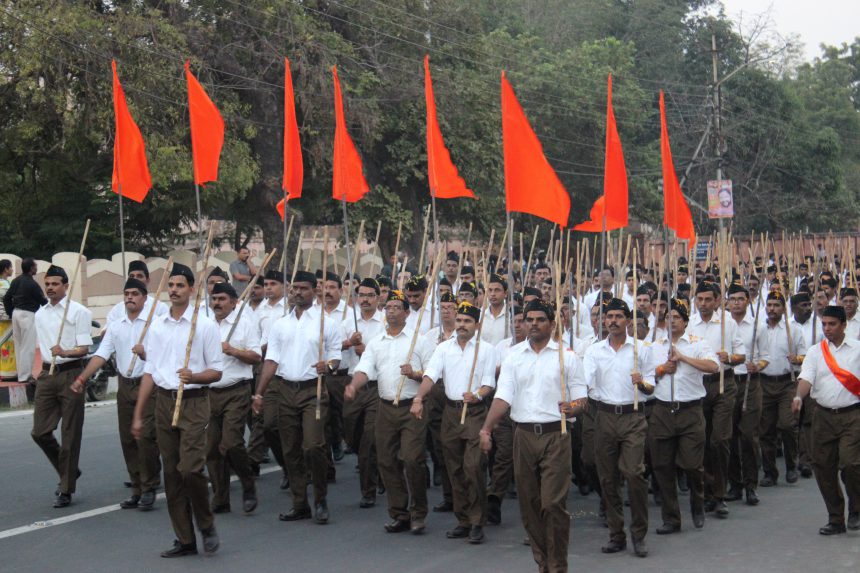
The Rashtriya Swayamsevak Sangh (RSS), which once opposed adopting the tricolour as India’s national flag, now sees people aligned with its ideology using that same flag to spread hatred and pass judgment on others’ patriotism.
In an exclusive interview with BeyondHeadlines, Saurabh Bajpai, convener of the ‘Rashtriya Andolan Front,’ stated that even he does not meet the narrow definition of patriotism set by the current government and the RSS. He recalled that on January 26, 2001—Republic Day—three men, Baba Mendhe, Ramesh Kalambe, and Dilip Chatwani, attempted to hoist the Indian national flag at the RSS headquarters in Reshimbagh, Nagpur. For this act, they were jailed and targeted by the RSS for 12 years. In August 2013, a lower court in Nagpur acquitted them of all charges. Members of the ‘Rashtriya Premi Yuva Dal,’ these men had been angered by the RSS’s long-standing refusal to fly the tricolour even on national occasions like Independence Day and Republic Day.
In the extended conversation, he explained that after the 2001 incident—when the matter was in court—the RSS began hoisting the national flag at its headquarters from 2002, largely out of fear that the court might reprimand them for not doing so. This raises an important question: Was the RSS before 2002 not patriotic? His answer was blunt—no, it was not.
According to him, the organisation’s history shows it has never truly been patriotic, but rather focused on capturing political power under the banner of Hindutva, a goal it fully achieved in 2014. He argued that the RSS has always displayed the tricolour out of compulsion, not conviction. Historical records show that in 1950, before lifting the ban imposed on the RSS for its alleged role in Gandhi’s assassination, Sardar Patel compelled Golwalkar to accept the tricolour as India’s national flag. Under this pressure, Golwalkar hoisted it on Independence Day, but once the compulsion ended, the RSS reverted to its earlier stance. In his view, leaders aligned with the Hindutva ideology have always opposed the tricolour at heart.
RSS’s Opposition to India’s National Flag
Dr. Shamsul Islam, a political science professor at Delhi University and founder of the Nukkad Natak movement, notes in his book ‘Know the RSS: Based on Rashtriya Swayamsevak Sangh Documents’ that M.S. Golwalkar—then Sarsanghchalak (chief) of the RSS—openly rejected the tricolour. Speaking at a meeting in Nagpur on Guru Purnima, 14 July 1946, Golwalkar declared that “It was the saffron flag which in totality represented Bhartiya [Indian] culture. It was the embodiment of God. We firmly believe that in the end the whole nation will bow before this saffron flag.”
Even after independence, when the tricolour was officially adopted as India’s national flag, the RSS openly refused to embrace it. In his essay Drifting and Drifting, published in the book Bunch of Thoughts, M.S. Golwalkar criticized the decision, writing: “Our leaders have set up a new flag for our country. Why did they do so? It is just a case of drifting and imitating…”
Not only that, the RSS openly attacked the national flag in its English mouthpiece, Organiser, on August 14, 1947, writing: “The people who have come to power by the kick of fate may give in our hands the Tricolour, but it will never be respected and owned by Hindus…”
This hostility toward the tricolour persisted for decades. From 1950 onward, for 52 years, the RSS hoisted only the saffron flag on Republic Day and Independence Day. It was only in 2002—under public pressure and fear of criticism—that they reluctantly began flying the tricolour, not out of conviction, but compulsion.
The Tricolour Actually Has Four Colours
In an in-depth conversation with Sadan Jha, it was pointed out that India’s national flag is not just a tricolour—it actually has four colours. Jha questions why we call it a tricolour when the blue of the Ashoka Chakra is so central, yet often ignored in popular explanations.
He explains that the blue represents rebellion and Dalit politics. In the collective memory of the colonial era, blue symbolized resistance—first in the peasant revolt against indigo planters in Bengal (1859–60) and later in the Champaran Indigo Movement. The blue of the Ashoka Chakra thus stands as a tribute to these rebellious farmers, who occupy the very center of the flag.
It raises an important question: why, when discussing the national flag, do we always mention only three colours while the blue is forgotten? Is this merely an oversight, or does it reflect a deeper marginalization of Dalit, backward, and oppressed voices?