


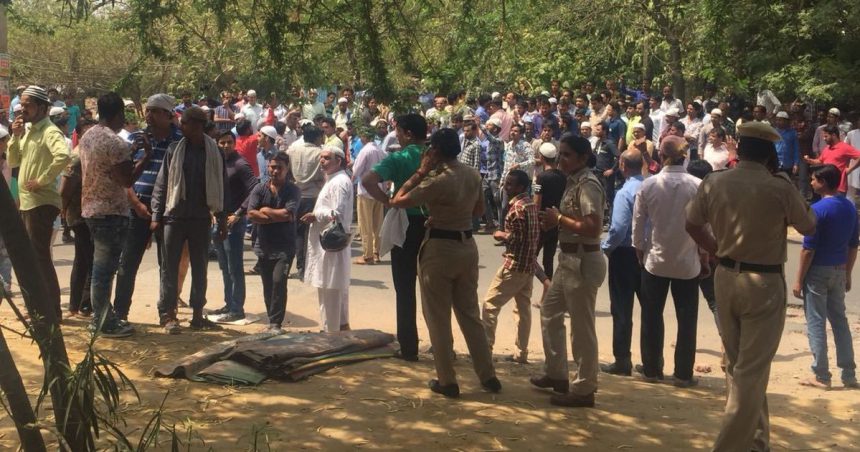
Can a mosque be leased to a non-Muslim? While Islamic tradition generally prohibits this, the Waqf Board has nonetheless taken such action. This has happened in an area where there is currently no mosque available for Friday prayers, and the local Muslim community is struggling to meet this need. In response to their efforts, they have faced attacks, and legal cases have been filed against them.
This account comes from Gurugram (formerly Gurgaon) in the Indian state of Haryana, where the issue of offering Friday prayers has drawn national and even international attention. In the same city, the Haryana Waqf Board has leased several mosques, graveyards, shrines, and other Waqf properties to non-Muslims. This information comes directly from the Haryana Waqf Board and is also publicly available on the Waqf Management System of India’s official website, wamsi.nic.in.
According to the Waqf Management System of India, 19,345 square yards—nearly four acres—of land in Chomoha village, within the Gurgaon Municipal Corporation limits, has been leased to Mrs. Megha Chaudhary, a resident of Defence Colony in Meerut, for a monthly rent of ₹40,000. The property includes a mosque. Notably, the lease expired on December 31, 2016, yet the mosque is now in the unauthorized possession of an individual named Kesar Singh.
A similar case exists in Fazilpur Jharsa village, within the Gurgaon Municipal Corporation area. Here, a mosque covering 6,590 square yards (approximately 1.36 acres) was leased by the Haryana Waqf Board to an individual named Rishi for a monthly rent of ₹22,425. The lease expired in 2017, and the mosque is now in the unauthorized possession of a man named Udmi.
Likewise, in Hidayatpur Cantonment village, a mosque was leased from the Waqf Board to four individuals—Prateek Kumar, Prem Prakash, Sanjay Goyal, and Ramkrishna. This lease also expired in 2017, and the mosque is currently in the possession of a person named Krishna Chand.
This issue extends beyond mosques to hundreds of other Waqf properties in Gurgaon, all under the oversight of the Haryana Waqf Board. Even graveyards and dargahs were not exempt.
For example, a graveyard in Gurgaon covering 17,545 square yards (approximately 3.625 acres) was leased to a woman named Rukmini for an annual rent of ₹28,000. Similarly, an Eidgah was leased to Charanjit Singh for a monthly rent of just ₹3,370. That lease expired in 2017, and the Eidgah has since ceased to exist.
The Waqf Board also leased a dargah measuring 9,044 square yards (about 1.90 acres) for a monthly rent of only ₹500. The lease ended in 2014, yet the Board now reports that it does not know the current status of the dargah.
How many mosques are there in Gurgaon?
Across the entire Gurgaon district, there are 89 mosques. Within Gurgaon city, 35 mosques are registered under the Waqf Board. The list of these 35 mosques is publicly available on both the Haryana Waqf Board’s website and the Waqf Management System of India’s portal.
However, a search on the Waqf Management System of India’s website shows that 21 of these mosques are under illegal occupation by non-Muslims. In two cases, other structures have been built on mosque sites—one now houses a primary school, and another has been converted into a gurdwara.
Of the remaining mosques, 11 are still standing, though many are in poor condition and some have fallen into ruin. The Waqf Management System of India has no available information about the final three mosques on the list.
In 2018, the Haryana Waqf Board submitted a list of 19 sites to the Gurugram district administration where Muslims were unable to offer prayers despite the land being owned by the Board. In a letter to the District Commissioner, the Board stated that nine Waqf mosques were occupied by villagers, while ten other sites reserved for mosques did not permit Muslim prayers.
This raises a question, if there are 89 mosques in Gurgaon under the control of the Waqf Board, why were only 19 included in the list? Have the remaining 70 mosques been restored? Only the Haryana Waqf Board can clarify. The Board should also explain what action was taken after the list of 19 sites was submitted to the administration.
Local social activists claim that these 19 sites remain under non-Muslim possession, with some being used to tether buffaloes and other animals. According to them, the state government and district administration have taken no steps to return these mosques to the Muslim community.
Regarding the broader picture, the Haryana Waqf Board controls 766 Waqf properties in the Gurgaon district. These include 89 mosques, 108 graveyards, 112 houses, 209 plots, 50 agricultural lands, 9 dargahs, 9 Eidgahs, 16 khanqahs, 128 shops, 11 takiyas, and one building. According to the Waqf Management System of India’s website, only four of these properties are currently under litigation, 16 are recorded as being illegally occupied, and information is unavailable for 60 properties.
In Gurgaon city alone, the Waqf Management System of India records a total of 405 Waqf Board properties. These include 35 mosques, 42 graveyards, 19 houses, 191 plots, 7 agricultural lands, 6 dargahs, 6 Eidgahs, 3 khanqahs, 91 shops, and 3 takiyas. According to the Waqf Board, only five of these properties are under illegal occupation, while two are involved in ongoing court cases. Information about 23 of the properties is not available in the Waqf Management System of India’s records.
Waqf Board’s expenditure on imams’ salaries and schools
Although many mosques in Gurgaon are under illegal occupation, the Haryana Waqf Board continues to pay salaries to 18 mosque staff members, with an estimated annual cost of around ₹2 million (₹20 lakh). This information, along with the names and addresses of these employees, is publicly available on the Board’s official website.
The Board also provides a monthly grant of ₹14,000 to five schools operating within mosques in Gurugram. Notably, there is not a single school directly owned or operated by the Waqf Board in the entire Gurgaon district.
Petition in the Supreme Court
A petition has recently been filed in the Supreme Court of India concerning the disruption of Muslim prayers in Gurugram. The petition seeks action against the Chief Secretary of Haryana and the state police for contempt of court, alleging that they failed to act against individuals who attempted to stop Muslims from offering prayers in open spaces. It was filed by former Rajya Sabha Member of Parliament Mohammad Adeeb, with Advocate Fuzail Ayubi representing the case.
The petition argues that the police have not complied with the Supreme Court’s 2018 directives and that their inaction, along with that of the administration, has encouraged hate speech and hate crimes. It further states that no measures are being taken against those obstructing Friday prayers.
In 2018, the Supreme Court had taken cognizance of incidents of mob violence, directing governments to implement measures to prevent such violence and hate crimes. The Court had made it clear that state authorities cannot remain passive observers and that no one should be allowed to take the law into their own hands. The ruling stressed that mob violence has no place in a democracy.
Speaking exclusively to BeyondHeadlines, Mohammad Adeeb stated that as Muslims faced repeated disturbances during their prayers over several weeks, they continuously raised complaints with the local administration, often naming specific individuals involved. However, when the police and administration failed to take any action, they were compelled to approach the Supreme Court.
Adeeb emphasized that these incidents violate the guidelines issued by Supreme Court Justice Dipak Misra in 2018. He expressed hope that the case would be heard promptly when the court reopens on January 3, 2022, adding that the situation has now become very serious. He also revealed that he has been receiving open death threats.
Mohammad Adeeb stated that he wrote letters to 18 political parties and spoke to their leaders about this issue, but except for the Communist Party and the Muslim League, no other parties raised their voices in support. He suggested that many parties may fear losing voters in upcoming elections if they publicly back the Muslim community on this matter. Adeeb remarked that some so-called secular parties are effectively trying to position themselves as exclusively Hindu parties, some more overtly than others.
When asked whether the petition filed in the Supreme Court concerned contempt of court and if the mosque issue would still remain unresolved, Adeeb explained that since the mosque issue involves the provincial government, they plan to approach the High Court soon with this matter.
He also highlighted that in Gurgaon, 113 new sectors have been developed, with land allocated for more than 40 temples, 18 churches, 12 gurdwaras, as well as Buddhist and Jain temples. However, despite the presence of over 400,000 Muslims in the area, no land has been allotted for a mosque.
Why does the Waqf Board appear so powerless?
In a landmark judgment in 1998, the Supreme Court of India ruled, “Once a waqf, always a waqf. It cannot be bought or sold, and no one can alter the original character of the waqf property.” Despite this clear legal protection, illegal occupation and unauthorized sale of waqf properties continue.
This raises the question: Who is responsible for these violations? The Waqf Board, which has significant legal authority, could have taken stronger action to prevent or address these issues. However, it has often appeared weak and ineffective, even when empowered by law.
Under Section 28 of the Waqf Act, the District Magistrate—or, in their absence, the Additional District Magistrate or Sub-Divisional Magistrate—is responsible for enforcing the decisions of the Waqf Board within their district. Additionally, the Waqf Board’s Chief Executive Officer has the authority to seek directions from the Tribunal to ensure that its decisions are implemented.
Section 7 of the Waqf Act also clearly states that the Tribunal has the authority to assess damages caused by the unauthorized occupation of waqf properties. It can impose fines on those illegally occupying such properties and recover these damages as arrears through the Collector, typically the District Magistrate.
The law further specifies that any government official who fails to perform their legal duties to prevent or remove encroachments may be fined up to ₹15,000 for each offense.
Section 3 of the Waqf Properties Lease Rules, 2014, clearly states that the Waqf Board or any trustee cannot lease mosques, dargahs, khanqahs, graveyards, or imambaras. However, this restriction does not apply to waqf land located outside the main premises of these religious sites.
The rules also specify that any graveyards leased before the Waqf (Amendment) Act, 2013, will continue to be governed by the provisions applicable in Punjab, Haryana, Himachal Pradesh, and Chandigarh.
This raises important questions: If graveyards, mosques, and dargahs in Haryana have been leased after the 2013 amendment, does this not violate the law? More importantly, why did the Waqf Board decide to lease these properties despite a clear shortage of mosques and graveyards in the state?
Waqf Board Accused of Corruption and Mismanagement
Mohammad Adeeb commented on the situation in Gurgaon, where the Waqf Board officially manages 35 mosques—most of which are reportedly occupied by non-Muslims.
Adeeb strongly criticized the Waqf Board, calling it “the biggest den of corrupt officials,” and accused them of selling waqf lands in Haryana illegally. He also revealed his intention to file a petition in the High Court to challenge the Board’s misconduct.
“My question to the Haryana Waqf Board is, why haven’t eviction notices been issued against those illegally occupying waqf properties? And if such notices have been sent, what progress has been made so far?” he asked.
Akramul Jabbar Khan, former Chief Income Tax Commissioner (IRS) and expert on Waqf matters, said that when the issue of prayer spaces in Gurgaon first arose in May 2018, he wrote to members and officials of the Waqf Board and Waqf Council, but to this day, he has received no response.
Khan believes the current situation is a direct result of the inefficiency of the Waqf Board and Waqf Council. He questions whether officials of the Waqf Council are aware of what is happening in Gurgaon, especially considering the close proximity to Delhi. “Has any official from the Waqf Council visited Gurgaon to understand the challenges faced by the mosques there? In my opinion, no such effort has been made.”
He adds that this issue has persisted since 2018, and had the Haryana Waqf Board taken it seriously, many important mosques would have been built and completed by now. Khan emphasizes that the Muslim community should hold the Waqf Board accountable and calls for legal action against those responsible, stating that the members of the Waqf Board bear responsibility for the current state of affairs.
Finally, a Story from the Ground
A resident of Sector 105, Gurgaon, who wishes to remain anonymous, told BeyondHeadlines that there are five mosques within a three to four-kilometer radius of his home. The largest mosque, located very close to his house, can accommodate over a thousand worshippers at once.
Surprisingly, even on Fridays—the main day for congregational prayers—this mosque is never completely full. On regular days, only 20 to 25 people attend prayers at most.
He added that some individuals deliberately choose to pray in open areas on Fridays, where they face opposition from members of Hindutva organizations trying to disrupt their prayers.
He said it would be better if people working in offices and factories made more effort to attend prayers at the mosques nearby. Many mosques in the area are abandoned and slowly falling into ruin. More efforts should be made to restore and maintain them. The Waqf Board, which is responsible for their upkeep, should be held accountable for neglecting these properties. But unfortunately, such accountability rarely happens.
BeyondHeadlines also spoke with other residents, revealing that most Muslims in Gurgaon come from other regions and work in offices and factories. Many belong to the labor class and technically have enough time for prayers. However, some face the risk of wage deductions if they return late after praying. For this reason, many prefer to pray nearby rather than traveling to a distant mosque.
The man also shared that in recent days, his neighbors have been questioning why Muslims pray only on Fridays and why they choose to pray in open spaces instead of mosques. This stems from rumors being spread by outsiders suggesting that Muslims aim to claim all public land as “the land of Allah” through what they call “land jihad”—starting with government land, then moving on to temples and homes.
These rumors have caused locals to doubt the Muslim community’s intentions. Seeing many mosques empty in their neighborhoods, some now believe the rumors may be true, questioning why Muslims don’t use their mosques and instead prefer open spaces. As a result, local support for protests against Muslim prayers in public spaces has increased.
Seven or eight years ago, I [author of this story] traveled to many areas of Haryana for stories. During that time, I saw mosques and historic forts being used to tether cattle, with animal waste thrown on the walls of the mosques. I also witnessed gamblers gathering there to play. I spoke with many prominent Muslim leaders and national organizations, urging them to take action to protect and preserve our mosques and graveyards, and to start a campaign for their preservation. Unfortunately, these warnings have had little impact, and to this day, there is little concern about saving these ancient mosques.