


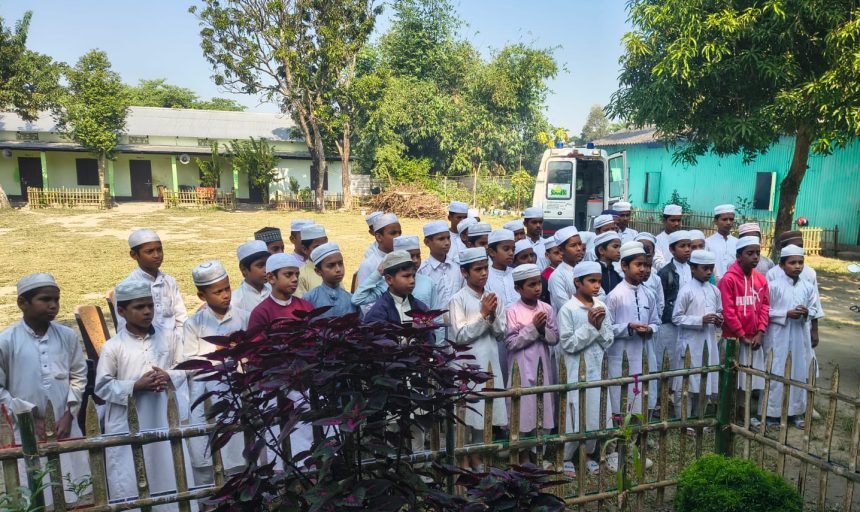
Traveling through rural Assam, a state in northeastern India, one encounters numerous school buildings that once carried the word “madrasa” on their signboards. Today, many of those signs have been replaced, their names have changed, and their identities in official records have been reclassified. A few years ago, the Assam government converted 1,281 state-funded madrasas into Middle English (ME) schools, a category of government schools that provides education at the middle-school level. The government described the move as an effort to standardize the education system. However, in many Muslim-majority districts, the decision was viewed as more than an administrative reform. For many families, teachers, and students, it represented a significant shift in the identity, history, and purpose of these institutions.
To understand the impact of this decision, we visited several schools across Assam that had previously operated as madrasas. Moving beyond official documents and political debates, we spent time in classrooms, spoke with teachers who experienced the transition firsthand, and listened to students who had been part of the system before and after the changes. Our central question was simple: What changed within these institutions following the conversion of the madrasas, and was anything lost beyond their names and official status?
One such institution is Bardaloni Sasra Senior Madrasa in Assam’s Barpeta district, which now operates as a regular government school. Umar (Name changed due to fears that being identified in the report could lead to harassment), a 15-year-old student, does not see the transformation as merely a change in curriculum or administration.
“Earlier, we came here because we received religious and moral instruction alongside modern subjects such as science,” he said. “Now everything has changed. The books and syllabus are the same as those in other government schools, but the training and identity for which our elders dedicated this land have disappeared. Sometimes it feels like we are studying in a place that is no longer familiar to us.”
Umar’s comments reflect a broader debate that continues in many Muslim communities across Assam. A large number of these madrasas were established on waqf land or land donated by local residents, with the goal of combining modern education and religious instruction. Local education advocates argue that the changes have had a particular impact on children from low-income and remote communities, many of whom chose these institutions because of this dual approach. According to them, some students have since sought alternative educational options, while others have left the education system altogether.
The Impact on Muslim Girls
The most significant impact of this structural change has been felt by female students living in Assam’s Muslim-majority riverine islands, locally known as char.
The father of Zainab (name changed), a 13-year-old student from a remote village in Barpeta district, works as a daily wage labourer along the banks of the Brahmaputra River. He is no longer willing to continue his daughter’s education.
“We sent her to the madrasa so that she could receive a basic understanding of the Quran and Islamic jurisprudence alongside modern education. Now that this educational identity has been removed, we cannot take the risk of sending her to a regular school,” he said, explaining the family’s decision.
For many low-income Muslim families, these madrasas served not only as educational institutions but also as spaces of social and cultural security, where they felt their daughters’ religious identity would be respected. According to local educators, the closure and conversion of madrasas have contributed to a growing number of Muslim girls leaving the education system.
Teachers also point to the strict implementation of school uniform policies. They say that in some schools, the wearing of the niqab or hijab has been treated as a violation of uniform rules, prompting some religious families to withdraw their daughters from school. In addition, practices that were common in traditional madrasas, including specific school schedules, religious recitations, and prayers, have been discontinued.
These concerns are also reflected in the report of the International Panel of Independent Experts (PIIE). On page 325, the report states that the closure of Assam’s state-run madrasas directly affected approximately 98,000 students, the majority of whom were girls, and examines these developments within the framework of international human rights law.
According to the report, the removal of religious instruction has had a disproportionate impact on Muslim girls. It argues that in more conservative households, the absence of educational environments perceived as culturally and religiously acceptable makes girls significantly more likely than boys to be withdrawn from school altogether.
The PIIE’s analysis contends that these consequences raise concerns under international human rights standards, particularly the principles of equal access to education enshrined in the Convention on the Elimination of All Forms of Discrimination Against Women (CEDAW) and the Convention on the Rights of the Child (CRC). The report argues that these treaties require states to address cultural, economic, and institutional barriers that restrict girls’ access to education and to ensure that educational policies do not result in their exclusion.
Debate Over Educational Restructuring
Siddiq Hasan, the founder of a government madrasa (now a government school) in the Dhakalia Para area of Assam’s Goalpara district and a former high school teacher, criticized what he described as the administration’s one-sided approach to the conversion process.
“When this madrasa was turned into a school, the entire village was shocked,” he said. “People across the village came together and submitted a signed petition to the Deputy Commissioner and our local MLA, requesting that the madrasa not be closed. But the authorities did not listen to our concerns.”
Hasan also challenged what he described as widespread misconceptions about these institutions. He argued that government-run madrasas did not provide only religious education, as some officials and public narratives suggested.
“These were government madrasas,” he said. “Alongside Arabic and Islamic studies, students were taught the full government curriculum, just like in other public schools. The goal was to ensure that children received modern education while remaining connected to their religious and cultural traditions.”
According to Hasan, the conversion of these institutions into regular schools disrupted that model. He believes that while the schools continue to operate, the original educational mission that combined modern and religious learning has largely been removed.
A senior teacher at a former government-run madrasa in Goalpara district, now operating as a Middle English (ME) School, described the transition as little more than a “renaming exercise.” Speaking on condition of anonymity, he argued that instead of reforming or strengthening the educational model of the madrasas, the government had simply removed their religious identity.
Throughout the conversation, the teacher remained cautious and repeatedly requested that his name not be disclosed.
“People outside the community may assume that a major educational reform has taken place,” he said. “But the reality is that the building is the same, the classrooms are the same, and most of the teachers are the same. The main changes are that the institution has been given a new name and religious instruction has been removed.”
According to a teacher, if the government’s objective had been to improve educational outcomes, it could have strengthened and modernized the existing madrasa model rather than eliminating a key part of its identity.
“Mathematics, science, English, and the state curriculum were already being taught here,” he said. “Students received modern education alongside religious studies. If the government can invest in and upgrade Sanskrit institutions into specialized educational and research centers, a similar approach could have been adopted for madrasas. Instead, only the religious component was removed.”
For critics of the policy, this distinction remains central to the debate. They argue that the issue was not whether modern subjects were taught, but whether an educational model that combined secular and religious learning could have been preserved while pursuing broader reforms.
He said the changes had significantly weakened the confidence of Muslim parents, particularly those who had chosen these institutions because they combined modern education with a religious environment.
“Earlier, parents were reassured that their children were learning about both religion and the wider world,” he said. “Now they feel that the spirit of the madrasa has disappeared. That is why many children, especially girls, have not returned.”
He added that the policy had created a growing sense among Muslim teachers that their cultural and religious identity was being gradually removed from the formal education system.
“We feel that the issue is no longer about education alone, but also about identity,” he said. “If modernization had truly been the goal, the madrasas could have been strengthened and improved rather than stripped of their identity.”
Similar concerns were expressed by Faizanul Haque, a retired army officer and member of Assam’s Bengali Muslim community. Reflecting on the changes, he said he felt a deep sense of disappointment and alienation.
“If the government’s objective was to expand modern education among Muslims, it could have invested in better infrastructure and provided greater support to teachers instead of dismantling institutions that had served these communities for decades,” he said.
Female students at Katarihara High School in Goalpara also told us that recent administrative measures had not improved the quality of education from their perspective. Instead, they said, some of the changes had made it more difficult for students to continue their studies, raising further concerns about the long-term impact of the policy on educational access and participation.
Questions of Equality
Critics argue that the Assam government’s policy raises important questions about consistency and equal treatment in educational reform.
According to the report of the International Panel of Independent Experts (PIIE) (page 87), the Assam government enacted legislation in 2021 that led to the closure of 620 government-aided madrasas, converting them into general schools without a religious education component. The report notes that during the same period, 97 government-run Sanskrit institutions were upgraded, a contrast that, according to its authors, highlights concerns about unequal treatment of different educational traditions.
The report further argues that the policy has since expanded beyond government-funded madrasas to include greater scrutiny of privately managed Islamic educational institutions. It cites a statement made by Assam Chief Minister Himanta Biswa Sarma in March 2023 expressing his intention to eventually close all madrasas in the state.
According to the PIIE, these developments call into question the government’s characterization of the policy as a purely educational modernization initiative. The report contends that the measures reflect a pattern of unequal treatment and indirect discrimination affecting Muslim educational institutions.
Drawing on international human rights frameworks, the report argues that such policies should be assessed against the principles of equality and non-discrimination contained in international treaties, including the International Convention on the Elimination of All Forms of Racial Discrimination (ICERD), which prohibits discriminatory policies and practices based on race, ethnicity, or religion.
Concerns Over Cultural Identity
The impact of the transformation of educational institutions is also being felt beyond the classroom in areas such as Anand Nagar and Bansar in Dhubri district. Local Islamic scholar Maulana Abdul Majid said that the changes have had broader social consequences, arguing that they have disrupted long-standing community relationships and created a climate of uncertainty that affects both Muslim and Hindu residents.
According to Majid, the sense of anxiety is particularly visible among teachers. One local educator, who requested anonymity because of fears of professional repercussions, expressed concern about the long-term implications of recent recruitment policies.
“As long as the older generation of teachers remains in service, you will continue to see people here who reflect the community’s cultural traditions,” he said. “But new recruitment rules have become so restrictive and selective that, over time, the cultural representation of the minority community may gradually disappear from the education system. Those who replace them may have little connection to the social and cultural background of the communities these schools were originally established to serve.”
Throughout the reporting process, one recurring theme was the reluctance of teachers and community activists to speak openly. Many requested anonymity and described an atmosphere of fear and caution when discussing government policies.
One social worker, speaking quietly and on condition of anonymity, said, “People worry that if the authorities learn they are sharing information about conditions on the ground, there could be consequences. Teachers often feel pressure to remain silent to protect their jobs. Many also fear being drawn into citizenship-related disputes or administrative scrutiny. As a result, people are often reluctant to speak openly.”
Whether these fears reflect actual policy outcomes or perceptions within affected communities remains a matter of debate. However, the widespread concern expressed by educators and community members highlights the extent to which questions of identity, representation, and security have become intertwined with the broader discussion surrounding educational reform in Assam.
In its discussion of Assam’s education policies, the International Panel of Independent Experts (PIIE) argues that the measures extend beyond educational reform and should be understood within a broader framework of state policy toward Muslim communities. On pages 145-146 of its report, the panel describes these developments as part of a process of “securitizing Muslim social and educational presence.”
According to the report, the impact is not limited to formal education but also affects cultural expression, particularly among Assam’s Bengali-origin Muslim communities, often referred to as “Miya” Muslims. The report cites several examples, including the sealing of the privately operated Miya Museum in Goalpara shortly after its inauguration, the arrest of its organizers under the Unlawful Activities (Prevention) Act (UAPA), and public statements that characterized Miya language and culture as “foreign.”
The report argues that these incidents should be viewed alongside policies affecting madrasas and other Muslim institutions, as part of a wider pattern influencing both educational and cultural life.
Concerns about these developments have also been raised at the international level. In its Early Warning and Urgent Action Letter issued in May 2025, the United Nations Committee on the Elimination of Racial Discrimination (CERD) expressed concern over the closure of religious schools serving Bengali-origin Muslim communities in Assam. The committee warned that such measures could have a significant negative impact on access to education, particularly for Bengali-origin Muslim girls in the state.
Together, these findings have contributed to a broader debate over whether the changes in Assam’s educational landscape should be viewed solely as administrative reforms or as part of a wider set of policies affecting the cultural, religious, and educational rights of minority communities.
“This Is Not Just Educational Reform”
Abdul Qadir Qasmi, General Secretary of the All Assam Tanzeem Madrasa Qaumia and Additional General Secretary of Jamiat Ulema-e-Assam, rejects the characterization of the madrasa conversions as a simple educational reform.
“This is fundamentally a political issue,” he said. “There was a great deal of rhetoric around madrasas during election campaigns. Now that the elections are over, that debate has largely faded from public discussion.”
Qasmi argued that public perceptions of madrasas have been shaped by narratives that portray them as institutions outside the educational mainstream. In his view, this characterization does not reflect reality.
When asked whether the government could eventually move against privately managed madrasas, he responded with confidence.
“That is not possible,” he said. “The existence of madrasas does not depend on the government. They cannot simply abolish them.”
He further argued that any attempt to restrict or close private madrasas would face significant legal challenges and social opposition across Assam.
Qasmi also expressed concern about the impact of the policy on the education of Muslim girls. According to him, many families stopped sending their daughters to the converted institutions after government madrasas were transformed into regular schools.
“After these institutions became schools, many girls did not return,” he said. “A large number of parents now keep their daughters at home because they believed the madrasa environment was safer and more compatible with their religious values.”
Looking ahead, Qasmi said that religious educational institutions should continue to operate within both the constitutional framework of India and the principles of Islamic law.
“We are committed to following the requirements of Sharia while also respecting the Constitution of India,” he said. “There is no contradiction between the two. If our institutions face unjust restrictions, we will seek legal remedies through the courts. We have faith in the judiciary.”
For Qasmi and others who oppose the policy, the debate is about more than educational administration. It concerns the future of institutions that they view as integral to the religious, cultural, and social life of Assam’s Muslim communities.
Critics of Assam’s madrasa conversion policy argue that the transfer of 1,281 government-run madrasas into general schools should not be viewed merely as an educational reform. In their view, it forms part of a broader process of social engineering that has weakened the religious, cultural, and educational institutions of a significant minority community.
According to this perspective, state authorities in Assam have relied on a range of legislative and administrative measures that, while presented as regulatory or developmental initiatives, have had the effect of restricting access to education, welfare programs, cultural expression, employment opportunities, and other aspects of public life for sections of the Muslim population.
Critics further contend that these measures have been implemented selectively and have had a disproportionate impact on Bengali-origin Muslims, a religious and linguistic minority in the state. They argue that the cumulative effect of these policies has been to undermine the community’s ability to preserve its educational traditions, cultural institutions, and collective social life on equal terms with other groups.
Human rights advocates and international observers cited in various reports have raised concerns that such outcomes may conflict with India’s obligations under international human rights instruments, including the International Covenant on Economic, Social and Cultural Rights (ICESCR) and the International Convention on the Elimination of All Forms of Racial Discrimination (ICERD). These frameworks require states to ensure equality, prevent discrimination, and protect the cultural and educational rights of minority communities.
For those who oppose the policy, the central issue is not simply the restructuring of schools. Rather, they argue that a process presented as administrative modernization has, in practice, contributed to the erosion of an important element of a marginalized community’s cultural and educational identity.
The Ground Reality of Assam’s Education Reform
The policy of converting government-aided madrasas into regular schools in Assam has, according to critics and local educators, resulted in serious institutional challenges on the ground. During field visits in Barpeta district, we found that two former madrasas had become largely non-functional after the transition. One abandoned school building had even fallen into such disuse that local residents were using the premises for purposes unrelated to education.
One of the most pressing problems reported by teachers and community members is the shortage of qualified staff. Positions for English and other modern subject teachers remain vacant in several converted institutions, while many of the remaining teachers were originally appointed to teach religious subjects.
As a result, educators without formal training in these disciplines have been required to teach subjects outside their areas of expertise. Teachers and local residents argue that this staffing imbalance has severely affected educational standards and undermined the government’s stated goal of improving the quality of education.
It is also important to note that many of the 1,281 madrasas converted into government schools by the Assam government are now facing serious challenges, in some cases leaving them in a weaker position than before.
A number of these schools have experienced a sharp decline in student enrollment. In some cases, the number of students became so low that authorities decided to merge them with nearby schools.
According to an order issued by Assam’s Directorate of Elementary Education (DEE) in January 2026, 91 Lower Primary (LP) and Middle English (ME) schools across different districts of the state were slated for merger. This was part of a broader trend in Assam’s education system. Over the past five years, a total of 2,980 schools, ranging from primary to secondary level, have been merged across the state. Of these, 206 secondary schools from 21 districts were integrated into nearby high, higher secondary, or senior secondary schools. In addition, 2,774 primary schools were merged under the Department of Elementary Education.
The reporting for the story was supported by a grant from the Human Rights and Religious Freedom Journalism Grant Program.