

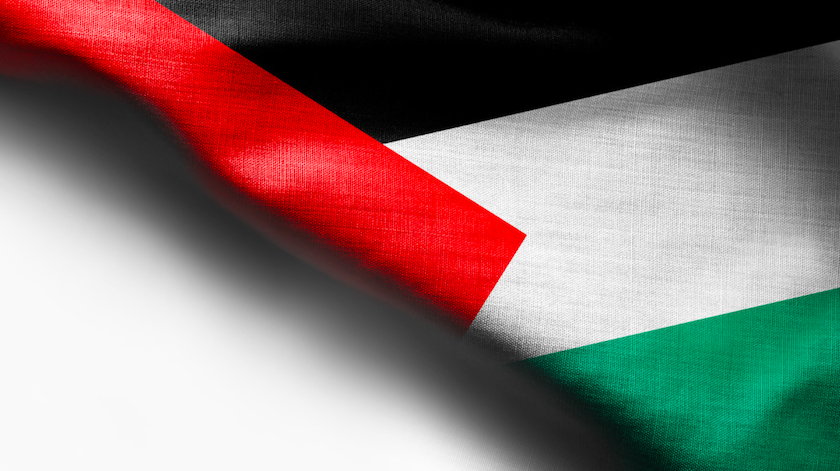
From the arrest of Aman Khan in Agra to the detention of Shahrukh — reportedly mentally ill — in Bilaspur, Rampur; from the filing of police reports against nine college students in Nashik, Maharashtra, to eight young men in Nawada, Bihar — a common thread connects all these cases: the individuals were accused of displaying the Palestinian flag during Muharram processions.
The situation escalated further when four young men in Deoria were arrested simply for wearing T-shirts bearing the Palestinian flag symbol during the same religious event. All four have been charged under Section 197 of the Bharatiya Nyaya Sanhita (BNS), a legal provision concerning actions deemed prejudicial to national unity.
In the Rahimabad area of Lucknow, two local businessmen were detained by police and questioned for five hours by law enforcement and intelligence officials. The reason: their car displayed a logo of the Palestinian flag. During the interrogation, officials examined their WhatsApp messages, call logs, and other mobile data. The vehicle was thoroughly searched, but no suspicious materials or messages were found.
After authorities confirmed that the individuals had no ties to Palestine, they were released on the orders of senior officials. However, the police removed the Palestinian logo from the rear windshield of their car before releasing them.
India has historically expressed support for Palestine at the diplomatic level, but legal action against individuals showing solidarity with Palestine is not new. In 2024, I personally documented 30 such cases across the country, in which over 100 Muslim youths faced legal action. Some were even charged under the Unlawful Activities (Prevention) Act (UAPA), a stringent anti-terror law.
Despite these crackdowns, many young Muslims continued to express their support for Palestine with the same passion during this year’s Muharram processions. While the scale of incidents appears to have decreased compared to last year, 15 new cases have still been reported so far in 2025.
In this account, I have highlighted several reported cases from India where individuals were targeted by police for displaying the Palestinian flag during Muharram processions. The incidents referenced are based on reports from various news websites. Social media videos and posts have not been included, as verifying their authenticity proved challenging.
— Agra (Uttar Pradesh): On July 6, police in the Itmad-ud-Daula area arrested a young man named Aman Khan for allegedly waving the Palestinian flag during a Muharram procession. According to police reports, he was seen displaying the flag at the Nagla Faturi Ghat near the Yamuna Bridge crossing. He has been charged with disturbing public order.
— Bokaro (Jharkhand): A complaint was filed at the Bermo police station concerning the display of a Palestinian flag during a Muharram procession on July 4 near the Fusro Market overbridge. The complaint was lodged by Archana Singh, the district vice president of the Bharatiya Janata Party (BJP). According to the complaint, a video circulated on social media allegedly showed the Palestinian flag being waved in a way that, the complainant claims, disturbed public peace and harmed communal harmony by inciting religious fervor. The Superintendent of Police stated that the matter is under investigation and appropriate action will be taken based on the findings.
— Deoria (Uttar Pradesh): In the town of Laar, some youths wore T-shirts featuring the Palestinian flag during a Muharram procession. However, the local police outpost in-charge, Deepak Singh, reportedly stopped them from wearing the shirts. According to media reports, Singh was later transferred—an action that sparked protests from Hindutva organizations. In response, these groups gathered at Shri Ram Marriage Hall and recited the Hanuman Chalisa as a form of protest. They demanded Singh’s immediate reinstatement and the arrest of those wearing the T-shirts. When asked for comment, Umesh Bajpai, the officer in charge of the local police station, said he had no knowledge of the incident. He added that transfers and postings are matters of government policy, and he was not in a position to comment further. Earlier, on July 2, a separate First Information Report (FIR) was filed at the Salempur police station over the waving of the Palestinian flag during a Muharram procession in the same town. Police stated that an investigation is ongoing and that action will be taken based on the findings. In a third related case from the same district, four young men were arrested in the Baghauchghat police station area for allegedly wearing T-shirts bearing the Palestinian flag during a Muharram procession. Police not only detained the youths but also confiscated the T-shirts. All four were charged under Section 197 of the BNS, a provision that addresses acts considered prejudicial to national unity.
— Gaya (Bihar): During a Muharram procession in the Gurua block of the district, a group of youths reportedly waved the Palestinian flag. According to a news report published online, the incident occurred in the presence of police officers, who did not intervene at the time. Following this, local organizations and social activists have called for an impartial investigation. They argue that such actions during religious events may raise concerns about maintaining the sanctity of the occasion and could potentially impact communal harmony.
— Giridih (Jharkhand): According to media reports, the Palestinian flag was displayed during a Muharram procession on July 5 in Chandauri village. The incident drew strong condemnation from Hindutva-affiliated organizations, which have called on the police to take strict action against those involved. A local BJP leader, serving as the District Organization Minister, claimed that such acts represent an attempt to “turn Jharkhand into Palestine”—a statement reflecting political tension surrounding the incident. In a separate case, a group of youths was also seen waving the Palestinian flag during a procession near Maulana Azad Chowk in the Nagar police station area.
— Jamui (Bihar): On July 5, a video circulated on social media showing a young man carrying the Palestinian flag during a Muharram procession. According to police, efforts are underway to identify the individual.
— Muzaffarpur (Bihar): During a Muharram procession in Turki Khararu village, under the jurisdiction of Meenapur police station, some youths were seen waving the Palestinian flag. According to local reports, residents expressed displeasure, stating that displaying foreign flags and weapons goes against local traditions. In response, the Superintendent of Police ordered an investigation. He confirmed that, based on the viral video, police have begun identifying the individuals involved. Notably, the video also shows the Indian national flag (the Tricolor) being waved alongside the Palestinian flag. A similar incident was reported in the Jajuar police station area of the same district, where authorities have also launched an investigation. Officials emphasized that any form of anti-social behavior or display of prohibited symbols is illegal and assured that strict action will be taken against those responsible.
— Nashik (Maharashtra): On July 5, a stall was set up in the Vihitgaon area of Nashik Road to distribute sherbet during the Muharram observance. The stall’s banner also featured the Palestinian flag. In response, police have filed a case against nine individuals in connection with this incident. According to authorities, most of those accused are college students with no known links to any organization.
— Nawada (Bihar): After a video showing the Palestinian flag being waved during a Muharram procession near Bundela Bagh ground in the district went viral, police have registered an FIR against eight individuals. According to reports, the video shows several youths standing on a vehicle, holding flags, with one youth prominently waving the Palestinian flag.
— Rampur (Uttar Pradesh): He was arrested on July 5 in Bilaspur city for waving the Palestinian flag during a Muharram procession. According to reports, police and intelligence agencies were alarmed when the video of the incident circulated on social media. After investigating, the police took the youth into custody. However, authorities have stated that the arrested individual, Shahrukh, is mentally ill, and preventive measures have been taken in his case.
Srinagar (Jammu & Kashmir): Tensions arose on June 2, the sixth day of Muharram, when a Jammu and Kashmir police team removed a poster near a bridge over Nigeen Lake in the Ashai Bagh area. The poster featured images of Hezbollah co-founder Hassan Nasrallah and former Iranian Supreme Leader Ayatollah Ruhollah Khomeini, displayed in support of Palestine. Aga Ruhullah, a prominent Shia leader and Member of Parliament from Srinagar, accused authorities of preventing Shia mourners from raising pro-Palestine banners. He urged the Jammu and Kashmir police to refrain from following the policies of the BJP and RSS political groups, stating, “Our police don’t work for Israel, and they should behave accordingly.”
Whose sentiments are really hurt by the Palestinian flag?
In India, the display of the Palestinian flag often provokes strong reactions, especially from those who have no issue with waving the Israeli flag or organizing rallies in support of Israel. And it is the Indian media that appears most troubled by these incidents. Their reporting on the waving of the Palestinian flag during Muharram makes their stance clear.
For example, a headline from the Hindi newspaper Navbharat Times read, “Muzaffarpur, Nawada ke baad Gaya mein Filisteeni Jhanda… Chunav se pahle mahaul bigadne ki koshish?” (After Muzaffarpur and Nawada, Palestinian flag in Gaya… An attempt to spoil the atmosphere before the elections?)
Setting aside the headline, the questions raised in the article reveal the depth of the controversy. Navbharat Times reports that, according to eyewitnesses, some youths carried the Palestinian flag during the procession. This occurred in the presence of police, who neither removed the flag nor raised any objections.
As a result, residents of Gurua (Gaya, Bihar) are questioning whether this was due to police negligence or a deliberate decision to remain silent. Concerns have also been raised about whether the administration was aware of the incident beforehand. The article asks: Is it legally permissible to wave a foreign flag during such a sensitive religious occasion? What explains the police’s lack of action?
Who will explain that, according to legal experts, waving the Palestinian flag in India is not a crime? Legally, there is no law in India that prohibits displaying the flags of countries with which India maintains friendly diplomatic relations. Section 7 of the Flag Code of India (2002) provides detailed guidelines on how flags of other nations may be displayed.
Despite the legal context, media coverage in these cases often paints the waving of the Palestinian flag as a serious offense. Reports tend to take a one-sided view, questioning the police and administration as if a major crime has been committed.
For example, while reporting on the Giridih case, the Hindi newspaper Prabhat Khabar wrote: “While the Akhara Committee was performing stunts in the evening, some youths were seen waving the Palestinian flag among the crowd. Notably, a large number of police personnel were deployed across the area, with many senior administrative and police officials present along the procession route. Despite this, the youths continued waving the flag for one to two hours.”
On the other hand, when the Israeli flag is waved in India, some media outlets appear to defend the act. For example, during the recent conflict between Israel and Iran, a few individuals were seen waving the Israeli flag in the Balhama area of Srinagar, Kashmir. Following this, police took three people into custody.
However, the news channel Zee News questioned the police action, publishing a headline that read: “Filisteen Club se Hamdardi… Israel Samarthakon par Sakhti; Kashmir mein Israel ka jhanda lagana gunah hai?” (Sympathy with Palestine club… strictness on Israel supporters; Is it a crime to hoist the Israeli flag in Kashmir?)
The story continued with this statement, “Another example of hypocrisy has emerged in the name of human sympathy in Jammu and Kashmir. A few days ago, slogans were raised with Iranian flags in Budgam, but no action was taken. Today, when some individuals waved the Israeli flag, the police immediately detained them, viewing them as a threat.”
There are numerous such reports, which clearly reflect a pattern of support for Israel alongside hostility toward Muslims expressing solidarity with Palestine.
Afroz Alam Sahil is a journalist and author. He can be contacted at @afrozsahil on X.