


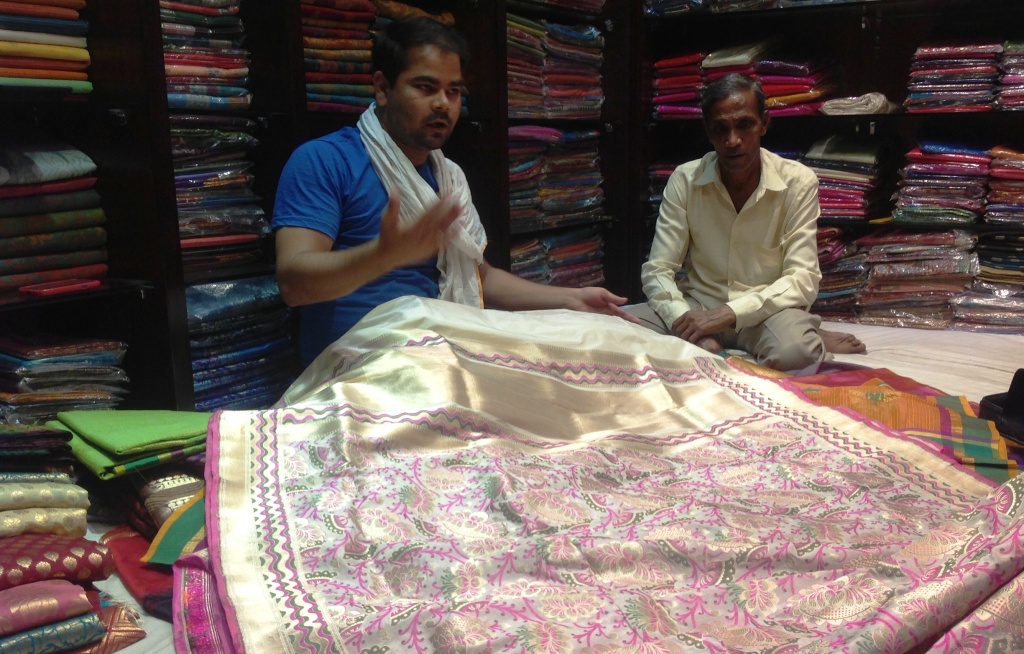
A new study, undertaken by Dr. Lenin and Shruti of PVCHR, India, explores the state of the Banarsi Saree Sector and working conditions of artisans with special focus on women, in addition to looking at possible future directions for improvement of the situation of artisans in these sectors in Lucknow and Varanasi. Reproduced below is extract from the 20 page report. – Editor
India is the home to one of the finest legacies of traditional Crafts. Over 10 million artisans and their families, though mostly on the brink of survival are dependent on crafts for a living.
Banarasi saree weaving is seen as one of the most exquisite crafts-forms of the country. This craft is in great demand in the export market, and are high revenue earners for the govt., exporters, middlemen and others who control the trade. Two Indian cities – Varanasi in the north and Kanchipuram in the south – are famous for their elegant silk saris.
India is the world’s second largest producer of silk, but India only accounts for 5 percent of the global silk market. This market share was still enough to generate approximately $260 million in revenues during 1995. Germany, the largest consumer of Indian silk, imported material worth DM 540 million ($231 million) in 1995. The bulk of Indian silk thread and silk cloth, however, are consumed domestically.
The silk industry has been expanding rapidly over the last several years, with substantial movement and international subsidies for sericulture projects and marketing schemes. In addition to government promotion, major funds to the silk industry come from the World Bank. From 1980-89, the World Bank began active promotion of the silk industry as a means of development by loaning $54 million to support sericulture in Karnataka.
In 1989, the World Bank provided two more loans totalling $177 million for the National Sericulture Project of which Karnataka and Uttar Pradesh were recipients. In total, the World Bank provided a $231 million for the expansion of the industry form 1980-89. In 1994 and 1995, the Bank provided a $3 million loan to modernise the Karnataka silk industry and provided further assistance on a $157 million project to upgrade the production and quality of Indian silk.
The exquisite traditional arts and crafts in India are under serious threat today, and are passing through a time of crisis. For the average consumer, craft is perceived to be a high maintenance, high cost product that neither wears nor functions as well as its industrial equivalent; for the craftsperson, craft is a profession that neither gives adequate economic returns nor social status.
The artisans and others working in the above handicrafts sectors are being hit by a multitude of problems. While the market for their hand made products shrinks in relative terms due to the onslaught of cheap, imported alternatives in the wake of a globalised economy, inadequate attention to their situation by the govt., civil society organisations and others has left them on the brink of survival, to face hunger, unemployment, gross underemployment, poor living and working conditions, consequent poor health and exploitation. Lack of workers organisations in some areas and ineffective ones in other areas further accentuate the problem.
This study attempts to highlight the state of the Banarsi Saree Sector, working conditions of artisans with special focus on women. It also seeks to look at possible future directions for improvement of the situation of artisans in these sectors in Lucknow and Varanasi.
Note: For full research report, contact Dr. Lenin Raghuvanshi at People’s Vigilance Committee on Human Rights (PVCHR) – http://www.pvchr.asia/.