
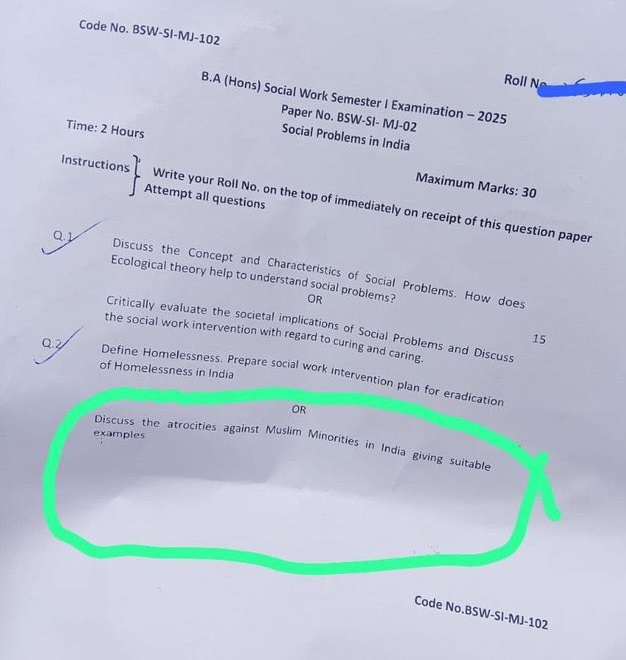
“Discuss the atrocities against Muslim minorities in India, giving suitable examples.”
On paper, this is a straightforward academic question. Versions of this question have appeared for decades in university classrooms and examination halls, particularly in disciplines like sociology and social work. It asks students to examine violence, discrimination, and vulnerability, subjects that lie at the very heart of these fields.
Yet this single sentence proved powerful enough to end a career.
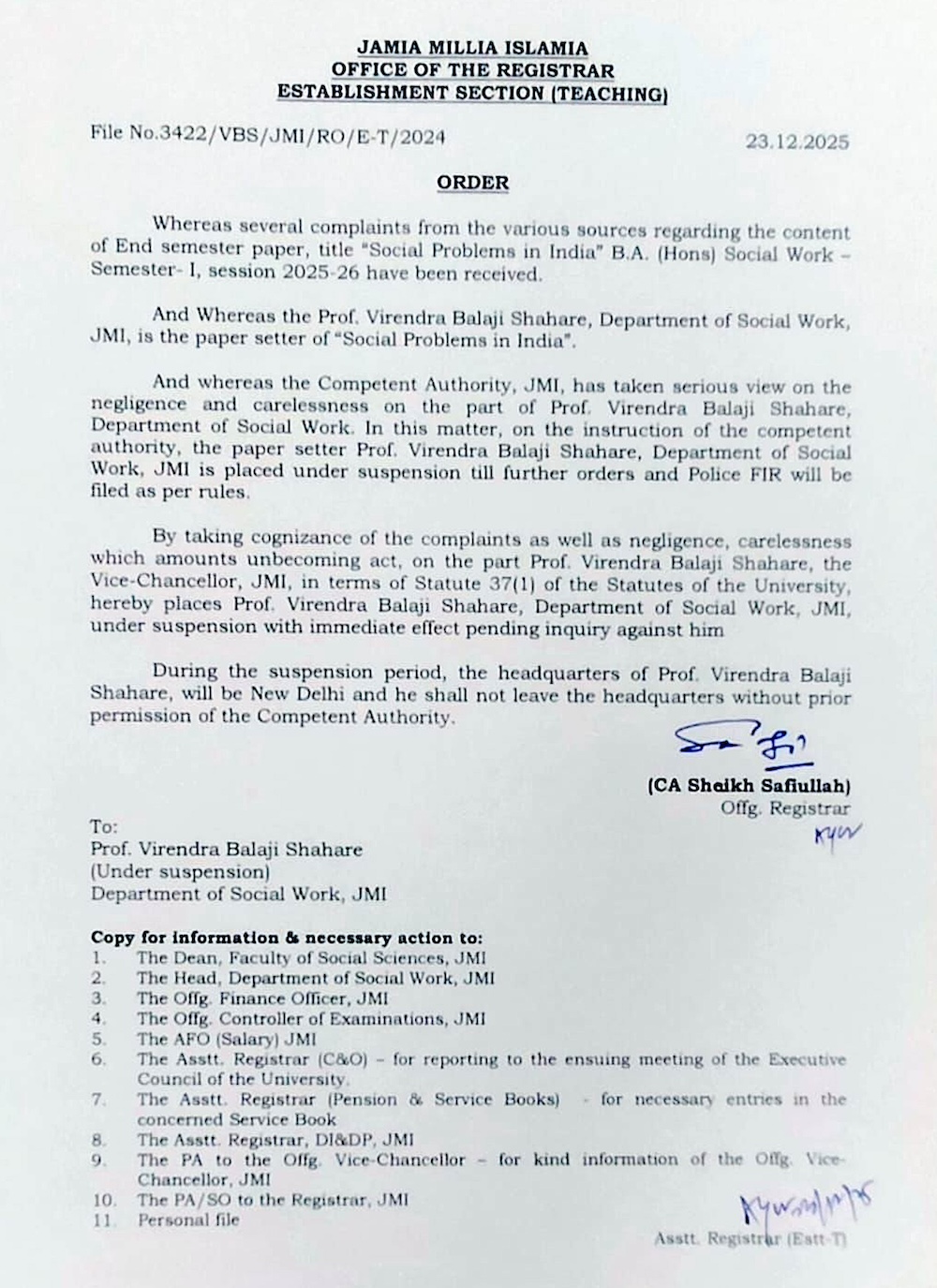
Professor Virendra Balaji Shahare, a faculty member in the Department of Social Work at Jamia Millia Islamia, one of India’s most respected public universities in India, was suspended for including this question in a first-semester B.A. (Honors) examination. The question was taken directly from the approved syllabus. Still, it was treated as an act of provocation rather than pedagogy, and met not with discussion, but with punishment.
That this could happen inside a university should give pause to anyone who believes higher education exists to encourage thought rather than enforce conformity.
It is important to understand a basic point. Disciplines such as social work and sociology are grounded in the critical examination of social inequalities, marginalized communities, and structures of power. When a teacher asks students to analyze atrocities against Muslim minorities, supported by examples, this is neither unusual nor a departure from academic norms. On the contrary, it reflects the core responsibilities of higher education. Such a question emerges from the same intellectual tradition that engages with constitutional principles, judicial observations, and human rights frameworks, which is broadly understood as academic inquiry.
It is also important to clarify that students were not compelled to answer this question. It was an optional question. Only those who did not address another question on homelessness, or who were unable to develop a social work intervention plan to address homelessness in India, were supposed to address this alternative question. The more relevant inquiry, therefore, should have been how many students selected this question and how they responded to it.
If an investigation were warranted, it should have focused on the students’ answer scripts—their understanding, reasoning, and perspectives. Had Jamia’s vice-chancellor or administration wished to do so, they could have compiled a factual report based on these responses. Such a report could have conveyed to the government how students perceived atrocities against Muslim minorities in India and what concrete measures they believed were necessary to prevent those atrocities.
This would have been a constructive way forward. Instead of relying on rhetoric, it could have encouraged introspection and meaningful progress toward the aspiration of becoming a “world leader.” It might also have demonstrated to the international community that India is genuinely committed to safeguarding the dignity and security of its minorities.
Instead, the university administration chose a different course. Its actions sent a stark message: that in today’s India, even raising questions about the oppression of Muslim minorities can be treated as an offense. The response to this perceived offense was not academic engagement or debate, but institutional repression.
I still recall my time as a student at Jamia Millia Islamia. During my BA in Mass Media, sociology was a subsidiary subject. It covered essential themes such as religion and society, diversity and social inequality, social problems, contemporary social issues, and the rights and challenges faced by minority communities. The syllabus drew on a wide range of significant academic texts. Our instructors specifically encouraged us to read works such as Beyond Secularism: The Rights of Religious Minorities by Neera Chandoke, Religious Minorities and the Secular State: Reflections on an Impasse by Partha Chatterjee, and Religious Nationalism: Hindus and Muslims in India by Peter van der Veer.
I also remember an examination question on minorities in my second year. In my answer, I cited information obtained through India’s Right to Information (RTI) Act and supported my arguments with concrete examples. After the results were announced, my teacher smiled and remarked, “Mr. RTI! At least spare RTI in the exams!”
These, however, are stories from another time, before 2014. What is striking today is the silence of a large segment of the educated community. Many seem to ask themselves, “How does this affect us?” or “Why should we risk our jobs?” For academics who adopt this mindset, one hard truth remains: compliance offers no lasting protection. Sooner or later, the consequences reach everyone. The only uncertainty is whether there will still be anyone willing to speak out.
Looking back, I feel a sense of pride in having left my M.Phil. at Jamia Millia Islamia midway. I also feel no regret about declining admission to a PhD in the same university, despite being selected. Had I continued on that path, I might well have found myself among those who remain silent today, not by choice, but by circumstances.
This case is part of a broader and deeply troubling trend in which questioning within universities is increasingly treated as a transgression. In recent years, academic debate has been curtailed through labels such as “anti-national,” “biased,” or “one-sided,” particularly when discussions involve minorities, human rights, or the accountability of the state.
The central issue, therefore, is not the wording of a single examination question. The real concern is whether universities will now be permitted to teach and ask only what aligns with the preferences of the ruling establishment or dominant public sentiment. If that becomes the norm, what is at stake is far greater than one professor’s suspension; it is the effective suspension of academic freedom itself.
Seen in this light, Professor Shahare’s suspension cannot be dismissed as a routine administrative measure. It reflects the gradual erosion of academic autonomy and discretion within Indian higher education. This is not merely the silencing of one individual. It is a warning signal about the narrowing space for inquiry, dissent, and critical thought. Ultimately, it is not a professor who has been suspended; it is the fundamental right to ask questions.
Afroz Alam Sahil is a journalist and author. He can be contacted at @afrozsahil on X.