


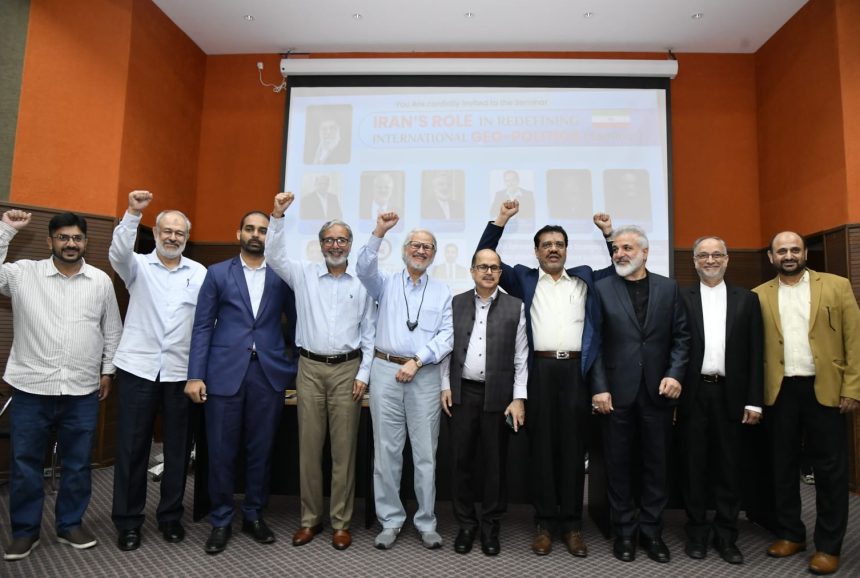
In his welcome address, Syed Ali Taher Abedi, Editor of Judicial Quest Magazine, which organised the seminar – ‘Iran’s Role in Redefining International Geopolitics’ observed that it is a timely convening at the moment when the Islamic Republic stands as both architect and lightning rod in the world’s most volatile fault lines. Picture the scene from the Strait of Hormuz, where 20% of global oil flows under Tehran’s watchful gaze. Iran is not merely reacting to the geopolitical chessboard; it is redrawing its squares. The seminar at Telangana State Media Academy attracted a large gathering from different sections of society in Hyderabad.
Abedi continued thus: As sanctions bite and nuclear talks shatter, Tehran wields asymmetric power through the Axis of Resistance, challenging US hegemony and reshaping alliances from Moscow to Beijing. This is no footnote in history; it’s the front page story of our era, where Iran’s maneuvers forceful reckonings on energy, scrutiny, security, as well as sectarian divides and the fraying post-1979 world order. Today, we gather not as passive observers, but as sharp journalists of power, tracking how Iran’s ballistic ambitions, cyber salvos, and diplomatic pivots are upending the Middle East balance. Our line-up of experts will unpack these threats, the shadow of the Abraham Accords, the ripple of the Russian gambit on Iran’s arsenal, and the high-stakes dance with a multipolar world.
He expressed the situation in Urdu for the audiences.
He taunted ‘America Bahadur sari duniya mein democracy ke danke bajane ki baat karta hai, aur apne paaltuon ko baadshahat ke shikanjon mein jakad kar rakha hai. Aur us intellectual dishonesty par jise daanishwarana munafiqat kaha jayega, us pasmanzar mein teen-chaar sher aap hazraat ki khidmat mein pesh kar raha hoon:
Phir ek manzile khabar ki taraf hai rawan,
Phir ek manzile khabar ki taraf hai rawan,
Woh rehnuma jo kai baar raah bhoole hain.
Buland daawe jamhooriyat ke parde mein,
Farogh-e-mehbaso zinda hain, taaziyane hain.
Bana-e-aman hai jung-o-jadal ke mansoobe.
(Jaise aapne dekha do martaba guftagu hui, do martaba talks hui, uske baad jo uska betrayal hua ki)
Buland daawe jamhooriyat ke parde mein,
Farogh-e-mehbaso zinda hain, taaziyane hain.
Bana-e-aman hai jung-o-jadal ke mansoobe.
Bashor-e-ahd tafawut ke karkhane hain.
Dilon pe khauf ke pehre, labon pe khauf-e-sukoot,
Saron pe garm salakhon ke shamiyane hain.
Magar mite hain kahin jabr aur tashaddud se?
Magar mite hain kahin jabr aur tashaddud se?
Woh falsafe jo jila de gaye dimaghon ko.
Koi sipaah-e-sitam pesha choor kar na saki,
Bashar ki rooh ke jaage hue ayaghon ko.
Kadam kadam pe lahoo nazar de rahi hai hayat,
Siyahiyon se ulajhte hue charaghon ko,
Siyahiyon se ulajhte hue charaghon ko’.
Abedi asked journalists to delve in with the rigors of investigative reporting and the foresight of strategic prophecy. Your insights will illuminate paths forward amid uncertainty, he concluded.
Dr. Shaukat Ali Mirza, former president, AURAK, UAE, and Aga Mujahed Hussain, MD, Olive Hospital, Hyderabad, expressed their pain and anguish due to the war.
Next, it was the turn of the veteran ‘embedded’ journalist Qurban Ali, who covered live war in his hey days spoke thus: Ladies and gentlemen, while I was traveling this morning, this couplet by Allama Iqbal kept echoing in my mind:
You will not be erased by the erasure of one Iran
The intoxication of wine is not dependent on the goblet.
Allama wrote this couplet 100 years ago. Under what circumstances and for what reasons, who knows, but it perfectly applies to today’s situation. And that is because a country, as the speakers before me have pointed out, has been made an untouchable around the world for the last 47 years. Sanctions have been imposed, dealing with it or doing any kind of business with it has been banned, yet that nation is alive and has given proof of its survival described Qurban Ali.
This is not just about Iran. In the last 50 years, the situation at the international and global level revolves around just one thing: America has been imposed upon this world as a global policeman, and everyone must agree with it and bow their heads before it. And whoever refuses will meet the same fate as Saddam Hussein in Iraq, or what was done to Afghanistan, or what was done in Syria with the help of others, or what was done in Libya, and now Iran has been targeted, he lamented.
We had been hearing for a long time that there are three ‘axis of evils’ in the world: Libya, North Korea, and Iran. No one dares to touch North Korea right now because it is a true atomic power. Libya was destroyed, and recently an attempt was made to destroy Iran. In the same way the President of Venezuela was kidnapped in broad daylight in an illegitimate takeover, he pointed out.
‘I covered the 2003-2004 war when America and Britain attacked Iraq. At that time, an army of journalists travelled alongside those armies, who were called ’embedded journalists.’ We heard this term for the first time. If I translate it into Urdu, who knows what it will become, but they were essentially ordered to report and show only what their rulers—meaning America and Britain—wanted them to show. At that same time, I was staying with some friends in Kuwait, and they told me that during the first Gulf War, it was already decided who would participate in the next war. Those who worked for the American forces, whether they were Indians, Arabs, or citizens of other countries, were asked to register their names. And we saw the result of that in 2003-2004, when Iraq was destroyed and Saddam Hussein was eliminated. A fabricated case was built that Iraq had WMDs—Weapons of Mass Destruction’ disclosed Qurban Ali.’
But when the scientists of the International Atomic Energy Agency, along with scientists from America and Britain, declared that Iraq had no WMDs, the US President at the time, George Bush, stated that they didn’t like Saddam Hussein’s face and that the ‘world will be better without Saddam Hussein.’ Now, when you decide that you don’t like a particular ruler’s face and want to eliminate him, you end up destroying an entire country. You destroy its economy, its reputation, its civilization, its culture, and its history. And that is exactly what happened in Iraq; grand old museums and libraries were destroyed and set on fire.
Qurban Ali continued: The exact same attempts were recently made in Iran, but I salute the Iranian people and their leaders for bravely fighting against that barbarism and aggression. Those who thought they would finish Iran, ruin it, and wipe it off the face of the earth within two or three days… after 40 days of bombing, despite using the most advanced weapons, despite creating all sorts of mischief, and despite eliminating Iran’s entire top leadership, when they failed, Trump said ‘tonight that civilization will end’.
Qurban Ali fumed at Trump: Look at America’s 237-year history; in all these years, there has never been a US President as absurd and ridiculous as this man named Donald Trump. Defying the United Nations, international law, and the International Court of Justice, he insisted that whatever he wants must happen, and he tried to force it in every possible way. But as the saying goes, ‘The Kaaba found its guardian in the idol,’ so the Strait of Hormuz emerged as an unexpected gift. And today, as Dr. Shaukat mentioned, the whole world is holding its breath over the Strait of Hormuz. It has become a bone stuck in the throat—it can neither be swallowed nor spat out. Now, all efforts are focused on somehow convincing Iran to allow the passage of oil and gas tankers through the Strait so that the world doesn’t face an oil famine, and so that the global crisis eases a bit.
The negotiations happening in Islamabad today, excuse me, are not happening because Iran has weakened, or America has won, or Israel has succeeded in its plans. It is happening because of Iran… and this is Iran’s greatness, it is like magic that speaks for itself. This is Iran’s magic, that even Donald Trump has to admit that ‘they are the best negotiators in the world, Iranians.’ And they have proven this; they proved it before too. Negotiations over Iran’s nuclear program went on for decades, and ultimately, US President Barack Obama had to concede and accept the Iranian position. But the very first thing this flawed man [Trump] did upon returning to office was to tear up the agreement Obama made with Iran. And now he is eating humble pie; despite everything, America has ended up in a situation where it has no other way out but to accept that same agreement again opined Qurban Ali.
Therefore, today, the Iranian people, their leaders, and their army are a guiding light for the whole world and for all those countries that lacked the courage and daring to stand up to America or face it. Iran has shown that path. The topic of today’s seminar, ‘Iran’s role in redefining international geopolitics’—Iran has already done that; there is no doubt left about it. What is geopolitics? Geopolitics is exactly this: protecting your sovereignty and your borders, upholding the dignity and honor of your entire nation, refusing to bow down, and forcing other forces to come to the table and negotiate with you. This is Iran’s biggest achievement today, and it will be written in golden words when the history of the world is written, foretold Qurban Ali.
Friends, a period of 47 years is not a small amount of time; three generations are born in that span. Those who were born in 1979 are men and women of about 50 years of age today, and their children, and their children’s children have been born. Imagine the miserable conditions they are living in—they don’t have medicines, they lack basic amenities, and pressure is being put on them that the whole world will not deal with them, their oil will not be bought.
‘And unfortunately, I feel ashamed about this—the Consul General is sitting here, and I confess in front of him—that our country adopted a very poor attitude towards Iran, which was a very good friend of ours. We did not show the courage to step forward and do what we should have done. I won’t go into the details of the many reasons for that, like why our Prime Minister (without naming Narendra Modi) visited Israel two days before the war started, what he went there to do, or what he agreed upon with Israel. I am not going into those details,’ lamented Qurban Ali.
But Iran was our friend. They always stood shoulder-to-shoulder with us and helped us in every difficult time. But when Hillary Clinton was America’s Foreign Minister, she came and told us to stop buying oil from Iran—which we were not even buying in dollars, we were buying it in rupees or bartering essential goods—and we stopped buying it. And today, I don’t need to tell you all, the stoves in your houses burn because of the gas being used in this country, and for that, we should be thankful to Iran for allowing all our ships to come to India. They said that regardless of the Indian government’s attitude, the Indian people have expressed solidarity and sympathy with us at this time, so we will not let the Indian people face any trouble. And to this day, whether ships from other countries are stopped in the Strait of Hormuz or not, no Indian ship has been stopped. We should all be grateful to Iran for this.
Friends, former Lieutenant Governor Mr. Najeeb Jung is here, and Mr. Ausaf Saeed is here, who has been our ambassador to many countries; you will hear them too. I won’t take much more of your time, I will just say this: the voice you have raised from Hyderabad today should rise from every city, every street, and every neighborhood in India in their support. We are not doing them any favors; rather, for our own sake and our own interests, we must support Iran. Any sovereign government cannot be suppressed or threatened, and you set out to change regimes. How many regimes will you change?
I was watching a viral clip of Ayatollah Khamenei with Mr. Larijani. Mr. Larijani went to Ayatollah Khamenei and told him that he should relocate to a bunker. Khamenei asked, ‘When you came to me with this proposal, what was going through your mind?’ Larijani replied, ‘My heart was testifying that you would not accept my proposal.’ To which the late Ayatollah Khamenei—who now holds the status of a martyr—said, ‘My conscience does not allow me to go into a bunker myself and ask my army to fight. I will die, I will perish, but I will not go into a bunker.’ What more can you expect from the supreme leader of a nation? And when a nation’s leader holds such spirit, won’t his nation be ready to lay down their lives for him? What else would they do, he questioned?
And you all saw that just two days ago, when the ceasefire was announced, before that, more than a million men, women, and children were present in Tehran, shouting, ‘Come, kill us, drop bombs on us, we will not back down, we will not be erased. You will have to destroy all of Iran before you can proceed further, otherwise, we will not let you succeed in your plans.’ Salute such a nation a hundred times.
Friends, this is not the time to talk like this, and I am not making any direct comparisons right now, but do not look at what happened in Karbala 1400 years ago purely from a religious perspective. I have heard the interpretation of the Battle of Karbala from many European and Marxist intellectuals who say, and it is still written in books today, that that was the first war against tyranny. What happened in Karbala 1400 years ago was exactly this: we will not accept or obey the words of a tyrant, and we will not bow our heads before someone who does not speak of justice. And today, the exact same situation has arisen, when America and its allied countries—although not many allies are left, as you might have seen Trump’s anger falling on NATO, the UK, France, and Spain. But sadly, our Arab countries are still following him, walking behind him; they haven’t realized yet that he is not going to sit here as their supporter forever, reminded Qurban Ali.
And although Iran gave very good proof of restraint—it did not attack the civilian areas of any Gulf country, be it the UAE, Qatar, Oman, Kuwait, or Saudi Arabia. It only attacked those installations where Americans and their allies were stationed or where they had business interests. It only destroyed those, or their military bases; this is no small feat. However, in war, everything is fair in love and war. When push comes to shove, you have to do it, and Iran had to do it, and it should have done it. Therefore, in such times, it is the duty of all of us to support Iran, stand with its people, and at least assure them that they are not alone. The whole world is with you because you are fighting a war for truth and justice; you are giving your sacrifices to achieve truth and justice, which is why we are with you, concluded Qurban Ali.”
Diplomat par excellence, Dr. Ausaf Sayeed, former Secretary, Ministry of External Affairs, Government of India, mesmerised the distinguished gathering thus:
At the outset, let me thank Syed Tahir Abidi for organizing this very topical seminar. As we are speaking, high-level talks are going on between the US and Iran, and the next few hours will actually let us know what the outcome will be. The entire world is waiting with great expectations that this talk should bring about something which the world should cheer about because the last 40 days have not been something we would like to remember. And of course, the entire premise on which this war was initiated had no legal sanctity.
There was no UN resolution to speak of, there was no internal Congressional approval within the US, and they say that there is credible evidence that Iran was planning to attack US interests in the region—yet there is no evidence that anywhere in the world, any country has confirmed this was the case. So basically, you decide to do something and then go about doing it.
The distinguished diplomat and author Dr. Ausaf Sayeed continued: So I have also been writing about this, that there is definitely a new order which we are seeing emerging before our very eyes. This new world order, whose manifestation is very much evident in the Middle East, is like ‘might is right.’ If you are powerful, you do anything you want and the world will remain silent. All the Bretton Woods institutions, the UN, and any other international organizations are not playing the role for which they were actually constituted. So we don’t find any UN resolution on anything. Even if there is a UN resolution, it will be more like an endorsement of what is happening, he remarked.
So when you begin something which was inherently incorrect and wrong, you make so many mistakes. The goalposts kept changing. First, they say, okay, our target is regime change in Iran. Okay, so when they hit Iran on Feb 28 and wiped out the top leadership, including the Supreme Leader Ayatollah Ali Khamenei and other top leaders, was that the end of the regime? Was that regime change? No, because then immediately a second-rung leadership came up. They eliminated the second-rung leadership as well, then came the third-rung leadership. Still, Iran was withstanding because, as the previous speaker said, you cannot be subjugated to tyranny, analysed the experienced diplomat.
There were practically three or four points on which Iran was targeted, he felt. One, of course, they say Iran is very close to making a nuclear bomb. But if you believe the words of IAEA (International Atomic Energy Agency) top officials, they say we don’t have any evidence that Iran is anywhere close to a nuclear bomb or that it is pursuing a nuclear bomb. So when the agency which controls nuclear enrichment and monitors this globally itself is saying that we have no evidence, but somebody else thinks they have evidence—so that was one excuse mocked Dr. Ausaf Sayeed.
Now you see, then they said the proxies, Iran’s proxies in terms of non-state actors like Hezbollah, Hamas, and Houthis—they are the ones who are also fomenting trouble in the region. So basically putting a few things together, then this war came about. And 40 days into the war, I am sure you know a very powerful country which led this war also started seeking help from its allies, NATO allies. None of the NATO allies said that they are willing to come because all of them knew that this war is an imposed war and they didn’t want to be part of it.
So you saw, some of the speakers also mentioned how there has been a rupture in alliances between the US and the European countries, the NATO alliance. So none of the countries wanted to join in. See, when we look at Iran, it is a civilization. It is of course a civilization, we don’t go by what the West terms it—a ‘regime.’ It’s not a regime, it’s a civilization much older than many of the countries which exist in today’s world. Even when we go back to medieval times, among the Muslim kingdoms there were hardly four or five: you had the Safavids which are the Persian civilization, then the Mamluks, eventually the Egyptians, then the Ottomans, and the Mughals in India. And of course, there were other Christian civilizations. So it is one of those rich civilizations we talk about which has enriched the world through its philosophy, literature, language, and people-to-people connections. Even in India, there were various states where Persian was the second official language. We still see the Persian contribution in all the cultural elements we talk about. So it is a huge, rich cultural civilization which has enriched throughout the world, the learned diplomat reminded.
And if you look at Iran in its current form, it occupies a unique geopolitical location because it is a bridge between the Arab world, Central Asia, and the Caucasus, which has a very unmatched regional depth and leverage all through.
And we have talked about Hormuz—there is a little sensitivity on it and we should not get emotional, so I beg to differ with some of the other speakers, thundered the bold diplomat Dr. Ausaf Sayeed. But definitely, Hormuz is a very important water body and a national water body through which almost 20% of global oil passes. And Iran currently has absolute control over what could pass through it and what could not pass through it. It’s a different matter whether it is legal what Iran is doing or not legal, but in the current state of affairs of the world where there is no law and order which anybody is following, we can give Iran the concession that is okay, it is also not obliged to follow the rule of law, he pointed out.
But otherwise, as per the United Nations Convention on the Law of the Sea, no country in the world which is located on a national water body can block it because otherwise what will happen? Every country would start blocking the water bodies in front of them or in their territorial waters, and internationally there cannot be any trade. So this is one thing, argued the disciplined diplomat!
Secondly, there has also been talk—and I will mention—about the subjects on which the two sides are talking and negotiating. One of the important things which Iran has put forward in the 10-point program is recognizing the right of Iran to enrich uranium. So that, you know, it has the right. We are not pursuing nuclear bombs, but we want nuclear energy for our civil purposes, so there is a right to enrichment; that is one.
Dr. Ausaf Sayeed stressed that when you talk about a ceasefire, there should also be a talk about a ceasefire in our allies, which means Lebanon in the current context. See, when we are talking about Iran, we are forgetting Lebanon. In Lebanon, in the last three or four weeks since the war started, almost 1500 people have died, most of them civilians, on the plea or excuse that Hezbollah locations are being targeted. And just two days back in a 10-minute attack, 100 bombs were dropped in Lebanon in which about 300 people died, mostly civilians again. 5 million people have been displaced, so where is the end to this? One country cannot indiscriminately bomb another country thinking that that country is posing a threat to it. So this is one aspect.
Iran now says as a precondition that all of Iran’s assets which were frozen in different parts of the world—amounting to about 100 to 200 billion dollars, and 6 billion dollars with Qatar—should be immediately released so that they can use it in reconstruction and other things.
Now another aspect is war reparations. Since you are the people who have bombed us, destroyed our civilization, destroyed our buildings, there has to be war reparation. Somebody has to pay for it. If you cannot pay, we will start imposing a fee on Hormuz so that any ship which goes through Hormuz will have to pay. So what is the fee which they said? $1 per barrel of oil which goes in, which means that if a big tanker goes through Hormuz they will have to pay 2 million dollars, which would mean very conservatively about $30 million dollars a year, and if the war prolongs it could actually go to several billions of dollars, calculated Dr. Ausaf Sayeed.
So see again, in a situation as Mr. Qurban Ali said, everything is fair in love and war, so Iran is pushing back to the corners, so obviously they also have to take some measures. But having said that, you see this will have a cascading effect if the world agrees to imposing this fee. Why? Because simply the cost of oil will increase. Any supplying country will add 2 million per tanker to the cost, so that means tomorrow if you are getting your LPG gas cylinder for ₹150, it will become 200. Everything will become expensive. So the fighting is going on somewhere, but the effect is somewhere else, and we are the countries which are bearing it; we have absolutely no connection with what is happening there deciphered the diplomat.
But at the same time, since we (India) are net importers of energy—not only oil and gas, but it affects everything, fertilizers, your agriculture is affected, your industrialization is affected, so many things. So the entire world wants these two sides, the US on one side and Iran, to agree, and we do hope that the next four or five hours should lead to some kind of a solution.
Dr. Ausaf Sayeed lauded Iran and observed: despite the conscious attempt of the world to isolate it, is trying to rehabilitate itself, saying that okay, they are a normal country like any other country. They are not a ‘regime’, but a civilization. They are part and parcel of the Shanghai Cooperation Organisation, which is a very important organization spearheaded by China, and they are part of BRICS, which they became a member of in 2024. By the way, this year India is the chairperson of BRICS. BRICS stands for Brazil, Russia, India, China, and South Africa. Now a few more members have been added, including Iran, UAE, Ethiopia, and Egypt.
Iran also has international treaties; it has a 20-year comprehensive strategic treaty with Russia, it has a 25-year cooperation program with China. More importantly, the world has always been talking about a Shia-Sunni conflict. There is no such conflict. I mean, our scholars have said no, our religion Islam is the one which talks about pluralism; everybody can coexist. So it is an artificially created disinformation campaign, this Shia-Sunni conflict. So there is no conflict, we are the same, a proud Dr. Ausaf Sayeed exulted! Now, for a moment, we will forget about what’s happening now, but a very momentous development which took place in 2023 was the rapprochement, or the reestablishment of diplomatic relationships between Iran and Saudi Arabia, which was facilitated by China. So which means it shows that the conflict is never on the lines of Shia-Sunni, but maybe of course geopolitical competition between competing countries in the region. Of course, it has come under some stress because of the current conflict, although the target of Iran has been the US military bases in the region, he pointed out.
But unfortunately, in any conflict, there is always collateral damage. In that collateral damage, we have seen some civilians come under attack, some civilian infrastructure also come under attack either way. See, when the US is hitting the bridges, when they are talking about power plants and other things, I mean it’s kind of a free-for-all, so it’s very difficult for strategic observers like us to make any value judgments, he admitted.
But I would also like to make one point. The West always considers itself as the champion of democratic rights and democracy, and calls Iran a regime, a theocratic country. In the context of Iran, they talk about that, but at the end of the day, if you look at the entire thing, it would be a war on oil, the control of oil. I would like to take you back to 1950, Iran of 1950s, that is pre-revolution (the revolution came in 1979). We had one Prime Minister—many of you may be aware or not—Mohammad Mosaddegh. Mohammad Mosaddegh was overthrown in a coup on August 19, 1953, by a combined US and UK intelligence operation, MI6 on one hand and the CIA and others in the US. Why did they want to remove him? Because it was a democratic country. You talk about democracy, but you don’t want this democracy. Why? Because that Prime Minister wanted to nationalize Iranian oil. Before that, the entire exploration of Iran’s oil was done by the Anglo-Iranian Oil Company (AIOC), which was the predecessor of British Petroleum. So you see the interest there is how to control. A Prime Minister came who wanted to nationalize, meaning the British oil companies would be out, so then they created a scenario where the government was toppled and then the Shah was brought in. And then we saw all that happened leading up to the revolution which has taken place, and which we still see now, 47 years of revolution. The people of Iran are definitely a very gritty people. There may be internal contradictions in the society because most of the population of Iran now is a post-revolution young population born after the revolution, so they may not relate to the circumstances when the revolution came in. They may have their own aspirations, they may be looking at what the West is doing and all that, but when it comes to crisis, you saw what was mentioned: thousands and thousands of people, young and old, holding flags right there and circling the bridges and circling power plants, showing the world that ‘we may have our problems, but we will solve it ourselves, don’t prescribe to us what we need to do, pleaded Dr. Ausaf Sayeed.’
So I think this is one of the lessons which we see in geopolitics: you have to stand up. You have to stand up if there is some tyranny going on, some kind of external prescription being given to you on how to govern. See, it is very easy to prescribe democratic values and other things, but I have seen what had happened in Iraq. You know they talked about Weapons of Mass Destruction, they did everything, they hit every part of Iraq, and they actually killed Saddam Hussein right in the streets. Not a single Weapon of Mass Destruction was recovered. Now if you see the books, all of the same people who attacked are now saying that we made a mistake, it was wrong intelligence, and they went about it. The same has happened whichever place they have gone, and this has been the problem. Now during this war itself, they were thinking that let us prop up the Kurdish and other ethnic communities inside Iran to go against the regime, but what happened? Countries like Turkey, for example, were very firm and said any instigation of the Kurds would mean the whole region will get affected, feared Dr. Ausaf Sayeed.
So I think at some point in time, the world has to stand up. We cannot let an international order emerge before us where ‘might is right’, where one country or a couple of countries can decide what is good or what is not. Earlier it was a rule of law, rules-based law, which means any country irrespective of the size of its military might—a small island country like Monaco or Seychelles—has the same right in the UN as India, the US, or the UK. So that is the thing which we should talk about in the future, not go back in time where anybody can just go and invade other countries and all that, he pointed towards the future.
So I think I am trying to be optimistic and do hope that by the time we end this seminar and go home, we should hear something very positive which would make us feel very happy, hoped Dr. Ausaf Sayeed.” The optimistic diplomat’s wish was answered within hours as when I came on the Sultanate of Oman Television’s 7 pm English News in the evening, I analysed the situation of the on-going talks thus: ‘As a (political) Commentator of the Middle East for the past 30 years, at this stage, I think the focus is likely on immediate de-escalation. A broader agreement would require time, trust and continued engagement. However, a temporary easing would be a meaningful step in the current climate for peace in the Middle East.’ The News Anchor Abdullah bin Ahmed Al Rubaiey concurred thus: ‘Indeed, a cautious start but encouraging start, with hopes that dialogue may pave the way toward stability. Dr. Ahmed, thank you for your insights.’
Those wishing to listen to the full interview can do so at:
https://youtu.be/1Pl7tzqbBjc?si=6Szx5Cc73IlAvqOI
The smart and upcoming journalist Syed Khalid Shahbaz, who was compering the Seminar,
transitioned to the Consul General of Iran Hamid Ahmediyeh and invited him to speak:
It’s time to hear from the Consul General himself, who obviously needs no introduction. He is one of the most respected Iranian diplomats on foreign soil. He has served in several key positions in Iran, including as the Deputy Director General for Support Affairs, as the Administrator and Financial Counselor for Central and Northern Europe, and has also served as an advisor to the Ministry of Finance. He has formally held many roles, including missions in Austria and Vienna.
Speech by H.E. Hamid Ahmadi, Consul General of Iran
(Translated from Persian)
“Bismillah ir-Rahman ir-Rahim. Assalamualaikum wa Rahmatullah. Good evening.
Before I come to my main topic, I want to offer my condolences to all of you on the martyrdom of the Leader, Hazrat Ayatollah Syed Ali Khamenei. In these days, as 40 days have passed, our eyes are filled with tears, but our other eyes are equally awake and aware. Hazrat Syed Ali Khamenei was martyred in the month of Ramadan, just like his master, Hazrat Ali.
If we look at the example of Hazrat Ali Khamenei today, it is like the event of Karbala, where figures like Hazrat Ali Akbar and Ali Asghar were martyred. Yet, even after 1400 years, the echoes of ‘Labbaik Ya Hussain’ are heard by the people today. The Leader had said regarding this that we are victorious—whether we win, we are victorious, and whether we are martyred, we are victorious. I do not want to take much of your time; I want to move to my main topic.
Respected guests, esteemed teachers, and dear attendees, it is a matter of pride for me to be present among you in this prestigious seminar. The topics being discussed today are not merely a title, but a living reality that the world is facing.
In today’s era, geographical borders, military power, and influence alone do not determine true strength. Rather, real significance lies in how much a country can influence global equations, how it shapes its narratives, and how it maintains its relations at the national and international levels.
Due to its great civilizational history and strategic position, Iran has always played an important global role. In recent years, despite facing various pressures, Iran has chosen the path of sovereignty, resistance, and wise engagement.
Today, I have not come before you just to talk about politics, but to narrate a living experience. An experience named Iran, which is a tale of steadfastness, identity, and hope. In a world where power is often equated with dominance, Iran has tried to give a new definition to power—a power that is born from the people, culture, faith, and an unshakable resolve, and one that does not bow even before a storm, thundered the Consul General Hamid Ahmediyeh.
Respected audience, the world is moving towards a new global order where power is no longer limited to a few countries but is being distributed among various players. In such an environment, the successful countries will be those that are flexible, intelligent, and adopt a collaborative approach in their strategies.
If I were to explain Iran’s role in the reshaping of global geopolitics in simple but profound words, we must accept that the world is no longer unipolar, where one or two powers dictate the path of global politics. In today’s world, countries like Iran are playing an active role, rather than merely subordinating to the decisions of others.
Iran has faced severe sanctions in recent years, many of which were imposed under the UN Security Council. Despite this, Iran did not take a step back. Instead, it explored economic and political alternatives, such as self-reliance, cooperating with non-Western countries, and forming alternative trade and financial systems. Iran faced the sanctions through these means. This is a sign that Iran has moved forward by turning its difficulties into opportunities.
Along with this, Iran’s nuclear program has also been one of the important arenas that has highlighted this country’s role at the global level. The JCPOA nuclear deal is a prime example of this effort, showing that Iran has always tried to resolve its issues through negotiations and within the framework of international law. In this journey, international institutions like the International Atomic Energy Agency played a monitoring role, which highlights the importance of global laws. However, America’s withdrawal from this agreement and the failure of European countries to fulfil their promises raised the question: to what extent can the international system be trusted? This very issue has caused Iran to focus on strengthening its sources of power alongside negotiations pointed out the consul general.
Iran’s geographical location is in a highly sensitive and important region where energy resources are abundant, and its strategic importance is immense. Playing an active role in this region, Iran has enhanced regional cooperation. Iran has taken the stance that regional security should be determined by the countries of the region themselves, not by any external power.
In this way, Iran has challenged some of the traditional concepts of the international system—especially the idea that only major powers have the right to make global decisions or that the international system will run solely on the whims of a few countries. Countries like Iran have questioned this. This trend is leading the world towards a multipolar system.
Of course, we have to be realistic. This path has not been easy. Economic pressures, global sanctions, and political differences with some countries have remained major hurdles. But new global changes, such as emerging powers and the decline in the influence of traditional powers, are also creating new opportunities for Iran.
If we articulate Iran’s role clearly, four fundamental changes are visible, explained the distinguished consul general:
- A Change in the Concept of Power: Power is not just military strength; it is manifested in national resilience, public support, and cultural identity.
- Support for Multilateralism and Opposition to Unilateralism: Iran has always emphasized the principle that the future of the world must be shaped on the basis of dialogue, cooperation, and balance, not on the basis of force and dominance.
- The Blend of Politics and Civilization: Iran’s model shows that international relations are not just a battlefield for competition but a medium for interaction and closeness between civilizations.
- The Model of Resistance: Iran has presented an example that countries can choose the path of progress and sovereignty without depending on anyone else.
In recent days, the Iranian nation has faced a war-imposed situation due to the cowardly attacks by America and the Zionist genocidal regime—a situation where the smell of war was in the air during the day, and the earth bore witness to the pain. In this difficult era, Iran stood up not just against one enemy, but against a vast system of injustice and pressure. But the thing that changes the course of history is not modern weapons, but strong hearts that stood firm, kept the faith, and did not bow down, declared the bold consul general.
In these days, we saw the effects of the wise leadership of the martyred Commander-in-Chief, Ayatollah Syed Ali Husseini Khamenei, who in past decades built Iran’s military strategy on the principles of legitimate defense and the deterrence doctrine. This path will now continue with even more strength and vision under the leadership of Ayatollah Mojtaba Khamenei. Along with the leadership, the public—this unparalleled asset—has explained the true meaning of resilience and resistance to the world through their conscious and sacrifice-driven participation, claimed the Consul General Hamid Ahmediyeh.
And here I want to mention a very important and praiseworthy aspect of the Iranian nation. Amidst all these difficulties, the light of humanity also remained prominent, especially from the kind and humanitarian people of India observed the Consul General Hamid Ahmediyeh in a moving tone. During this imposed war, through their material and spiritual support, they proved that relations between nations transcend politics and borders. This is what ‘Beyond Borders’ means—where humanity erases distances. As Saadi has said, ‘Human beings are members of a whole, in creation of one essence and soul.’
He hoped that the seminar, will prove to be a meaningful beginning for dialogue, a means to bring hearts closer, and will help build a world where humanity rises above all borders.
Syed Khalid Shehbaz invited the keynote speaker, the honorable former Lieutenant Governor, Mr. Najeeb Jung and introduced him thus:
Najeeb Jung is the son of Haleem Jung Sahab. His Excellency’s grandfather, Sir Buland Jung Sahab, served as the Chief Justice in the court of the last Nizam of Hyderabad. His great-grandfather, Maulvi Samiullah Khan Sahab, was one of the co-founders of the Aligarh Muslim University. So welcome back, welcome home.
He was educated at St. Stephen’s College and the London School of Economics. He joined the IAS in 1973, went on to work in the energy sector, later moved into policy research, and has worked with the Asian Development Bank, Oxford, and leading think tanks in India. He has been writing and speaking regularly on public issues, and we have all seen him very recently, very active on TV channels. As Vice Chancellor of Jamia Millia Islamia and later as the Lieutenant Governor of Delhi, he has brought a very thoughtful approach to both academics as well as governance. He has served India across the decades in both academics as well as governance.
The philosophical Najeeb Jung brooded thus: I have been speaking on this matter for some time in Delhi and so, at the cost of repetition, let me say a few things. I am truly ashamed at what’s happening in the world today. I stand before you as a human being who has been dehumanized. I believe half of humanity is dehumanized. I think the countries around us are dehumanized, and the qualities for which God made man have fled away somewhere else. It is indeed the rule of the Satan, he declared.
So when we talk on geopolitics, before I come to that, let me come country by country so that my thinking process is clear. I have prepared no notes, so I am speaking from my mind as thoughts come to me.
A 240-year-old country, the United States of America, formed on the basis of racial exploitation, the exploitation of the white against the black, which continues today. A country which over the last 70-80 years, or shall I say 100 years, has a terrific history. The only country that has exploded bombs twice on a country—in Hiroshima and Nagasaki. The interesting thing was that when the first bomb was dropped on Hiroshima, and the pilots flew off, it occurred to them that the bomb may not have exploded or caused enough damage. So they came back and dropped a second bomb. That was humanity? Was it humanity?, questioned Najeeb Jung.
It is the only country which exploded napalm on young children in Vietnam; we have pictures and evidence of that. It is the only country which has exploded cluster bombs in Iraq, which explode within the building to a temperature of 3000 degrees. So if you are in the building, you will be pasted to the walls. I have had the distinction of seeing those buildings in Baghdad. So the cluster bomb comes, penetrates through the roof, and bursts at 3000 degrees centigrade. That is humanity. But nobody talks about that, Najeeb Jung lamented.
It is the only country where, as Qurban Ali Sahab said, they can pick up a President from his bedroom, take him away, put him in a lockup, release him after two days, four days, five days, try him in your country, and change the regime. The same trick that they thought they could try with Iran. Fortunately, they met with an adversary they had no idea who they were dealing with exclaimed Najeeb Jung.
So let me come to Iran, but before Iran, I will come to the partner, to the country that partners the United States, and that is Israel. This is Zionism at its peak, where I believe that the soul of Satan has entered the people living in Israel. It is Iblis who has entered the souls of people who are there, because every day for the last two and a half years, there has been a Karbala in Palestine. Every day. 7,000, 8,000 children maimed, killed, injured, dying. Schools destroyed, hospitals destroyed, journalists killed, doctors not allowed to serve. Is this not Satanic? But they get away with it. And today, as Ausaf says, when people talk of peace in Islamabad, who is the person who stands as a barrier to those dialogues? Think about it. It is one man. And that is why I say the soul of Satan has been recreated in the world. It comes back. It is the time when Allah said ‘go’, and he says ‘I want space in the body, in the soul of man.’ He comes back again and again, and we have it, opined Najeeb Jung.
And amidst this, ladies and gentlemen, let me come to Iran. In this hall, let me share a secret which I have shared earlier only with my wife. On 9/11, 2001, I was actually sitting with Ayatollah Khamenei in his hujra in Tehran. I had gone there to negotiate a gas deal for a British company. And like you said, they are the toughest negotiators that one could come by. In two days, we were exhausted. We were tired. We knew that we would not get what we wanted, and the Iranians were sticking to their guns. So I called on him just to say goodbye. I had failed in my enterprise, I knew the people I was trying to negotiate for would be very angry. But when I went in—and he lived in a hujra, you imagine where Prime Ministers live, where Presidents live, you imagine the golden ballroom that President Trump is building for himself, you look at the palaces that Presidents live in—but he stayed in a hujra. So there was a small office where we went to, and that is the moment when the Deputy Minister of Petroleum, I think his name was Maleknejad, he came into the room and he said that two planes have hit the towers.
There was no happiness in His Holiness. He felt sad. He felt sad that a tragedy had struck the same country where you call them ‘The Great Satan’. The leader of that country feels sad. Inna lillahi wa inna ilayhi raji’un. That’s what he felt. And that is the difference between humanity and Satanism. That is the country that they were dealing with, narrated Najeeb Jung.
I, as a sociologist, as a student of history, have a grouse against Iran, for instance. I think that Iran needs a great deal more democracy than exists. I really believe that women in Iran need much greater freedom. You mentioned mathematics, but that’s one example. I think I would like to see the women in Iran as free as the ladies here. I believe that they should go out and vote, and teach, and dance, and play, and be out on the streets. I think that’s the time, and it’s time that democracy came to Iran, Najeeb Jung advised the Iranians.
But leave that aside. This moment in its history is a remarkable moment for the country. And I am reminded of a statement by Che Guevara, the great revolutionary who, along with Fidel Castro, liberated Cuba. There were just 58 revolutionaries in the little boat which came to Cuba to throw out the government. Che says, when they are facing gunfire etc., he says that ‘Death will be welcome, provided that this, our battle cry, reaches out to other ears, and other hands stretch out to pick up our weapons, to more sounds of battle and victory.’ That, I think, is the voice of the Iranian youth today. When you talk about them being ready to sit on bridges, when you talk about them sitting on railway tracks—that is people who are looking for martyrdom.
And then you think of Karbala. Great historical facts of the grandson of the Prophet who knows that he will lose his life, but he will fight injustice. And that is exactly what Iran has done in the face of atrocities. No other country, I believe, in the world has the capacity to sustain this. Today, there is no country—I don’t think any country in Europe with all their mighty powers can sustain this onslaught. I don’t think any country in South America can do it. Of course, China is a different kettle of fish; I’m sure Russia is different, nobody meddles with them. But is there any other nation which could have stood this onslaught of 40 days of constant bombardment of the most vicious armaments that have ever been produced by the human mind? asked Najeeb Jung.
Please bear in mind that American technology is far more advanced than anywhere in the world. They have hundreds of Nobel prizes in mathematics and engineering. Their laboratories are full of the greatest scientists in the world. So they also produce great war machines. And those war machines brought hell to an issue. It would take years to supplement what they have lost. But what have they gained? They have proven one thing. They have proven that science, and technology, and money, and threats do not hold water when the human spirit comes up. Because suddenly a spirit of nationalism was awakened in these people that only a month or two months before were protesting. And that is what misled President Trump to think that he would achieve regime change. But that is what suddenly happened; the nationalism awoke.
I often say that the myth of Pan-Islamic togetherness is completely shattered. There is no Pan-Islamism in this world. This is not Shia-Sunni; this is pure selfishness. You want to survive; you want to survive at any cost. But now, what will they get in return is what we must understand. Because they will today understand that there is no shelter from American bases anymore. The Americans have the least choice; they have the choice now to go back. They may leave a periphery of a few soldiers here and there in some hotels, but this great huge base in Qatar or the huge bases in Saudi Arabia, they will no longer exist. And so the major damage done too, is to the American psyche itself, and to the psyche of the GCC. Today, they will seek the shelter of a nation that will emerge from the embers of ruins to become a mighty power in that region. And that is what Iran will be. You can’t help it now. I don’t know which way the peace talks will go. I don’t know which way the war will go. It may go on for a month more, it may finish tomorrow, and it does not concern me. But what does concern me is that all wars do come to an end. And so will this. And when this happens, and when the embers of fire settle down, then one country will emerge in the region foretold Najeeb Jung.
Alexander the Great, a mighty force conquering the world, comes to Persia. Darius rules the world; he is the greatest emperor of the world at that time, faced with this young 24-year-old general who is conquering the world. But when Alexander comes to Persia, he lays camp there, and he admires the culture. He admires the country so much that he says, ‘I can’t go on further.’ And the Queen Mother, the Queen Mother of Darius actually adopts Alexander as a son. And that’s the relationship, that’s the admiration that Alexander had for Persia. He comes to India but goes back and indeed dies in Persia. He doesn’t go back to Greece, Najeeb Jung delved into history.
You can’t destroy culture. You can’t destroy civilizations. As His Excellency (consul general) has said, this is a very mighty civilization. We have all seen great civilizations. But if you have seen Isfahan, if you have seen the hall that they met us in Tehran, your eyes open up to the culture. The only comparison that comes to my mind really is the mighty palaces of the Czars in St. Petersburg or Moscow, where you see the same comparison of power, glory, and heritage. But look at the tragedy around us. That great heritage has been destroyed by these mechanical bombs without a thought. You destroy Isfahan, what have you destroyed? You have destroyed human history. You have destroyed a complete human history of 5000, 7000 years without a thought. How could you even think of that? Questioned Najeeb Jung.
And that is the thoughtlessness that has occurred to us through a lack of education. There is a great philosopher in the world, his name was Will Durant. Some of you who may have read philosophy, he has written a very famous book called The Story of Philosophy. But another book he has written, which very few people read, is The Pleasures of Philosophy (I am forgetting the name exactly). But there he writes that the world suffers today because you don’t go back to the roots of knowledge, because the roots of knowledge lie in true philosophy. All your religions have emanated from thematic philosophy. But you will not teach your children philosophy anymore. And that is exactly the tragedy of Europe; it is the tragedy of the Americas because they have gone back to money. Money becomes God. When money becomes God, then you destroy people, then you drop bombs, then you use napalm, grieved Najeeb Jung.
I have worked in Afghanistan immediately after the Taliban lost to the Northern Alliance. And there, the Americans were searching for Osama bin Laden. And the mountains in Tora Bora are ash and gray because they used low-grade uranium on those beautiful mountains searching for Osama. Is there no thought process? Where is the courage? Where is humanity? Where are people? Where are governments? And what a shame, what a shame on these Western countries who are part of that Northern Alliance not to object.
I hope all of you will speak. I hope all of you will go and speak in your mohullas. I hope all of you will write papers. I hope all of you will write to tell your MLAs, and your Ministers, and your Chief Minister to go and write and speak. I hope all of you will go and meet your Prime Minister and your Home Minister to convince them that India has to take a stand, which it has not taken so far. We must stand up to the world, concluded Najeeb Jung.


Heartiest congratulations to Mr. Ahmed Mohiuddin for his outstanding journalistic achievement in authoring the powerful and thought-provoking article titled “Iran’s Consul General Praises India’s Humanity – No Legal or UN Basis for Attack on Iran, Says Dr. Ausaf Sayed.”
Your work reflects not only exceptional writing skills but also a deep commitment to truth, balance, and global awareness. By highlighting perspectives on international law, diplomacy, and India’s humanitarian values, you have contributed meaningfully to informed public discourse. At a time when clarity and responsible journalism are more important than ever, your article stands out as a shining example of integrity and intellectual depth.
May your dedication to impactful storytelling continue to inspire readers and elevate the standards of journalism. Wishing you continued success and many more remarkable achievements ahead.
Heartiest congratulations to Mr. Ahmed Mohiuddin for his outstanding journalistic achievement in authoring the powerful and thought-provoking article titled “Iran’s Consul General Praises India’s Humanity – No Legal or UN Basis for Attack on Iran, Says Dr. Ausaf Sayed.”
Your work reflects not only exceptional writing skills but also a deep commitment to truth, balance, and global awareness. By highlighting perspectives on international law, diplomacy, and India’s humanitarian values, you have contributed meaningfully to informed public discourse. At a time when clarity and responsible journalism are more important than ever, your article stands out as a shining example of integrity and intellectual depth.
May your dedication to impactful storytelling continue to inspire readers and elevate the standards of journalism. Wishing you continued success and many more remarkable achievements ahead.
My co-worker Luka has one of these. He says it looks purple.