

On February 14, 1954, the official Urdu publication of Jamiat Ulema-e-Hind, Al-Jamiat, published an editorial titled ‘When Will This Tyranny End?’ The editorial was later translated into English by India’s Ministry of Information & Broadcasting and forwarded to the Prime Minister’s Secretariat. The ministry noted that the article concerned ‘the desecration and forcible occupation of two Muslim religious institutions by Hindus.’
Prime Minister Jawaharlal Nehru personally forwarded the matter to the Home Ministry, writing: “I am sending you some papers which have been sent to me regarding the articles of the Al-Jamiat in which some incidents have been referred to. I hope that an inquiry will be made in this regard.”
From that point, a chain of official correspondence began. Reading these letters makes it clear that the mosque of Maulana Kamaluddin in Dhar had been desecrated. However, the government of the time, despite presenting itself as secular, appeared eager to downplay the matter as a minor incident, largely because those in power were treating the site as a temple on the basis of their own interpretation of the evidence.
The editorial published by Al-Jamiat stated:
“An isolated act of tyranny and misdeed can be bemoaned. But when every day tyranny is perpetrated and even the Government does not take any action (to check it), what are we to do? To whom should we go for redress?
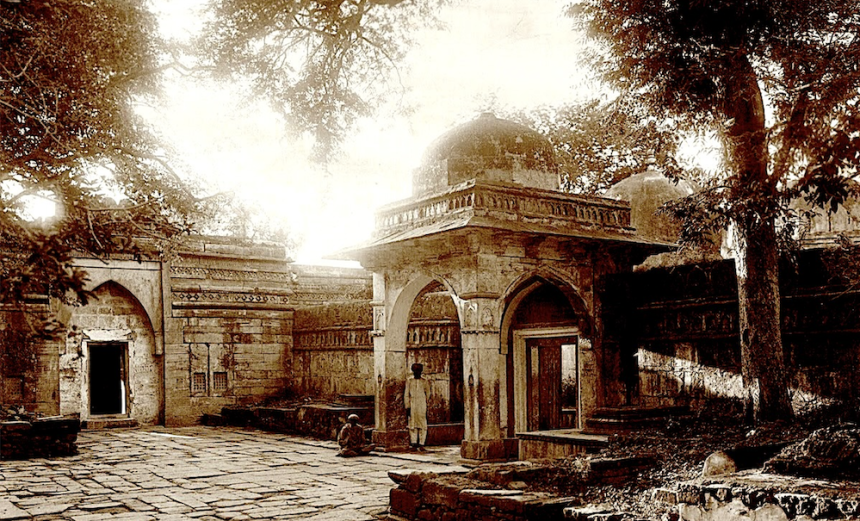
At ‘Dhar’ in Madhya Bharat [Madhya Pradesh], there is an old and grand mosque known as Maulana Kamaluddin Chishti’s mosque. In this mosque were buried some religious leaders and the relations of Muslim Kings. Their tombs are still in evidence today.
Now, this mosque has been forcibly rechristened as Bhojshala and Saraswati Mandir.
This act was not single-handedly performed by the Hindu Mahasabha, but the police came ejected the Muslims and witnessed the worship Saraswati which was held in front of the ‘pulpit’.
This is a long-standing dispute and after intervention of the Jamait-ul-Ulema Hind, it was agreed that the mosque will be retained as a mosque.
Sometime ago the Muslims were stopped to offer their five daily prayers in it. Only the ‘Friday gatherings’ continued. But look at the brazen-facedness of the Hindu Mahasabha and its conceit of false superiority, that it completed its action – not surreptitiously, but with full pomp and show after announcing it for two days on the loudspeakers – with the assistance and in the presence of the police and after holding public meetings on the ground attached to the tomb of Maulana Kamaluddin Chishti.
The Muslims lodged a complaint before the Collector and other officials but all went in vain.
After all, in the presence of the police the place of worship for God was polluted with the filth of idol worship and in this way the heart of Islamic world was riddled through and thus new lustre was added to the name of the Secular and Democratic Government.
We have a fear that our plaint may in return be construed as an act of communalism. The test of nationalism is taken to be that one should not complain over this tyranny of the Government and communalists and after all these mishaps, it should be said that the star of secularism in the country is shining in all its glory.
Alas! the mosque which was spared by the English and even the Princely Hindu State did not let its sanctity be desecrated, has now been converted into a Saraswati Mandir.
We request the Indian Government to devote special attention to the happenings in the Madhya Bharat and to take the dispute of the mosque in its own hand, to assure justice to the Muslim minority and to bring to book the men who have hurt their feelings.”
The above mentioned parts of editorial directly questioned the secular credentials of Prime Minister Jawaharlal Nehru, who was widely regarded as a leading advocate of secularism in India. The editorial expressed a very important point that even those seen as champions of secular values appeared unwilling to take strong or meaningful action on the issue.
Telegram of Jamiat Ulema-e-Hind
An office memorandum sent by the Prime Minister’s Secretariat to the Ministry of States reveals that Amiruddin Sahib, secretary of the Dhar district branch of Jamiat Ulema-e-Hind, sent a telegram to Prime Minister Jawaharlal Nehru on February 9, 1954.
In the telegram, he alleged that after announcements were made over loudspeakers, Hindu Sabha leaders Kale Pradhan and Dwarkaprasad, along with a crowd of around 200 Harijans, entered Maulana Kamaluddin’s mosque on February 8.
According to the complaint, a picture of Saraswati was placed inside the mosque, the words Jai Shiv were written where Allah had previously appeared, and provocative slogans were raised. The telegram further claimed that police officers present at the scene failed to intervene, no action was taken, Muslim religious sentiments were deeply hurt, and inflammatory speeches and activities continued despite repeated reports to the police and district authorities.
Chief Minister’s Reply to Maulana Azad
An important letter regarding this matter was also written by Abul Kalam Azad, who was then India’s Education Minister. On February 22, 1954, he wrote to the then Chief Minister of Madhya Bharat, Mishrilal Gangwal, seeking full details of the incident.
In response, the Chief Minister sent a detailed letter on March 23, 1954. The letter stated: “The Nagar Hindu Sabha of Dhar decided to celebrate Bhoj Diwas on 8th February, and gave publicity to their programme for the celebration through loudspeakers. With the permission of the local Municipality, they pitched a tent in the open ground near the Bhojshala, which is an ancient monument, and performed Saraswati Puja in the tent in which about 200-250 persons participated. The same day, some of the spectators, who had visited the Bhojshala, placed some garlands there and wrote the words “Om Sarasvatyai Namaha” in chalk over the Arabic writings in the building. No puja was performed in the building but the above incident was magnified by rumour and it was alleged that the Hindus had installed an idol in the building. Apprehending that the circulation of this rumour might lead to a breach o the peace, the police took additional precautions and made adequate arrangement. Nothing untoward happened.”
This was the response of a Chief Minister who was widely regarded as secular, a committed Congress leader of that era, and someone considered close to Prime Minister Jawaharlal Nehru. Yet in this letter, he himself referred to the historic Kamal Maula Masjid as Bhojshala and an ancient monument under the protection of the Archaeological Survey of India. He acknowledged that members of the Hindu Mahasabha had performed Saraswati Puja near the mosque with municipal permission and that some visitors entered the mosque, placed garlands there, and wrote ‘Om Saraswati Nama’ in chalk over Arabic inscriptions inside the building. Still, according to the Chief Minister, none of this amounted to an ‘untoward incident.’
The Government’s Position on Kamal Maula Masjid
Earlier, on December 3, 1952, Maulana Abul Kalam Azad had written to Mishrilal Gangwal seeking information about the Kamal Maula Mosque after receiving a telegram from residents of Dhar alleging that the mosque was being desecrated.
The Chief Minister replied on January 15, 1953, and wrote: “I must state at the outset that the building in question is not known as Jama Masjid. It is popularly known as Bhojshala and has been officially described in the records as Bhojshala Masjid Kamal Maulana, and is an important archaeological monument of Madhya Bharat. There is evidence in hand that originally there was a Hindu temple at this site built and dedicated to Goddess Saraswati in the 11th century A.D. by the Parmar King Bhoj of Dhar. The Saraswati image which was installed in this temple is now in the British Museum, London, having been salvaged from the site and removed to England by some British officers in the old days. The temple was destroyed sometime, it is believed, in the 13th or 14th century by Muslims to create a mosque on the site entirely out of the material of the original temple.”
The Chief Minister viewed the Kamal Maula Masjid not as a mosque, but primarily as a former temple site. He also stated that official records referred to the structure as Bhojshala Masjid Kamal Maulana, although historical records indicate that the term Bhojshala was only added in 1935; an issue we will discuss later in this article.
At the same time, the Chief Minister acknowledged in the same letter that disputes over Muslim rights at the site had intensified in 1935. He wrote: “The dispute regarding the rights of Muslims over the building came to a head in 1935 when the former Dhar Government in view of the existing character of this building, had to declare by a notification in the Dhar Darbar Gazette dated 24.8.1935 that the building was a mosque, and give the assurance that the right of prayer by Muslims in that building would be duly respected. From time to time, however, the Dhar Darbar made it clear to Muslims that the building was, nevertheless, Government property in all respects, and that no new rights could be allowed to accrue on it in favour of the Muslim community.”
Notification in the Dhar Darbar Gazette
The letter further noted, “Hindu agitation against the use of this building for prayers by Muslims, reached its climax in 1944 during the time of the Hindu-Muslim disturbances in Dhar. These disturbances were promptly put down by the Dhar Administration, but concession allowed to Muslims has always remained an irritant to the communal-minded Hindus. The building has however always been maintained by the Government and a full-time caretaker is posted there by the Archaeological Department. The policy of the Archaeological Department in regard to the right of worship in Archaeological monuments has been that as far as possible no new rights should be allowed to be created in favour of any community, although existing usages and rights must be respected.”
The Chief Minister further stated that, after considering the matter in its entirety, the Government of Madhya Bharat had taken three decisions: (1) to inform the Hindu Maha Sabha that the building cannot be given to either community for conversion into a temple or a full fledged mosque, and that the righto of entry to the bullding must be conceded to all sections of people for purposes of sight-seeing; (2) to inform the Muslim community that while Muslims may continue to say their Friday prayers in the building, no articles should be kept there and that no part of the building should be used for residential purposes; (3) to reject summarily the request of some Hindu organisations to celebrate the Bhoj Diwas in this building.
He also clearly stated that the Muslim community would continue to retain the right to offer Friday prayers there, in accordance with long-standing practice.
When Did Tensions Escalate?
In 2006, workers of the Vishwa Hindu Parishad allegedly attempted to disturb the situation at the Kamal Maula Mosque on a Friday. The administration had instructed that the Saraswati Puja should be concluded by 12:30 pm, but the group reportedly did not comply with the deadline.
When police and Rapid Action Force personnel tried to enter the mosque premises to clear the area, they were allegedly attacked with stones, leaving at least five policemen seriously injured. These incidents were reported in The Times of India on February 4, 2006.
The report also noted that until April 2003, access to the site was regulated: Hindus were allowed entry only on Basant Panchami, while Muslims were permitted to offer Friday prayers for two hours. However, in 2003, shortly before the state assembly elections, the NDA government expanded Hindu access by opening the site for weekly entry on Tuesdays, a decision that was also approved by the Archaeological Survey of India.
Parliamentary records from 2003 indicate that the District Magistrate had recommended allowing Hindu visitors entry between 9:00 am and 11:00 am every Tuesday, with restrictions on slogans, puja rituals, offerings, idols, or religious materials inside the premises.
However, the Archaeological Survey of India later allowed broader access, stating that Hindu visitors could enter freely throughout the day on Tuesdays, from sunrise to sunset and could carry minimal offerings such as flowers and grains of rice.
In contrast, Muslims were permitted access only on Fridays between 13:00 p.m. and 15:00 p.m., specifically for offering Friday prayers.
Did the Controversy Emerge Abruptly?
It is important to note that these developments did not happen overnight, but unfolded over time amid growing tensions and mobilisation by various Hindutva organisations.
The Times of India report dated May 10, 1995, noted that Sadhvi Rithambara, a leader of the Vishwa Hindu Parishad, had reportedly declared from jail that she would return to Dhar to take part in what she described as a movement for the ‘liberation of Bhojshala.’ She had been arrested for allegedly delivering provocative speeches in Uday Nagar and was later released following an order of the Indore Bench of the Madhya Pradesh High Court.
Another The Times of India report dated February 18, 2003, stated that the Hindu Jagran Manch had issued a warning on February 6 that if the site was not opened to the majority community by February 18, it would be forcibly opened. The report also mentioned that around 5,000 workers were planning to break the locks and enter the Bhojshala complex in Dhar on that day.
At the time, the state BJP reportedly stated that it supported the demand raised by the Hindu Jagran Manch on the issue, but would not take part in any forced entry.
The same report also noted that Union Minister for Culture and Tourism Jagmohan had written to the Chief Minister of Madhya Pradesh, Digvijaya Singh, stating that the central government had no objection to lifting restrictions on Hindu entry into the complex, and that the final decision rested with the state government, as the restrictions had originally been imposed by it.
In response, the Chief Minister stated that his government was not opposed to Hindu entry at the site, but that the matter required the central government to lift restrictions imposed through the Archaeological Survey of India, since the site fell under its regulatory framework.
The Times of India reported that on February 19, 2003, clashes broke out in which two policemen and 22 members of the Hindu Jagran Manch were seriously injured. According to the report, protesters set several shops in the town on fire.
Police used tear gas and lathi-charge to disperse the crowd, while also coming under attack from stone-pelting from rooftops. The state administration cordoned off the entire temple area and deployed multiple layers of security, which the protesters were unable to breach. Around 150 members of the Hindu Jargon Manch, including nearly 50 women, were arrested.
Following the violence, the Hindu Jagran Manch called for a bandh (shutdown) the next day, alleging police excesses. At the same time, the district administration convened an all-community meeting to address the issue of restrictions at Bhojshala, but Hindu organisations chose to boycott the talks.
The report also noted a significant shift in terminology in media coverage, with references to the ‘mosque’ largely disappearing and the site increasingly being referred to only as a temple or Bhojshala.
It is also important to note that this period coincided with the 2003 state elections, in which the Bharatiya Janata Party won a majority, and Uma Bharti was sworn in as Chief Minister.
In the years that followed; 2006, 2013, and 2016, the Basant Panchami festival, marking the arrival of spring and traditionally associated with the worship of Goddess Saraswati, again coincided with Friday. On these occasions, tensions reportedly flared during celebrations at the site. A similar communal atmosphere was disrupted this year on February 12, as Basant Panchami fell on a Friday.
‘Bhojshala’ Added to the Mosque Name in 1935
Records indicate that in 1935, the Archaeological Survey of India placed a notice board inside the courtyard of the Kamal Maula Mosque that included the term Bhojshala. This move was reportedly objected to by members of the Muslim community in Dhar. The related documents are preserved in the National Archives and are available for reference.
Truth about the statue in the London Museum
It is often claimed by some Hindu nationalist organisations that a statue of Goddess Saraswati from the Kamal Maula Mosque is kept in the British Museum in London. However, this claim is disputed.
In her book Negotiating Mughal Law: A Family of Landlords Across Three Indian Empires, scholar Nandini Chatterjee notes, based on the British Museum’s own records, that the statue is identified as Ambika, a deity revered in both Hindu and Jain traditions. The Sanskrit inscription beneath the statue states that it was commissioned and dedicated by a person named Vararochi. Historical context links Vararochi with Jain traditions during the reign of Raja Bhoj. The same patron is also credited with dedicating statues of Vag Devi (a form associated with knowledge) and three Jain elders.
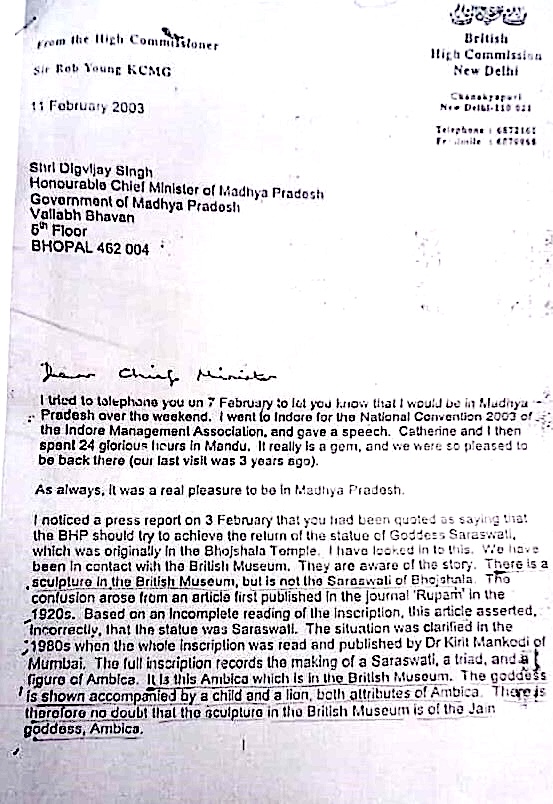
In addition, a letter attributed to Sir Rob Young, who was posted in New Delhi in February 2003, has circulated in public discussions. In this letter to the then Chief Minister of Madhya Pradesh Digvijaya Singh, he clarified that the British Museum statue is not actually the Saraswati image associated with Bhojshala.
According to the letter, the confusion originated from a 1920s article in the journal Rupam, where an incomplete inscription was misinterpreted, leading to the identification of the statue as Saraswati. Sir Rob Young further explained that in the 1980s, Dr. Kirit Mankodi published a fuller reading of the inscription, which showed that the figure is actually the Jain goddess Ambika. The statue is also depicted with a child and a lion, iconographic features traditionally associated with Ambika Devi.
The Viceroy’s Visit to the Mosque
Historical records show that the site has also been referred to in older documents as the Juma Masjid or Jama Masjid.
For example, a report in The Times of India dated November 5, 1902, notes that the Viceroy of India visited the mosque on November 1, 1902. The report also mentions that the mosque was believed to have been built around 1400 CE.
Earlier, in 1871, James Macaulay, editor of the London-based family journal The Leisure Hour, also visited the site. In his travelogue The Ruins of Mandu, he described his observations of the monument:
“As the sun was setting, we arrived at the singular building which was to be our inn for two days, namely, the Jumma Masjid, the ruin of the great or ‘Friday Mosque.’ The builder of this mosque was Mahmud Khilji, the fourth King of Malwa, who reigned from 1435 to 1468 A.D. …We abode in the great entrance chamber of the mosque aforesaid. A lofty flight of sixteen steps led up to it. The interior is a square of forty-four feet, surmounted by a spacious dome, which is ornamented by carving and blue enamel. The eight windows of this apartment are filled with beautiful screen work. In a corner we deposited our traps, and made our bedroom and dining-room. Passing out of this entrance-chamber at the back we found ourselves in a great court-yard, which in ancient days was surrounded by beautiful colonnades three rows deep. Many of these have fallen, and one side of the court-yard is filled with rubbish; but the colonnades opposite the entrance, or on the west side of the mosque, are in fair preservation. This, being the side of the building next [towards] Mecca, was the portion devoted to worship. Under a fine dome stands almost uninjured the marble mimbar, or pulpit, facing the marble slab which indicates the direction of Mecca, towards which every true Mussulman must turn when he prays. There are many little marble stalls in the walls near the pulpit, which used to be the private chapels of the nobles of Mandoo; and the marble throne used by the king when he came to pray is still uninjured. On the opposite of the street from this mosque is the ruined college, which also owed its origin to Mahmud Khilji, and behind it a mound of ruin —all that remains of the famous minaret which was once seven stories high.”
His travelogue was published in the November 4, 1871 issue of The Leisure Hour. The excerpt mentioned above is from that account. From his description, it appears that in front of the mosque, across the road, there stood the ruins of a college said to have been built by Mahmud Khilji. Behind it, he also describes a large mound of ruins, identified as the remains of a seven-storey minaret. This minaret was reportedly constructed to commemorate the Malwa ruler’s victory over the Rana of Chittor.
Looking back, it is unfortunate that many of these historical structures have not survived. Macaulay does not mention any temple or college associated with Raja Bhoj in this account. From this brief passage of a much longer travelogue, it can be understood that at that time there appears to have been no recorded dispute surrounding the mosque.
When did the controversy begin?
In reality, the controversy began to take shape in the late 19th and early 20th centuries, particularly after the 1890s.
One early figure often mentioned in this context is Dr. Alois Anton Führer, an archaeologist associated with the Archaeological Survey of India. During his 1892–93 visit to central India, he published observations in the Annual Progress Report of the Archaeological Survey, North-Western Provinces and Oudh. He suggested, without firm evidence, that certain Sanskrit inscriptions found at the site might be linked to an ‘educational institution.’ His work later came under serious academic criticism, was considered unreliable, and he was eventually dismissed from the ASI.
In the early 1900s, K. K. Lele, then Superintendent of the State Education Department and later associated with archaeological work in Dhar, advanced a similar interpretation. He referred to the mosque as ‘Raja Bhoj’s school.’ In 1903, Lele published a report titled The Summary of the Dramatic Inscription found at the Bhoja Shala (Kamal Maula Mosque), Dhar. This is widely noted as one of the earliest instances in which the term Bhojshala appeared in written form, and from then onward the name gradually became associated with the site.
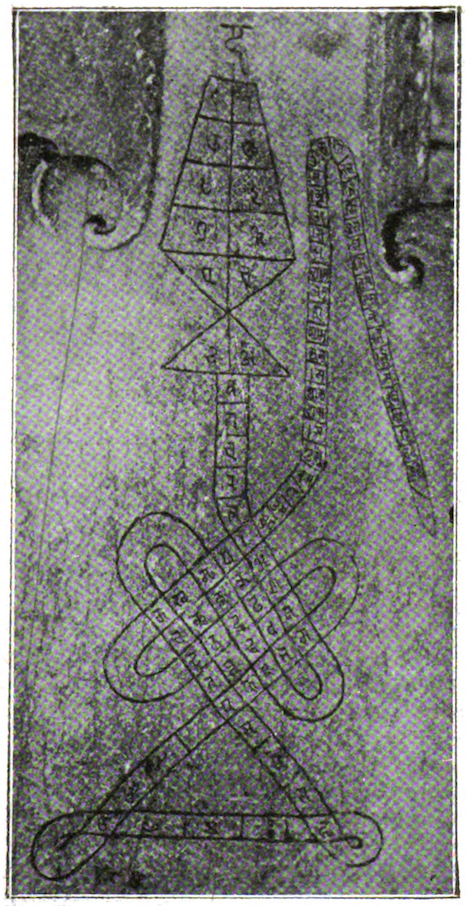
Some scholars, including Michael Willis in his research Dhar, Bhoja and Sarasvati: from Indology to Political Mythology and Back have examined how this interpretation developed over time. According to this line of scholarship, the idea of Bhojshala was not an ancient or widely established local tradition, but rather a later interpretive framework shaped through colonial-era archaeological readings, administrative records, and subsequent political narratives.
Early British accounts from the 19th century, including those of writers such as John Malcolm, William Kincaid and others who described Dhar and the Kamal Maula Mosque, do not mention the term Bhojshala or any related public tradition. This absence is sometimes highlighted to suggest that the term gained prominence only later, rather than being an established historical name.
In this view, Bhojshala is understood not as an ancient designation, but as a term that emerged through early 20th-century scholarly and administrative interpretation, later entering broader public and political discourse.
Another research paper by Michael Willis, co-authored with Saarthak Singh, Vishwa Mohan Jha, and Muntazir Ali, describes the site as a broader religious and social complex, not limited to a mosque alone. According to this study, the area included a mosque along with a monastery, courtyard, well, lodging facilities for pilgrims and visitors, and arrangements for feeding the poor and travelers.
The paper also notes that Persian sources refer to the site using names such as rawz̤ah-i riz̤wān and a dome full of the saint’s light (qubba-yi pur-nūr). Importantly, it records that during the reign of Sultan Mahmud Shah Khilji (1456–57), the shrine and mosque complex underwent significant renovation and expansion, as documented in these Persian texts. This interpretation presents the site in Dhar as an active Sufi and Islamic religious and charitable center, whose historical character was later reinterpreted through different narratives over time.
An important point raised in this discussion is that the site was initially referred to only as ‘Raja Bhoj’s madrasa,’ and at that stage there was no reference to Goddess Saraswati. Early writers such as Führer and Lele did not describe it as a Saraswati temple within the mosque complex. The association with Saraswati and the idea of a Hindu educational institution emerged later in the early 20th century.
Michael Willis describes this evolving narrative as a form of ‘political mythology,’ suggesting that the interpretation of the site developed gradually; from ‘Raja Bhoj’s school,’ to ‘Bhojshala,’ and eventually, in later discourse, to a ‘temple.’ In more recent times, it is also noted that legal and administrative interpretations have further influenced how the site is formally described.
The question is not only ‘What was this place?’ but also ‘Why and how has history been interpreted (an appropriated) in different ways over time?’
At its core, the issue is not simply whether a historical structure in Dhar is a mosque or a temple. The deeper concern lies in the growing tendency for courts and state institutions to accept long-standing claims rooted in belief, tradition, or mythology as historical fact. If such a precedent is established (as happened in the case of the Babri masjid), it could open the door to similar claims over countless sites in the future; where any group might assert that a place of worship once stood wherever they now seek recognition.
In that scenario, history risks being shaped more by collective sentiment than by evidence, and this raises important questions about the purpose of laws such as the Places of Worship (Special Provisions) Act, 1991. One must ask why such a law exists in the first place if historical claims alone are allowed to override settled status.
Taken further, this logic could extend far beyond any single site. By the same reasoning, disputes could arise over private homes, public buildings, or entire neighbourhoods based on ancestral claims stretching back generations. Would such assertions be accepted as sufficient grounds to alter present-day rights? Would courts be expected to adjudicate solely on belief or inherited narratives?
Similar arguments could be made in reverse as well, with different communities pointing to historical destruction of their places of worship and seeking restoration or recognition. If every such claim were reopened, it could turn state institutions into arenas of ongoing religious contestation, where no site, sacred or secular, remains settled.
Afroz Alam Sahil is an Independent journalist and author. He can be contacted at @afrozsahil on X (Twitter). Afshan Khan is doing a Ph.D. in Political Science and International Relations at Istanbul Sabahattin Zaim University.