

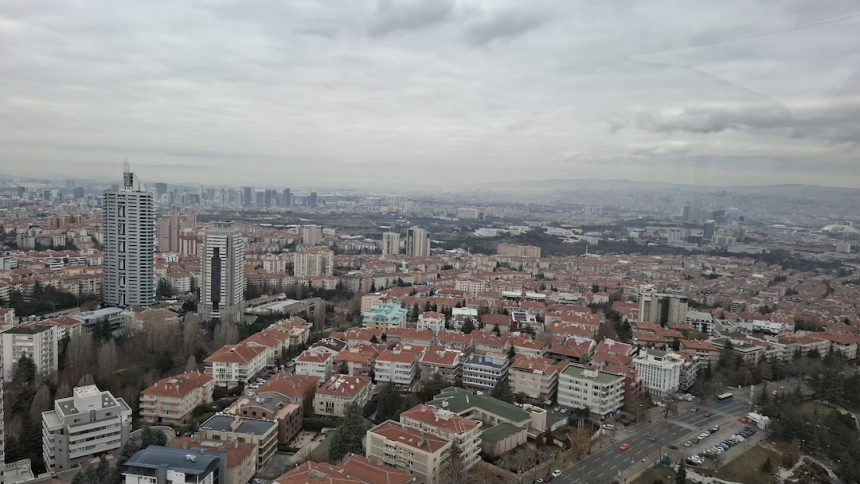
Standing atop the 410-foot-high Atakule Tower in Ankara, I could see the city stretching out in every direction. Despite the clouds hanging low in the sky, the temperature hovering around freezing, and an AQI of about 45, the entire city remained clearly visible.
Looking at Ankara from that height, I suddenly found myself missing my own city, the capital of my country, India.
I am talking about Delhi. The same Delhi that is now widely regarded as one of the most polluted cities in the world. The same Delhi where citizens demanding clean air have taken to the streets, only to face police crackdowns and imprisonment for asserting something as basic as the right to breathe. The same Delhi where toxic air is silently eroding the health of millions, and where doctors at the country’s largest public hospital have warned that the city is currently unfit to live in.
From hundreds of feet above Ankara, I could not stop thinking about the stark contrast. One capital city allowed me to see clearly across its skyline, while thoughts of my own capital were clouded by a crisis that millions of people are forced to endure every day.
Standing beneath Ankara’s clear skies, one question kept returning to my mind: How has Türkiye managed to keep its air so clean?
Surely there must be a major government initiative or national campaign behind it. After all, in India, the government launched an ambitious air-quality initiative. Since its introduction in 2019, the National Clean Air Programme (NCAP) has received nearly ₹14,000 crore (about US$1.6 billion) in funding to tackle air pollution across the country.
Curious, I pulled out my phone and began searching. I wanted to understand what model Türkiye had adopted to make its cities so breathable. But the more I looked, the more surprised I became.
I could not find any nationwide scheme that matched India’s National Clean Air Programme in terms of scale, publicity, or ambitious official targets. Yet, despite the absence of a highly publicized national campaign, Türkiye’s air quality appeared noticeably better.
Türkiye does, in fact, have a National Clean Air Action Plan. Its primary goal is to monitor air quality across the country, identify pollution risks, and implement effective measures to reduce them at the national level. In addition, Türkiye has adopted a comprehensive National Action Plan on Climate Change and Emission Reduction for 2024-2030, which outlines a strategy for reducing pollution and greenhouse gas emissions from key sectors such as energy, industry, buildings, and transportation.
It is fair to say that Türkiye has adopted a systematic and multi-pronged approach to tackling air pollution. The country still faces significant challenges, particularly because of industrial activity and its continued reliance on coal. However, there is at least a visible effort to treat air quality as a policy priority and to address the issue through long-term planning.
During my stay in Ankara, and especially in Istanbul, I repeatedly felt that air pollution is not viewed solely as an environmental concern. It is also part of broader government planning and public policy. I saw this reflected in the environmental and climate-related commitments included in the ruling AK Party’s manifesto for the 2023 general election, which emphasized climate action, sustainable development, and the creation of more environmentally friendly cities.
By comparison, when I reviewed the ruling BJP’s manifesto for India’s 2024 general election, I found little emphasis on air pollution as a distinct national challenge. That contrast stood out to me. On one side is a country where the problem has not been fully solved, but where there appears to be an acknowledgment of the challenge and a commitment to addressing it. On the other is a country where millions of people continue to breathe polluted air every day, yet the issue has struggled to secure the political attention and urgency it deserves.
The reality is that India’s government does not always appear to approach air pollution with the seriousness the crisis demands. Equally important, there is often a lack of transparency and public accountability around the implementation and outcomes of various clean-air initiatives. As a result, many citizens are left uncertain about whether official commitments are being matched by meaningful action on the ground.
Thoughts of Delhi kept returning to me, especially when I found myself taking deep breaths of Ankara’s clean air.
Every year, particularly during October and November, Delhi’s air becomes so toxic that the city seems to be on the verge of suffocation. A thick blanket of smog settles over the capital, sunlight grows dim, and clear blue skies become a distant memory. What is perhaps most frustrating is that, instead of a united effort to address the crisis, the season often brings a familiar cycle of political blame.
The Delhi government has long argued that the central government and neighboring states, particularly Punjab and Haryana, have failed to adequately address crop-residue burning, allowing the capital to slowly turn into what many describe as a “gas chamber.” The BJP, meanwhile, has accused the Delhi government of failing to effectively utilize funds allocated for pollution control, including revenue collected through environmental taxes. As a result, alongside the haze of pollution, a haze of political accusations also hangs over the city.
I remember reporting extensively on this issue, particularly in 2018, when I conducted a detailed study of Delhi’s air pollution crisis. Around that time, I spoke with Sunil Dahiya, a senior Greenpeace campaigner who has worked on air quality issues for many years. He explained that pollution in Delhi is not merely a seasonal problem confined to October and November. It persists throughout the year, but winter makes it far more severe.
As temperatures drop, atmospheric conditions change. Winds slow down, and polluted particles become trapped closer to the ground instead of dispersing into the atmosphere. The result is a dramatic increase in pollution levels, wrapping the city in a toxic blanket that can linger for days or even weeks.
Perhaps that is why the arrival of winter in Delhi does not bring excitement for everyone. For many residents, it marks the beginning of a season when every breath carries a greater health risk. Winter becomes a period of anxiety rather than comfort.
My experience in Türkiye could not have felt more different. There, I found myself looking forward to winter, eager to see the snowfall and enjoy the changing season. It was a reminder of something many people elsewhere take for granted: the ability to welcome winter without worrying about whether the air itself has become dangerous to breathe.
As I reflected on these issues, I also found myself revisiting some of the investigations I had conducted years earlier. Back then, I relied extensively on India’s Right to Information (RTI) Act, visiting government offices, obtaining official documents, and piecing together stories that later appeared in newspapers across the country.
One investigation, conducted in 2016, revealed a deeply troubling picture of Delhi’s water resources. According to information obtained from various departments of the Delhi government, the city had 905 registered water bodies. Of these, 168 had been encroached upon, 39 contained unauthorized structures, and 78 had authorized constructions built on them. Most alarming of all, 285 of these water bodies had disappeared entirely, while another 338 had dried up completely.
The documents showed that many of Delhi’s ponds, lakes, and natural waterways had gradually been converted into residential colonies, cremation grounds, community facilities, and religious structures. In other cases, government agencies had used the land for bus terminals, schools, stadiums, and other infrastructure projects. It seemed as though the city had slowly consumed many of the very water resources on which it once depended.
My observations in Türkiye presented a striking contrast. There, water management appeared to be viewed not merely as a matter of supply, but as an issue closely linked to national security, agricultural productivity, and long-term development. Over the past few decades, the country has built more than a thousand dams, significantly expanding its water-storage capacity and connecting millions of acres of farmland to modern irrigation networks.
Perhaps more importantly, Türkiye’s approach has extended beyond simply conserving existing water resources. Policymakers have also invested in what might be called the creation of “new water” through alternative sources and technologies. Treated wastewater is increasingly reused, efforts have been made to recover and utilize agricultural wastewater, groundwater monitoring systems have been strengthened, and some coastal regions have explored seawater desalination as an additional source of supply.
Türkiye still depends primarily on its rivers, reservoirs, and water-reuse systems. Yet what stood out to me was its willingness to plan for future challenges rather than react only when a crisis emerges. That long-term perspective is something many rapidly growing cities around the world, including Delhi, must embrace.
Many longtime residents of Istanbul say that the condition of the city’s waterways and coastline today is vastly different from what it was a few decades ago. The restoration and cleanup of waterways, including the Golden Horn, gained momentum during Recep Tayyip Erdoğan’s tenure as mayor, and the impact of those efforts remains visible today. For this reason, many Turks regard these projects as a turning point in Istanbul’s modern urban history.
The same approach can be seen in Türkiye’s National Water Plan 2026-2035, which outlines a range of strategies aimed at improving water management. The plan focuses on increasing irrigation efficiency, expanding wastewater reuse, improving water quality, and preparing for the challenges posed by climate change.
Of course, Türkiye is not free from water-related challenges. Drought, climate change, groundwater depletion in some regions, and industrial pollution remain serious concerns. The difference, however, is that these problems are openly acknowledged and addressed through long-term planning. Across the country, one can see tangible examples of that effort in the form of dams, water-treatment facilities, monitoring systems, modern irrigation networks, and water-reuse projects.
Unfortunately, I cannot say the same about my own country, India. There is no shortage of policies, schemes, and ambitious promises on paper. Yet the reality on the ground often falls short of those commitments.
These thoughts occupied my mind as I stood there taking in the view. Then my son, Yusuf, tugged at my sleeve and said, “Baba, let’s go.”
But I was in no hurry to leave.
Before me stretched a cityscape that seemed to go on forever. The air was clean, the horizon was clear, and the view required no effort to appreciate. For someone who comes from a city where clear skies have become increasingly rare, it was a moment I wanted to hold on to just a little longer.
Dusk was slowly settling over Ankara as we made our way down from Atakule Tower. Across the city, lights began to flicker on, illuminating the streets below. Yet even as night approached, the air remained remarkably clear.
As I looked out over the city stretching into the distance, my thoughts kept returning to Delhi.
Delhi is a city where I have spent many years of my life. It is where I have reported from crowded streets, investigated public issues, and written countless stories beneath polluted skies. It is also where I have often found myself wondering whether, in our pursuit of economic growth and urban development, we have overlooked some of our most basic human needs.
Standing there, I was reminded that clean air, safe water, and a healthy environment are not matters of luck or geography. They are the result of political choices, long-term planning, effective governance, and sustained public commitment.
A nation’s progress cannot be measured solely by its bridges, skyscrapers, or highways. True development is reflected in something far more fundamental: whether ordinary people can breathe clean air without fear, whether they have access to safe water, and whether natural resources are protected for future generations.
As I left Atakule, one question stayed with me: What do we really want from our cities? Do we want endless concrete, wider roads, and taller buildings? Or do we want places where life is genuinely healthy, sustainable, and livable?
The answer to that question may shape not only the future of our cities, but also the future of our politics, our environment, and the generations that will inherit them.