


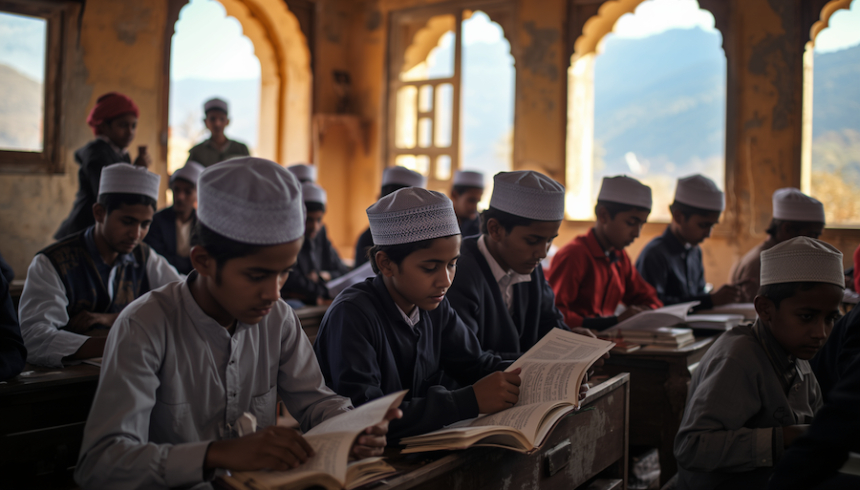
When the train stopped at Katni railway station in Madhya Pradesh, 163 young children from Bihar’s Araria district had no idea that their journey in search of education was about to take an unexpected turn. Railway police and child welfare officials removed them from the train on suspicion of human trafficking. The suspicion was later found to be unfounded, but the incident left the children with a fear that is likely to stay with them for a long time.
For these children, this was more than a legal intervention. It was their first direct encounter with the state and its institutions, and instead of inspiring trust, it left them frightened.
Muhammad Furqan, one of the children, remembers that day vividly. “The police took us off the train as if we were dangerous criminals,” he says. “They started asking us, ‘Are you a terrorist?’ We told them we were going to study the Quran, but they kept threatening us. We were so scared that we thought we would never be able to return home. Now my father won’t let me travel again. I’ll study near our village instead. What if something happens to me outside?”
Furqan’s story is not an isolated one. Thousands of children from Bihar who leave home to pursue religious or secular education in other states begin their journeys with the same fear and uncertainty.
Fifteen-year-old Muhammad Tasleem (name changed), from Pandol village in Bihar’s Madhubani district, is one of them. He was traveling to Uttar Pradesh to continue his education. His words reflect not only the fear of travel but also the deep sense of identity-based anxiety that many Muslim children experience today.
“We are afraid to wear kurta-pyjamas,” he says. “We had heard about a Maulana who was beaten on a train and thrown off. Whenever we travel, we are afraid that people will think we are criminals.”
After a brief silence, he asked a question that no official report is likely to answer.
“Why do people hate us so much?”
The experiences of Furqan and Tasleem are not isolated cases. A research report by Scroll points to a broader pattern. According to the report, 375 children were removed from trains in nine separate incidents this year alone on suspicion of human trafficking. In eight of those cases, all of the children were Muslim, and in seven they were traveling to madrasas. Subsequent investigations by the police and child welfare committees in Madhya Pradesh, Odisha, and Karnataka found no evidence of human trafficking in any of these cases.
On April 27, Ashish Ranjan of Jan Jagran Shakti Sangathan, an organization based in Araria, alleged at a press conference that Muslim children traveling to madrasas were being systematically targeted. Muhammad Zakir, the head of Darul Uloom Imamia in Bidar, along with officials from other madrasas, said that police investigations found no evidence of forced labor or any other wrongdoing. According to them, the most lasting impact of these actions has been the fear they have instilled in parents and children, while also deepening public suspicion toward madrasa education.
This raises a larger question: Why are so many children from Bihar’s poorer districts compelled to travel hundreds of miles to other states in search of an education?
When Leaving Home for Education Becomes a Necessity
If fear and uncertainty have become part of these children’s journeys, an earlier question must first be answered: Why do children from poor families in Araria, Kishanganj, Purnea, and the wider Seemanchal region of Bihar travel hundreds of miles to states such as Maharashtra and Karnataka in search of an education?
According to Akhtarul Iman, chairman of the Minority Welfare Committee of the Bihar Legislative Assembly and an MLA from AIMIM, there are two main reasons. “Our children leave the state for only two reasons,” he says. “First, extreme poverty, and second, the lack of quality educational institutions close to home. Nearly 90 percent of the children who travel to other states come from extremely poor families.”
At first glance, this may seem surprising. Bihar has one of the largest networks of Urdu-medium schools and madrasas in India. According to a 2015 report by the Milli Gazette, of the country’s 28,276 Urdu-medium schools, 3,624 are in Bihar, including 2,597 government-run schools.
Similarly, according to the latest figures compiled by educationist Maulana Abul Kalam Qasmi Shamsi, Bihar has a total of 6,409 madrasas. Of these, 2,822 are independent (privately run), while 3,587 are affiliated with the Bihar State Madrasa Education Board. The affiliated institutions include 1,128 older madrasas and 2,459 categorized as modern madrasas.
According to Mufti Sana-ul-Huda Qasmi, general secretary (Nazim) of the Federation of Islamic Schools of Bihar, only about 2,000 of these institutions receive government funding. The more pressing challenge, he says, is faced by the madrasas that have official government recognition but receive no financial support.
“There are 1,646 such madrasas,” Mufti Sana-ul-Huda Qasmi says. “At the centenary meeting organized by Saleem Pervaiz, the government promised that grants would be extended to all of them and that a formal announcement would be made. But Chief Minister Nitish Kumar made no such announcement. The meeting ended in a major uproar, and government representatives had to leave the stage.”
According to him, only about 600 of the 1,646 madrasas were later able to submit their files to the state secretariat. Even those cases did not move forward, with officials citing administrative hurdles and the election code of conduct. In his view, the issue is not only a lack of financial resources but also one of political priorities.
Despite repeated changes in government and shifting political alliances in Bihar, no major political party has presented a clear plan in its election manifesto to improve the financial condition of these madrasas or place them on a sustainable footing.
The consequences are felt most sharply by poor families, whose options for quality residential education close to home remain limited. Many are compelled to send their children to schools in other states. Along the way, what begins as a search for education can become a journey marked by suspicion, interrogation, and, in some cases, detention by law enforcement agencies.
From Legal Autonomy to Bureaucratic Control
Recent incidents alone do not fully explain the current state of madrasas in Bihar. They are also rooted in a series of legal and administrative changes over the past several years that have gradually reshaped the governance of the madrasa system.
Historically, madrasas in Bihar enjoyed a significant degree of autonomy in managing their internal affairs. This tradition continued after the establishment of Madrasa Islamia Shamsul Huda in 1912 and the creation of the Madrasa Examination Board in 1922. In 1981, the formation of the Bihar State Madrasa Education Board gave additional legal protection to the autonomy of minority educational institutions under Articles 29 and 30 of India’s Constitution.
Around the same period, the prominent Islamic scholar Qazi Mujahidul Islam Qasmi opposed proposals to nationalize madrasas. He argued that these institutions had been built through community support and charitable endowments, and that placing their administration directly under government control would undermine their fundamental character.
Over time, however, the administrative framework began to change. Media reports and several controversial sting operations involving a small number of madrasas in districts bordering Nepal, particularly Sitamarhi, Muzaffarpur, and Araria, led to growing demands for tighter government oversight. In this context, litigation concerning madrasas in Sitamarhi reached the courts, resulting in an order for the physical inspection of 1,637 madrasas.
A few months later, on April 22, 2022, the Bihar government issued Notifications No. 395 and 396. These transferred several key powers, including those related to the formation of madrasa governing bodies and the appointment of teachers, from the Bihar State Madrasa Education Board to District Education Officers (DEOs) and the Education Department’s online administrative system.
Speaking at his residence in Patna, Maulana Abul Kalam Qasmi expressed concern over these changes.
“Affiliated madrasas are minority educational institutions,” he said. “Under the 1981 Act, the Madrasa Board had the authority to frame its own rules. When that authority is transferred to the Education Department, institutional autonomy is affected. The district residency requirement and a recruitment process based solely on examination marks also reduce our ability to appoint the most suitable teachers.”
He added that several practical issues surrounding the recruitment of teachers for modern academic subjects remain unresolved.
“The curriculum has expanded continuously, but there has been no clear plan to increase the number of teachers.”
These administrative changes were later formalized through the Bihar State Madrasa Education Board (Amendment) Act, 2024. The legislation gives the government the authority, under certain circumstances, to dissolve the board and place its administration under a government-appointed administrator. It also revises the eligibility criteria for the board’s chairperson.
The impact of these decisions was not confined to policy documents. During my field reporting in Darbhanga, I met a science teacher at a government-run madrasa. He asked not to be identified, fearing it could affect his job. After a long conversation, he said:
“We live with a constant sense of uncertainty. We never know when another government order will be issued. We have seen what happened in Assam and Uttarakhand. Our fear is that the same thing could happen in Bihar at any time. We teach science and try to give our students a better future, but we ourselves feel uncertain about our own.”
The unease on his face was unmistakable. His concerns were not unique. Similar feelings surfaced repeatedly in conversations with madrasa administrators and teachers across different districts. The legal and administrative changes remain the subject of public debate, but on the ground, their most visible effect has been an atmosphere of uncertainty.
Transparency Claims, Questions on the Ground
Recently, Bihar’s Education Minister, Mithilesh Kumar Tiwari, announced a physical audit of all government-aided madrasas and Sanskrit schools in the state. The government says the exercise is intended to improve transparency, identify fraudulent institutions, and ensure that public funds are being used properly. But visits to madrasas across several districts after the announcement revealed a more complex picture.
The principal of a madrasa in a village in Darbhanga district, who spoke on condition of anonymity, said he did not see the audit as merely an administrative exercise.
“Two years ago, newly recognized madrasas and those in the 1,228 category were also audited. Many officials came at that time. Some of the madrasa administrators I spoke to said they were asked to pay large sums of money during the inspections. Some paid one lakh rupees, others two lakh. Now another audit is beginning, even though the government already has the previous report.”
It was not possible to independently verify these allegations.
After a brief pause, he pointed toward the madrasa building and continued: “The government provides no financial assistance beyond teachers’ salaries. We bought the land ourselves, built the school ourselves, and even pay for repairs. When a new inspection begins every few years under these circumstances, it is only natural that people become anxious.”
Although his allegations could not be independently confirmed, one theme emerged consistently in conversations with madrasa administrators across different districts: the inspection process has deepened a sense of uncertainty among school administrators and teachers alike. That anxiety extends beyond the inspections themselves.
The principal of another madrasa in Darbhanga, who also requested anonymity, said that teaching vacancies have remained unfilled for years, while decision-making within the Bihar State Madrasa Education Board has been slow. “Some madrasas are on the verge of shutting down simply because they no longer have enough teachers,” he said.
The shortage of teachers is reflected not only in such accounts but also in what can be observed on the ground. During visits and conversations with local residents at the government-run Madrasa Islahiya Namnagar Nabtolia in Darbhanga, it emerged that six sanctioned teaching positions have remained vacant for several years. According to residents, no new recruitment process has been initiated during that time. Although students attend classes every day, several subjects have no permanent teachers, directly affecting the quality of education.
This is an issue that madrasa administrators raised repeatedly. They argue that if the goal is genuinely to improve educational standards, then filling vacant teaching posts, strengthening basic infrastructure, and addressing financial constraints are just as important as conducting inspections. In their view, inspections alone cannot strengthen the education system unless its underlying problems are addressed at the same time.
Sanskrit Schools and Madrasas: Two Systems, Two Experiences
A key criticism raised by madrasa administrators and opposition parties is that, although the government says it is inspecting both madrasas and Sanskrit schools, the two systems do not appear to be treated equally.
This perception is shaped not only by official statements but also by recent administrative decisions. The Education Department has decided to relocate the office of the Bihar Sanskrit Education Board to the Intermediate Council building in Patna. It has also announced plans to recruit more teachers to address staffing shortages in Sanskrit schools. According to government officials, a new Standard Operating Procedure (SOP) for these appointments is expected to be finalized by July 2026.
Madrasa administrators say they have seen no comparable progress. During field reporting in parts of Darbhanga, Madhubani, and the Seemanchal region, the heads of several madrasas repeated the same concern: teaching vacancies have remained unfilled for years, yet inspections and administrative reviews continue without any meaningful effort to address the shortage of teachers.
On June 11, 2026, after meeting a delegation of Sanskrit teachers, Bihar’s Education Minister, Mithilesh Kumar Tiwari, directed the Education Department to conduct audits of Sanskrit institutions in accordance with the 1976 and 1993 regulations so that, in his words, they would not face “injustice.”
People associated with madrasas point to this decision as evidence of what they see as unequal treatment. “If the government can rely on the older rules to support Sanskrit schools, then the same principle should apply to madrasas,” one madrasa administrator said. “Our objection is not to the audits themselves, but to what we see as different standards.”
The government rejects these allegations. It maintains that the physical audit is a standard process for all government-aided educational institutions and that its sole purpose is to ensure transparency.
However, conversations with stakeholders across different districts suggest a growing sense of distrust among those associated with madrasas. They argue that when long-standing problems such as teacher shortages, financial constraints, and inadequate infrastructure remain unresolved, while institutions continue to face repeated scrutiny, it becomes difficult to view these administrative actions as routine oversight alone.
Government Policy, Opposition Criticism, and a Long-Running Crisis
The Bihar government says that its inspections of madrasas and Sanskrit schools are intended to improve educational standards and bring greater transparency to the system. Opposition leaders, however, dispute that explanation. Rashtriya Janata Dal (RJD) Member of the Legislative Council Qari Sohaib and Maulana Anisur Rehman Qasmi, working president of the All India Milli Council, argue that the campaign has disproportionately affected madrasas. According to them, including Sanskrit schools in the inspection process may create an appearance of balance, but the reality on the ground is different.
Akhtarul Iman, a member of the Bihar Legislative Assembly, said in a detailed interview that the current situation cannot be understood solely through the recent inspection campaign. In his view, it reflects the cumulative impact of government policies over many years.
“There has been no meaningful revival of the madrasa system since 2022,” he said. “Many institutions are struggling with severe teacher shortages, and in some places education has been seriously affected. The facilities available to teachers and students in regular government schools are not available in madrasas. From salaries to basic administrative support, the gap is evident.”
He also challenged the government’s characterization of madrasa education.
“It is incorrect to suggest that madrasas are disconnected from modern education,” he said. “Many have been teaching contemporary subjects for years. The real problem is that the government has never provided the resources needed to strengthen this system. Most of the children studying in these institutions come from poor families. If the state provided the same basic facilities and support that it gives to its regular schools, these children would benefit.”
However, Akhtarul Iman does not place the blame on the government alone. According to him, wherever local communities have supported these institutions, madrasas have continued to function well. “Madrasa Siddiquia Dagroh is an example of this. Even today, a large number of boys and girls study there in a residential setting. If both society and the government fulfill their responsibilities, the number of such institutions can increase.”
Referring to proceedings in the Bihar Legislative Assembly, he raises another question. “We asked several questions about madrasas in the Assembly, but the answers never became part of the public record. If the government has nothing to hide, why is this information being kept from the public?” This question is not only political but also one of administrative transparency.
During the past few weeks of reporting, I spoke to people across Araria, Darbhanga, Madhubani, and the Seemanchal region. Their concerns differed, but one feeling was almost universal: uncertainty. Some parents were anxious about sending their children to another state for education. Some teachers were worried about the security of their jobs. Madrasa administrators spoke of financial constraints, while others pointed to long-standing teacher vacancies.
All of these concerns are important in their own right. But perhaps the most fundamental question is the one asked by a young student who was taken off a train at Katni railway station: “Why do people hate us so much?”
The answer to that question cannot be found in any single police action, government order, or political statement. It is intertwined with the educational journeys of these children, state policy, institutional trust, and broader societal attitudes.
Perhaps that is why the story of Bihar’s madrasas is not just a story about madrasa education. It is also the story of why, when a child from one of the state’s most vulnerable communities leaves home in search of an education, the journey is accompanied by more fear than books.
The reporting for the story was supported by a grant from the Human Rights and Religious Freedom Journalism Grant Program.