

Walking along the unpaved roads of Sarisav Pahi village in Bihar’s Madhubani district, one would not immediately realize that the name of a local resident has frequently appeared in national and local media headlines over the past three months. While life in the village appears to be proceeding as usual, the mere mention of the particular household I had come to find causes many people to fall silent. Some avoid the conversation altogether, while others simply walk away. Even an educated individual I attempted to speak with chose to remain silent and refused to engage further. Nevertheless, after making inquiries, I eventually managed to locate the house.
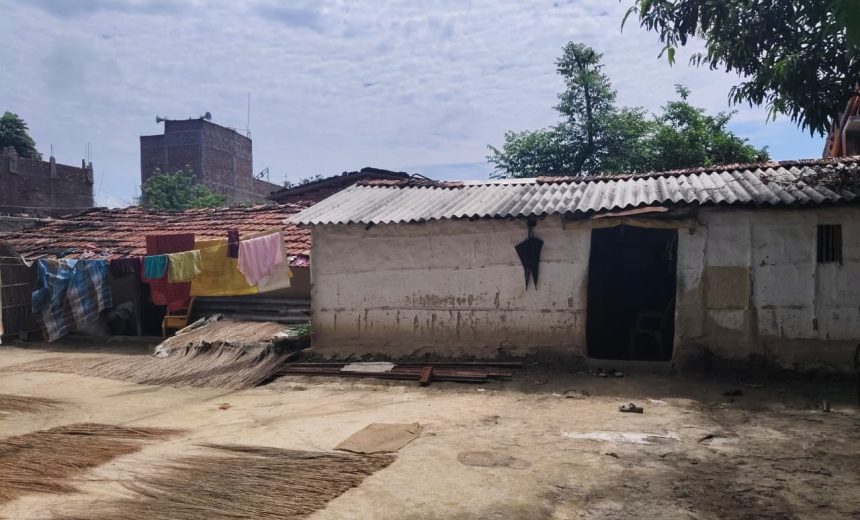
This is the home of 56-year-old Izhar-ul-Haq (Maulana Izhar), who was arrested during a joint operation by the Anti-Terrorism Squads (ATS) of Madhya Pradesh and Bihar on the night of June 14–15. The house is in a dilapidated state, featuring mud walls, a roof made of asbestos sheets and clay tiles, and a lack of basic amenities. Its condition reflects the financial hardships of a family that has been plunged into even greater distress following the arrest; the atmosphere of poverty inside is palpable. However, it must be noted that the condition of this house should not be viewed as evidence either refuting or confirming the allegations leveled against Maulana Izhar.
Numerous media reports labeled him an “anti-national” or a “traitor,” even though no crime has yet been proven against him in court. A particularly troubling aspect of this media coverage was that hardly any reporter attempted to present the perspective of Maulana Izhar’s family or anyone from his neighborhood to the public. In this context, the key questions for me were, What have the police or investigative agencies publicly stated regarding Maulana Izhar so far? How does his family view these allegations? And how have the repercussions of this case affected the lives of the people in this Madhubani household and the surrounding community?
It is worth noting that, according to locals, Maulana Izhar had gone to attend a wedding ceremony in the Bhowara area, about 17 kilometers from the village, that night; afterwards, he visited the nearby Madrasa Noor-e-Mohammadiya in Urdu Mohalla, from where he was taken into custody by the ATS (Anti-Terrorism Squad).
What Does the Family Say?
According to the family, at around 3:30 in the morning, around 50 people arrived at the house in Sarisav Pahi village. Some of them were in police uniforms, while the rest were in plain clothes. All of them were men, with only one female police constable stationed outside the house gate. There were only women in the house at that time. Firoza Khatun, the Maulana’s wife, recalls that night, saying, “We were sleeping. Suddenly, there was a loud knock on the door, as if someone was going to break it. My niece went and opened the door. We asked, ‘We are women. Who are you, and why are you entering the house?’ They said, ‘Step aside.’”
According to her, the officials asked about a rack in the house and took some papers from there. After that, the drums containing rice and wheat were also searched including the chicken coops.
Firoza Khatun says, “The women of the house repeatedly asked the officials what the matter was, but they were not told any details. We have no knowledge of what they found during this search or what documents they took from our house.”
When and how did the family learn of the Maulana’s arrest? The account given by Maulana Izhar’s 26-year-old son, Umar Farooq, presents a different picture. At the time, Umar Farooq was residing with his family at the madrasa, an institution established by Maulana Izhar himself.
Umar Farooq recounts receiving a call from his mother around 4 PM, informing him that their home had been raided; the police were searching for his father and rummaging through the entire house. Upon hearing this, he rushed home immediately, but the officers had already left by the time he arrived. He began searching for his father everywhere but could not find him. A child from the Bhowara area mentioned that some men dressed in trousers and shirts had taken him away. Umar Farooq adds, “At 7 AM, I went to the local police station with some people, but we could not get any information there either.”
It should be noted here that, on the same day, June 15, the Bihar ATS issued a press release in this case, stating that the Anti-Terrorism Squad (ATS), along with the Madhya Pradesh Anti-Terrorism Squad (MPATS), arrested Maulana Izhar-ul-Haq in a joint operation based on information related to anti-national and radical activities. According to the press release, the action was taken during the investigation of a case registered under Section 152 of the Bharatiya Nyaya Sanhita (BNS) and Sections 13(1)(b) and 18 of the Unlawful Activities (Prevention) Act, 1967 (UAPA), in STF Police Station Case No. 06/2026 of Madhya Pradesh, dated June 12, 2026.
In fact, according to media reports, three arrests had been made in the same case before the arrest of Maulana Izhar. Initially, Muhammad Faraz, alias Khalid Saifullah (35), was detained from Qazi Camp in Bhopal. Naeem Abdullah Qureshi (38) from Saharanpur in Uttar Pradesh and Muhammad Shakir Mayo (34) from Alwar, near the Rajasthan-Haryana border, were arrested after he was interrogated. The fourth arrest was that of Maulana Izhar.
The Bihar ATS press release also states that, “Preliminary investigation and available technical evidence revealed that the accused was allegedly in touch with a Pakistani handler. During the joint raid, two Android mobile phones (Redmi Note 5 and Oppo) were recovered from the possession of the accused. The recovered mobile phones and other digital evidence are being scrutinized, and detailed investigation of the case is underway.” However, neither the police nor the investigating agency has publicly stated the basis of the alleged Pakistani link. Neither have the family members of Maulana Izhar been given a copy of the FIR.
However, the nature of the reports circulating in the media struck fear into the hearts of the entire family and the village community. Certain national and local media outlets, citing investigative sources, made even more serious allegations. These included claims regarding contacts with individuals in various states, plans for overseas training, the establishment of a Caliphate, the concept of “Ghazwa-e-Hind,” online groups, and the alleged recruitment of youths into a network.
A report by The New Indian Express on June 18, citing investigative sources, claimed that Maulana Izhar was accused of helping youths obtain passports and facilitating their travel to Pakistan via Nepal. The same report, citing police sources, also mentioned the presence of specific content on mobile phones and the forensic analysis of digital evidence. It must be noted, however, that the veracity of these claims can only be determined through evidence presented during the investigation and subsequent judicial proceedings.
Maulana Izhar’s family categorically rejects all these allegations. According to his son, Umar Farooq, his father had been teaching the Quran and Hadith for nearly three decades and had established a madrasa in Madhubani to provide education to local children. Describing his father as a gentle soul, Umar Farooq says, “My father is an extremely kind-hearted and well-mannered man. He has never harmed anyone. He used to share in the joys and sorrows not only of Muslims but also of our Hindu neighbors.” He also questions the technical proficiency attributed to his father, stating, “My father doesn’t even know how to properly operate a smartphone.”
Media reports have also mentioned Maulana Izhar’s travels to various states. Regarding this, Umar Farooq states that his father runs a madrasa and used to travel to different states during the month of Ramadan to collect donations for it. If these journeys are considered significant to the investigation, then details such as dates, locations, the purpose of the travel, and relevant records could prove crucial in understanding the matter.
The Impact of the Arrest
The repercussions of Maulana Izhar’s arrest have extended far beyond the individual himself. According to his son, Umar Farooq, he used to serve as an imam at a mosque but was removed from the position following the arrest. Another brother, who taught at a madrasa, was also dismissed from his job. “For nearly three months now, we have been sitting at home unemployed, struggling even to put food on the table,” says Umar. The family is now grappling with economic and social hardships alongside the ongoing legal proceedings.
When I attempted to speak with some locals about this matter, they agreed to talk only on the condition of anonymity. One individual remarked, “Look, we are Muslims. If, tomorrow, they were to send us to jail on some trumped-up charge, there is nothing I could do about it.” This statement highlights another facet of the situation, an arrest can instill fear not only in the accused’s family but also among the surrounding community.
However, while a more open dialogue with the locals was necessary to fully grasp the nature and extent of this fear, the villagers flatly refused to discuss the matter. Standing amidst the village’s quiet lanes, a dilapidated house, and an unemployed family, the most pressing question arises; when a person faces grave allegations such as terrorism, who determines their social punishment before a court verdict is even reached, and should the family also have to bear the burden of such accusations?
The Charge Sheet Has Yet to Be Filed
To understand the legal status of this entire matter, this reporter spoke to Syed Javed Akhtar, Secretary of the Association for the Protection of Civil Rights (APCR), Madhya Pradesh, an organization monitoring the case. He explains, “In Maulana Izhar’s case, the investigating agency has secured an extension of the remand period upon the completion of three months. Until the charge sheet is filed, the defense lawyer will not even know what the actual allegations are.”
It should be noted here that, unlike ordinary cases, the investigating agency has 90 days to file a charge sheet in UAPA cases; however, Section 43D(2) of the UAPA allows the investigation period to be extended from 90 to 180 days if certain conditions are met.
In any case, on one side, there are allegations by the ATS regarding foreign handlers and conspiracies against the state, claims that the media highlights daily. On the other side, there is a modest, unplastered house, an unemployed son, and a family that dismisses these allegations. While the judicial process will ultimately determine the veracity and legal standing of the charges against Maulana Izhar, a journalistic responsibility remains; not to treat investigative claims as proven facts, nor to view the family’s denials as definitive proof of innocence, but rather to present the questions arising from both sides exactly as they stand. Yet, journalists do not appear to be fulfilling this responsibility in their reporting. In this home in Sarisav Pahi, the most prominent elements right now are not definitive answers, but questions; the true story of this case will likely only be complete once the answers to these questions emerge.