

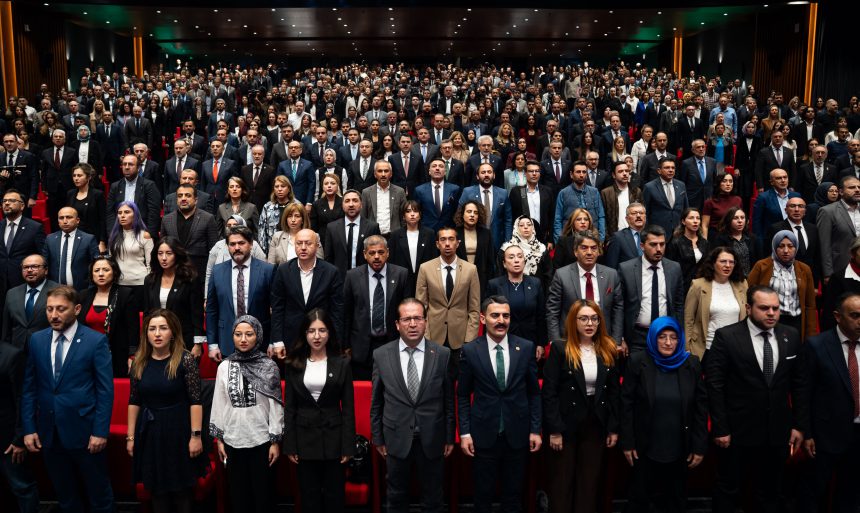
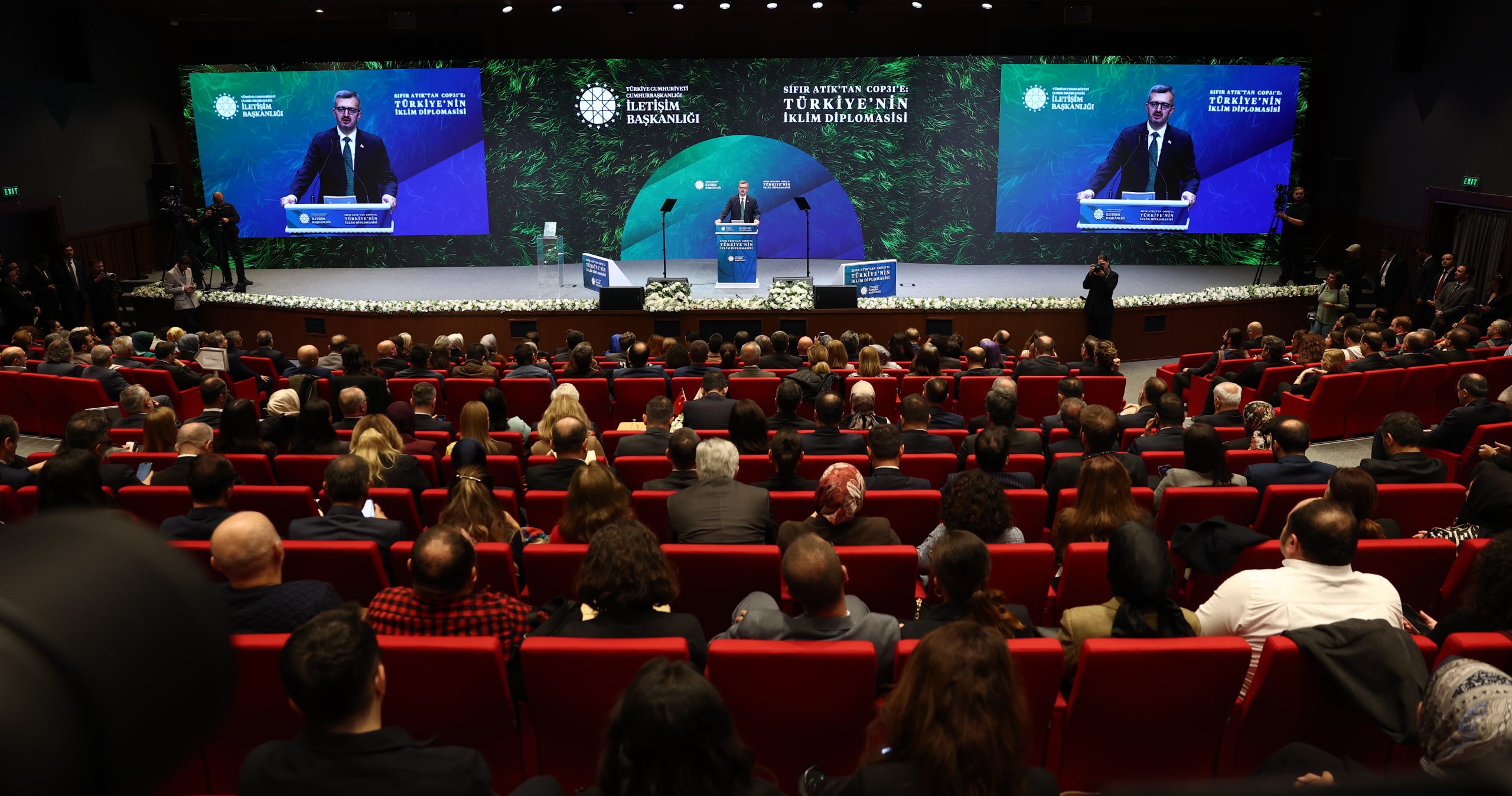
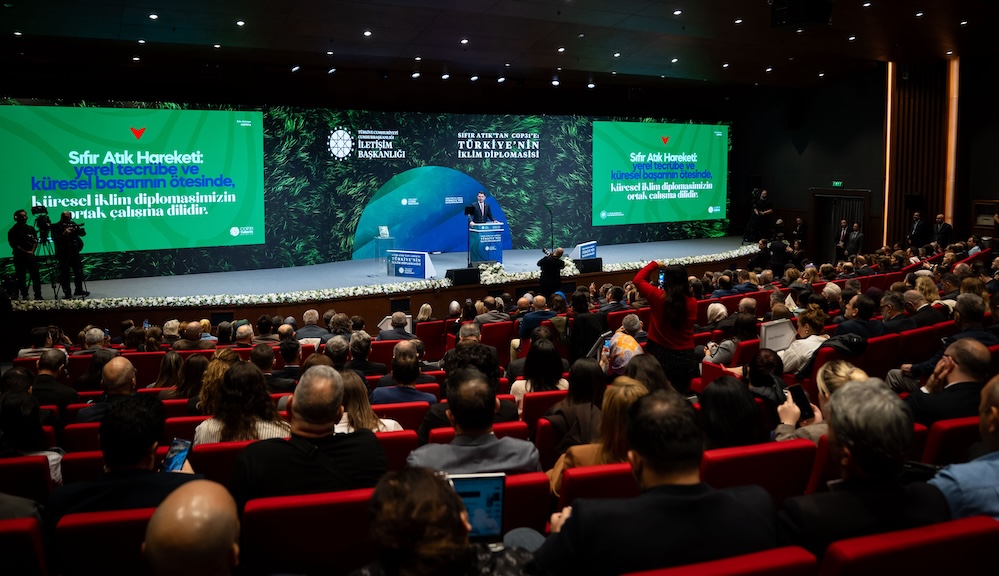
October 27. The auditorium at the Directorate of Communications of the Turkish Presidency in Ankara is packed. Not a single seat is empty, and I have to stand at the back of the hall to follow the proceedings.
On stage, Burhanettin Duran, head of the Directorate of Communications, is delivering an address. The hall is silent. Everyone is listening intently. A few minutes later, a man gets up and leaves his seat. I seize the opportunity and immediately take his place. From here, I can listen more closely and get a better sense of the atmosphere in the room.
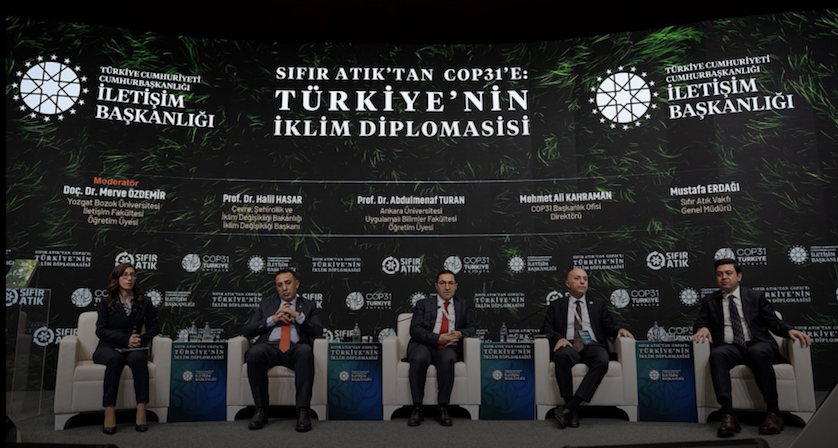
Following the Climate Finance Conference in Istanbul, this was my second event in Türkiye related to the upcoming UN Climate Change Conference, COP31. The panel was titled “From Zero Waste to COP31: Türkiye’s Environmental Diplomacy.”
I had not come merely to listen to a speech. I wanted to understand what message Türkiye, the host of the upcoming UN climate conference, intends to convey to the world. More importantly, beyond promises, how much room is there for concrete action and tangible results?
As I listened to the discussion, one question kept coming back to my mind: What is the real value of pledges to address the climate crisis if they do not translate into action?
The question was particularly relevant because the discussion went beyond waste and pollution to address the war in Gaza and its environmental consequences. This brought attention to an aspect of the environment that is often treated in isolation. War, human life, environmental destruction, and international politics are deeply interconnected. None can be fully understood without considering the others.
Gaza’s Climate Cost
Duran said climate change recognizes no borders and that no single country can tackle the crisis alone. Addressing it requires global cooperation, effective policies, and a balance between the rights and responsibilities of nations. Social justice, he emphasized, must not be overlooked.
Referring to Gaza, he noted that wars do not merely claim human lives; they also devastate the environment. The impact of Israeli attacks extends beyond the loss of life and the destruction of infrastructure. Carbon emissions generated by the conflict further aggravate the climate crisis.
Duran asserted that carbon emissions resulting from Israeli attacks on Gaza since October 7 exceed the annual emissions of hundreds of individual countries. This raises a fundamental question: Are the environmental consequences of war being adequately incorporated into the global climate debate?
Protecting human lives during wartime is undoubtedly the immediate priority. But the long-term consequences, including destroyed buildings, mountains of debris, damaged water and sanitation systems, and depleted natural resources, can persist for generations. The burden may fall not only on those living through the conflict today but also on generations to come.
If climate justice means sharing responsibility and prioritizing the protection of human life, then restoring environments devastated by war must also be part of the conversation. This is not simply a concern for war-torn regions. It is a matter of global environmental responsibility.
Duran described COP31 as an important opportunity for Türkiye to present its environmental vision to the international community. He said the conference would emphasize rebuilding trust, strengthening global cooperation, and turning commitments into tangible results.
Yet the significance of a global conference cannot be measured by its declarations alone. What changed after those declarations? How many goals were achieved? And who ultimately benefited from the initiatives they set in motion? The answers lie not in speeches, but in what happens afterward.
From Waste Targets to Measurable Results
Meanwhile, Murat Kurum, Türkiye’s minister of environment, urbanization, and climate change and president of COP31, took the stage. This was the second time I had heard him speak. This time, I was particularly interested in understanding the concrete goals Türkiye is setting as part of its environmental ambitions.
Kurum said Türkiye aims to halve the projected global increase in municipal waste generation by 2035. He also emphasized the importance of reusing resources and strengthening international cooperation to address climate change.
This target requires greater clarity about its precise scope, baseline year, and measurement methodology. Reducing the current volume of waste, slowing the growth of waste generation, and halving the projected increase are three distinct objectives. Understanding these differences is essential to assessing the practical significance of any environmental commitment.
Listening to Kurum, I was reminded of India, where waste management goes far beyond urban cleanliness. It is closely linked to public health, urban planning, water resources, and social justice. Piles of garbage, polluted water bodies, and settlements near landfills are all part of the problem. But the burden is not shared equally. Poor and vulnerable communities often pay the highest price.
The success of waste management, therefore, cannot be measured solely by the amount of waste collected or the number of cleanup drives conducted. It is also necessary to examine how much waste generation has been reduced, how effectively reusable materials are being recovered, and whether pollution-related burdens on vulnerable communities have eased. These are the benchmarks against which any country’s environmental ambitions should be assessed. Announcing a policy is only the beginning. It does not prove that the policy has succeeded.
Referring to global conflicts, political tensions, and economic uncertainty, Kurum said the climate crisis had become a serious threat to the future of humanity and the natural world. One of his key points was that while political and economic crises can be overcome, some damage to nature is irreversible.
This was more than a rhetorical flourish. It pointed to a fundamental reality. Political landscapes can change, wars can end, and economies can recover. But the consequences of environmental destruction can persist for years, sometimes even generations. The cost of delaying climate action, therefore, may be borne not only by people today but also by those who come after them.
Kurum linked Türkiye’s message for COP31 to the need for implementation. Climate commitments, he said, must be translated into investments, international partnerships, and concrete action.
This is where the real test of any environmental policy begins. Are the goals clearly defined? Are the necessary resources available to achieve them? Have measurable indicators been established to track progress? And will governments be held accountable for failures as well as successes?
Without answers to these questions, ambitious targets may sound impressive, but their practical significance remains difficult to assess.
Understanding Türkiye’s environmental efforts also requires looking at its Zero Waste initiative, launched under the leadership of First Lady Emine Erdoğan. The initiative focuses on reducing waste, preventing the wasteful use of resources, and promoting the reuse of materials.
Although the concept may appear to concern everyday habits, its implications extend to government policy, industrial production, and urban planning. Waste disposal is important, but it is equally, if not more, important to examine how much waste is generated in the first place and how that volume can be reduced.
Ultimately, the success of any initiative cannot be measured by its popularity or the awareness it generates alone. It must be judged by its actual impact on waste volumes, resource reuse, and environmental pressures. Efforts to promote the Zero Waste concept around the world must be assessed by the same standard: not just the promises made, but the results achieved.
From Commitments to Action
When the tea break was announced, I stepped out of the auditorium. A crowd had gathered, eager to get a new book on environmental diplomacy, written in Turkish. I chose not to join them. The language barrier was a stark reminder of the distance between me and the world around me.
Soon, people began returning to the auditorium. The two main guests from the opening session had left, and a panel discussion was about to begin. I was particularly interested in how the panelists would translate the aspirations expressed in the earlier speeches into concrete policies and practical measures.
The panel featured Halil Hisar, director of the Climate Change Department at the Ministry of Environment, Urbanization and Climate Change; Professor Abdulmenaf Turan of Ankara University; Mehmet Ali Kahraman, director of the COP31 Presidency Office; and Mustafa Ardağı, director general of the Zero Waste Foundation. The discussion was moderated by Merve Özdemir, an associate professor at Yozgat University.
The discussion focused on the Zero Waste initiative, climate change, and Türkiye’s role in environmental diplomacy. Speakers addressed preparations for the conference, international cooperation, long-term goals, and the practical steps needed to achieve them.
Halil Hisar noted that negotiations to host COP31 had begun three and a half years earlier. He emphasized that COP should not be viewed as a single event, but as an ongoing process involving discussions about countries’ development plans and the decisions that shape them. Professor Abdulmenaf Turan highlighted Türkiye’s goal of achieving net-zero greenhouse gas emissions by 2053 and the climate legislation adopted in 2025.
Mehmet Ali Kahraman discussed the proposed COP31 action plan, explaining that its aim was to strengthen cooperation and coordination among countries. He said its 10 key areas, including food security, agriculture, clean energy, and environmentally friendly industrial development, could be incorporated into the national strategies of both developed and developing countries.
Mustafa Ardağı stressed the importance of promoting the Zero Waste initiative internationally and encouraging countries to adopt its practices. He pointed out that the climate conference process does not begin and end with a few weeks of meetings. It requires long-term preparation, concrete action, and continuous evaluation of results.
A common theme ran through these discussions: international cooperation and practical measures are essential to addressing the climate crisis. Yet the statements also raised further questions. What immediate steps will Türkiye take to achieve its long-term goals? How will progress be measured? And will the government’s performance be judged against the results?
Whether the goal is net-zero emissions by 2053 or halving the projected increase in waste by 2035, the seriousness of these commitments can be assessed only if they are backed by clear milestones, measurable outcomes, and accountability. Setting a target does not guarantee that it will be achieved.
The same applies to environmental diplomacy. International agreements and negotiations matter, but their ultimate purpose is to bring about changes that are visible in national policies and in the lives of ordinary people. It is also essential to ask who benefits from environmental initiatives and who bears their costs.
The environmental crisis is often treated as a problem for the future. Yet its effects are already being felt in people’s lives. Clean air, safe water, a healthy environment, and secure livelihoods are not needs that can be postponed to some distant future. They are fundamental requirements of life today.
The success of environmental diplomacy, therefore, should not be measured solely by the number of countries that agree to a joint declaration. What matters is whether those decisions reduce pollution, improve resource efficiency, and protect the people most severely affected by environmental degradation.
The discussions in Ankara brought one critical question back into focus: How can the gap between global climate commitments and tangible results be bridged?
COP31 will give Türkiye an opportunity to advance its environmental vision and diplomacy. But the real significance of that opportunity will not be determined by the conference itself. It will depend on what is achieved afterward.
Ultimately, promising to save the planet is one thing; ensuring that it remains habitable is another. Future generations may not ask how many countries attended a particular conference or how many speeches were delivered. They will want to know something more fundamental: When we understood that the Earth’s climate was changing and the risks to human life were growing, what did we do with that knowledge?
The climate crisis demands that we ask ourselves a different question. What matters now is not simply what we know, but what we do with what we know.