

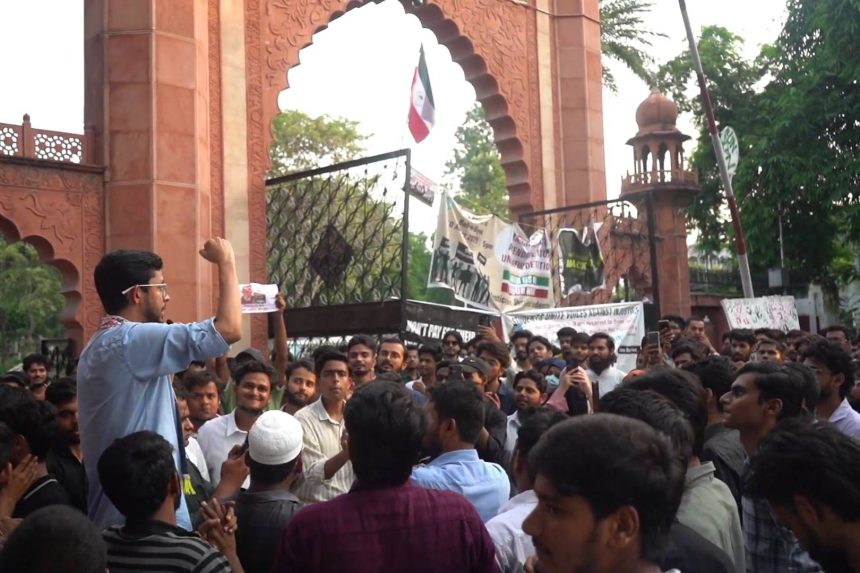
The recent agitation against the exorbitant fee hike at Aligarh Muslim University (AMU) reflects a deeper crisis in higher education policy that undermines the principle of affordable education in India, particularly for the underprivileged sections of society. However, this protest has also attracted criticisms regarding its nature and maneuverings. Some argue that it is fueled by anti-administration lobbies within the campus, while others view it as an arena for power struggles among certain faculty members who are filled with obvious longing for lucrative administrative posts.
Amidst all these debates, a troubling and misleading narrative has emerged on social media. A research scholar from AMU’s Department of History has attempted to associate the ongoing agitation and even previous campus protests as an inherent assertion of a “Muslim right-wing” ideology and its dominance on campus.
The fundamental flaw in this narrative lies in its generalization. It takes isolated cues from a handful of individuals and projects them onto the entire AMU student body. The author bases his allegations on three questionable points: the issue of Friday prayers, a statement from an obscure alumnus, and a speech by a speaker representing a religious student organization that holds negligible influence on campus. While critiquing fringe elements is both welcome and necessary but exaggerating their presence and impact distorts reality and reflects serving either preconceived notions, biases, or provocations.
One of the most misplaced analogies in the write-up is the comparison between Friday prayers at AMU and Bal Gangadhar Tilak’s use of Hindu festivals as tools of political mobilization. This juxtaposition is historically flawed. Tilak’s strategy moved beyond the issue of simple festivity, which led to his branding of being communal. He is believed to have deliberately infused communal undertones into public festivities, often excluding Muslims. For example, provocative songs were sung during these festivals, such as: “What boon Allah has conferred upon you, that you have become Muslims today? Do not be friendly to a religion which is alien, do not give up your religion, and be fallen.” Moreover, he also timed the Ganpati festival to coincide with Muharram, clearly to foment communal discord.
In contrast, Friday prayers are neither a festival nor a political performance but a mere religious obligation, which is a common and prevalent part of the majority campus culture of Indian universities across the nation, irrespective of religion. More importantly, Friday prayers have not been part of the ongoing AMU protests. When a small group of students attempted to organize prayers at the protest site, they were met with police action, triggering outrage at the denial of their right to pray on campus. Presently, students are offering prayers quietly in a university guest house, and notably, they rejected calls from fringe groups to organize prayers on August 15 to prevent the protest from acquiring a religious overtone. Historically, too, Friday prayers at AMU protests have never excluded non-Muslim students; instead, non-Muslim peers have often stood in solidarity, shielding their fellow students during prayers to demonstrate solidarity.
The article further highlights a slogan raised by a member of the Students’ Islamic Organisation (SIO): “Islam Ki Dawat Zinda Hai”. However, it remains unclear what the author perceives by this slogan. Although communal provocation wherever they occurs should certainly be condemned, and the fringe presence of the right wing on campus cannot be denied altogether. But it is inaccurate to attribute stray statements made by individuals who are not even a bonafide students of the university to the collective intent of an entire student body. Protests are rarely choreographed events; without a student union in place, accountability for isolated slogans cannot be generalized across the whole movement.
The author also ignores an important distinction that a mere manifestation of religious identity or general religiosity cannot be conflated with an entire protest being “Islamic,” “fundamentalist,” or “right-wing. One would have expected from a budding historian to contextualize the agitation within AMU’s institutional and contemporary realities, recognizing that AMU has historically nurtured diverse ideological currents. Instead, the attempt seems to reduce a complex issue into a simplistic and misleading narrative that echoes familiar tropes invoked whenever Muslim institutions or issues come under scrutiny.
Like the followers of Islam themselves, AMU’s student community is not a monolithic bloc. It is made up of disparate, diverse, and differentiated groups. Ignoring these nuances by projecting stray incidents onto the entire community risks two dangerous consequences: first, it undermines the legitimacy of genuine protests against unjust policies; and second, it fuels both majority communalism which seeks to delegitimize Muslim identities and minority communalism, which thrives on fossilization and mobilization as a result of imprinting a cohesive identity to varied thought process among Muslims. What is needed is not the flattening of diversity into stereotypes but an acknowledgment of complexity. To caricature an entire student movement through the actions of a few is to deny AMU’s pluralist legacy and, more importantly, to obscure the central issue at stake—the right to affordable education for all.
Dr. Ishtiaq Hussain is an alumnus of AMU’s Department of History, and is currently serving as an assistant professor at the Department of History, Aliah University, Kolkata. He can be contacted at ishtiaqzargar01@gmail.com