


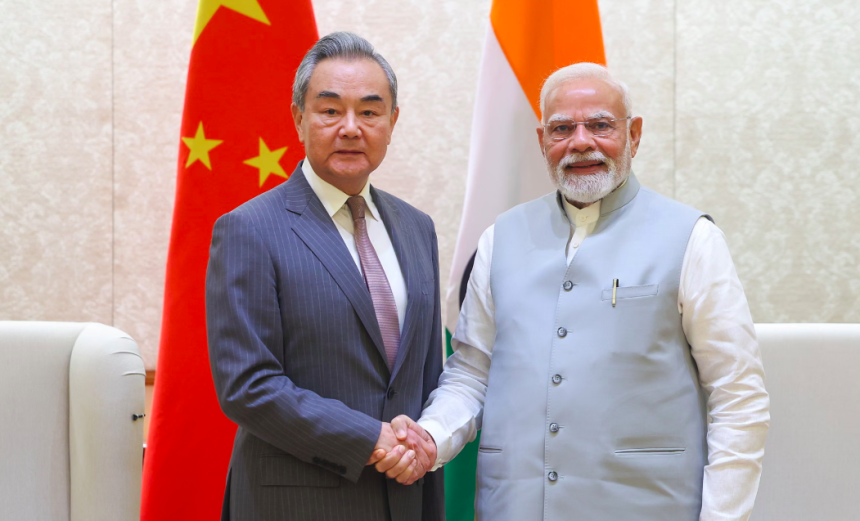
When India and China shake hands, it is never just a simple gesture. There is always history in the room, memories of war, missed opportunities, and moments of uneasy partnership. Yet there is also the reality that nearly one in three people on Earth lives across their borders, and what these two countries choose to do, fight, compete, or cooperate, shapes not just Asia but the world.
This week, China’s Foreign Minister Wang Yi arrived in New Delhi, 18–20 August 2025, for the 24th round of border talks, among the world’s longest-running negotiations. His visit comes at a moment of global flux: U.S.–India ties face turbulence after President Trump’s 50% tariffs on Indian exports, while New Delhi and Beijing cautiously test the waters of rapprochement. Some even speculate that Prime Minister Narendra Modi may travel to China later this month for the Shanghai Cooperation Organisation (SCO) summit, his first visit in seven years.
A Relationship of Highs and Lows
Since 1950, ties have swung between promise and disappointment. The optimism of Panchsheel in the 1950s collapsed with the 1962 war, leaving scars that still shape mistrust. Rajiv Gandhi’s 1988 Beijing visit reopened doors, while Vajpayee’s 2003 trip and the 2005 Strategic Partnership Agreement created a more stable footing.
The Xi–Modi years have been especially contradictory: informal summits at Wuhan (2018) and Mamallapuram (2019) raised hopes, but Doklam (2017) and Galwan (2020) reminded both sides how fragile peace remains. Today, trade crosses $118 billion annually, yet their troops still face off in Ladakh. It is a relationship both deeply interdependent and deeply contested.
Where Cooperation Still Makes Sense
1. Economic Interdependence: Trade is the backbone. According to the Global Trade Research Initiative, India–China trade reached $118.4 billion in 2023–24, making China India’s largest partner. As ORF’s Samir Saran put it: “There is no way you can be a $10 trillion economy without a substantial trading relationship with China.”
Calls for “decoupling” remain politically popular but practically limited. A better strategy is “de-risking”, building supply chain resilience without cutting ties altogether.
2. Resuming Connectivity: Direct flights are back, select border crossings have reopened, and high-level defence and foreign ministry dialogues have restarted. After years of near-freeze, these modest steps signal both sides want to manage differences, if not resolve them.
3. Multilateral Engagements: Despite rivalry, India and China often converge in BRICS, the SCO, and the G20. Both push for reform of global governance, especially to amplify the Global South’s voice. On climate change, energy transition, and supply chains, cooperation is not just possible—it is necessary. Economist Jeffrey Sachs has even suggested India revisit joining the Regional Comprehensive Economic Partnership (RCEP) to diversify trade links.
Where Friction Persists
1. Trade Imbalance: According to India’s Ministry of Commerce and Industry, the trade deficit with China reached a record $99.2 billion in FY 2024–25, driven by imports of electronics, batteries, and solar cells. Exports, meanwhile, fell 14.5%. This asymmetry leaves India dependent and strategically vulnerable.
2. Border Dispute: The Ladakh and Arunachal sectors remain flashpoints. The October 2024 patrolling accord in Depsang and Demchok was a tactical step forward, but large troop deployments show how thin trust remains.
3. Competing Geopolitical Visions: Beijing’s expanding influence in South Asia and the Indian Ocean fuels Indian fears of encirclement, while China views India’s closeness with the U.S. and the Quad as containment. These competing leadership claims keep relations brittle.
Bridging the Divide: Small Steps, Real Impact
India and China don’t need sweeping declarations to reset ties. What they need are practical, visible steps that build trust slowly.
Crisis hotlines between local commanders could prevent routine patrol encounters from spiraling into clashes.
Joint projects in renewable energy or public health would show citizens—not just elites—that cooperation delivers real benefits.
Student exchanges and easier visas could bring the next generation closer, creating familiarity instead of suspicion.
Expanding direct flights would reconnect people-to-people ties frozen since the pandemic.
According to recent research, public opinion in both countries is marked by deeply negative perceptions of the other, reinforcing an entrenched trust deficit. These small, visible measures cannot erase that hostility overnight, but they can begin to soften attitudes and rebuild confidence at the societal level. Former Foreign Secretary Nirupama Rao calls this “competitive coexistence”: recognizing rivalry but managing it with guardrails strong enough to prevent crisis.
Looking Ahead: 75 Years, A Choice Point
At 75 years, India–China ties stand at a crossroads. They can fall back into old cycles of suspicion or attempt to build steadier coexistence. Borders will remain contested; suspicions will not vanish. But climate action, trade stability, and a stronger Global South cannot wait for perfect trust.
The test will be whether the much-cited “three mutuals”—mutual respect, mutual sensitivity, and mutual interest—move from words to practice. If they do, India and China could show the world that even fierce rivals can cooperate when global stakes are too high to ignore.
Seventy-five years after Nehru and Zhou first exchanged ambassadors, the real question is no longer about friendship or enmity. It is whether two ancient civilisations, both rising in the 21st century, can find a way to live as neighbours without letting rivalry consume the future.
Mohammed Affan is a final-year Indian undergraduate student of Political Science and International Relations at Istanbul Sabahattin Zaim University. He completed his Erasmus program in Poland and writes on diplomacy, international relations and policies, global justice, and human rights.