

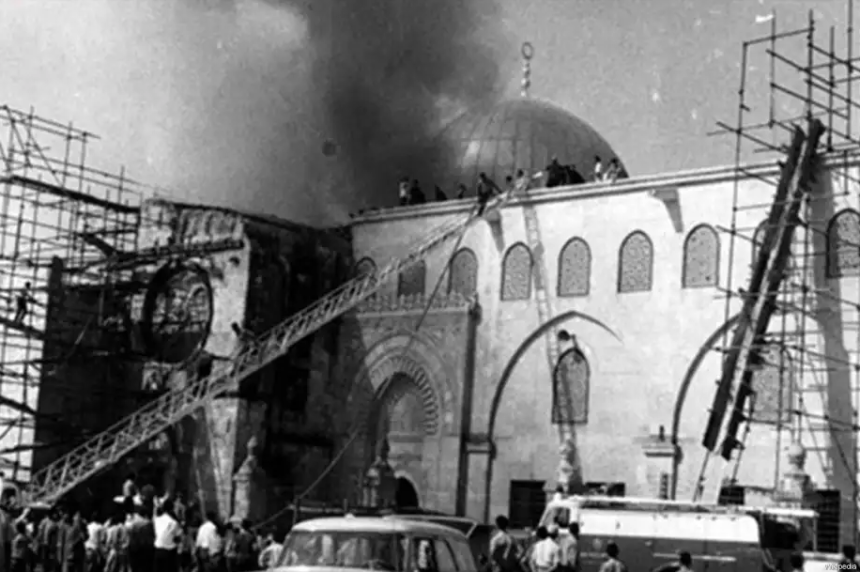
56 years ago, on August 21, 1969, a tragic fire engulfed the Al-Aqsa Mosque — the first Qibla of Muslims — sending shockwaves across the world. The Muslim community felt the deepest pain, and in India, the tragedy left a profound impact. Moved by grief and anger, Muslims across the country took to the streets. After Friday prayers in almost every major city, they were joined by justice-seeking citizens of India in widespread protests.
The situation in Kashmir escalated sharply after the Al-Aqsa Mosque fire. On August 22, 1969, during a protest against the burning of the mosque in Israeli-occupied Jerusalem, police opened fire on demonstrators in Habbakadal, a central area of the city. One protester was shot and later died in hospital from his injuries. Tensions rose so high that authorities imposed a 24-hour curfew across Srinagar.
Kashmir Chief Minister G. M. Sadiq said that anti-social elements pelted stones at government vehicles in busy areas like Lal Chowk and Budshah Chowk. The administration immediately imposed orders banning gatherings of five or more people and processions in the entire Srinagar district. On this occasion, he appealed to the people of Kashmir not to let their injured feelings be exploited by anti-social elements. He also demanded the United Nations to investigate the incident at Masjid Al-Aqsa.
Newspapers from that period reveal that protests and public statements continued for nearly two weeks after the Al-Aqsa Mosque fire. Demonstrations soon spread beyond major cities into smaller towns. In my hometown of Bettiah (West Champaran, Bihar), for instance, a procession was organized and led by my late father along with his associates, as recalled by the headmaster of my childhood school, who was also his close friend.
The fire deeply angered India’s Muslim community and sparked one of the country’s largest protest rallies against Israel. Demonstrators sought to condemn Israeli policies and called on the international community to safeguard and restore the Al-Aqsa Mosque. The Indian government, led at the time by Prime Minister Indira Gandhi, also voiced its concern over the incident.
Condemnation in India’s Parliament
On August 26, 1969, members of various political parties in the Lok Sabha (India’s lower house of Parliament) strongly condemned the partial destruction of the Al-Aqsa Mosque.
India’s Foreign Minister, Dinesh Singh, stated, “The shocking incident makes it imperative that the Security Council’s resolutions on Jerusalem should be implemented without delay. In this context, Israel cannot be absolved of responsibility for this outrage.”
He emphasized that “the Government and the people of India are deeply shocked and pained at this sacrilege of this holy shrine.” Singh further clarified that the desecration of the Al-Aqsa mosque was not merely a question involving Muslim sentiment but the sentiments of all the people.
Indira Gandhi Rejects Israel’s Intransigence
On September 9, 1970, Prime Minister Indira Gandhi addressed the Third Conference of the Non-Aligned Movement in Lusaka, Zambia. In her speech, she noted that while she had touched upon some general issues, certain explosive global situations could not be ignored.
Turning to the question of Palestine, Gandhi stated unequivocally, “We disapprove of Israel’s intransigence. Israel should be prevailed upon to comply fully with the U.N. Security Council Resolution of November 1967. We can not deny to the people of Palestine their inalienable right to the homelands from which they were exiled.”
India Deeply Saddened by the Desecration of Al-Aqsa
According to the United Nations Security Council’s annual report (July 16, 1969 – June 15, 1970), during the Council’s 1507th to 1512th sessions (September 9–15, 1969), India strongly condemned the fire at the Al-Aqsa Mosque. “The representative of India stated that the act of vandalism that had caused fire in the Aqsa Mosque had been condemned throughout the world, including his country. The Prime Minister of India had stated further that the damage to Aqsa had increased tension in the area, which could have worldwide repercussions.”
In this meeting, India clearly stated, “India, with its firm belief in secularism, had felt especially grieved at the desecration of a place of worship, and numerous and religious leaders of many faiths had expressed their profound shock. Nevertheless, it must not be believed that the question before the Council was a religious issue. Any attempt to create such a diversion would do incalculable harm and present fresh difficulties in solving the West Asian problem. India considered that the incident was a direct consequence of the illegal occupation by Israel of Jerusalem and other Arab areas. Israel thus could not be absolved of its responsibility for the incident of 21 August.”
According to a report published in The Times of India on August 12, “India asked the U.N. Security Council yesterday to take prompt measures to ensure peace in West Asia and see that the Security Council resolution of November 22, 1967, was implemented.”
India emphasized that the council not be diverted from this central issue. The Indian Ambassador, Mr. Samar Sen, denounced the attempts to turn the Aqsa affair into a “religious issue” and said this would only complicate the difficult West Asian situation.
India best suited to advance Arab cause
According to a report published in The Times of India, a public meeting of the Indo-Arab Society was held in Bombay on August 27, chaired by the Minister of Public Health, Dr. Rafiq Zakaria. In his presidential address, he said that “It was all the more shocking that the Jews, persecuted everywhere, should have perpetrated such a crime in the 20th century.” He warned, “If they do not wake up,” he warned, “they will go the way. of Hitler.” He also said that No country was better equipped than India, the land of the Buddha, Asoka, Mahavir and Gandhi, to take up the cause of the Arabs.
While expressing its deep sorrow at the burning of the Masjid-Al-Aqsa, the resolution approved the secular stand of the Government of India, “which has always stood for equal protection for all religious denominations,” and placed on record its appreciation of the sentiments expressed by over 100 M.P.s and of the statement made by the Union Minister for External Affairs, Mr. Dinesh Singh.
The burning of the mosque, the resolution stated, showed the lack of respect to all religions by the Israeli Government, which had acted contrary to all principles of humanity and justice.
Meanwhile, Mr. V.K. Krishna Menon, chairman of the All India Peace Council, and Mrs. Aruna Asaf Ali, vice-president of the Indian Association for Afro-Asian Solidarity, in a joint statement issued in New Delhi on 27 August, 1969, condemned the recent acts of vandalism against the Aqsa Mosque in Jerusalem and said Israel could not get away from its responsibility for these.
On August 23, Dr. Syedna Muhammad Burhanuddin, the head of the Dawoodi Bohra community, appealed to the Indian government to take action at both national and international levels to ensure the rightful protection and authority of the Al-Aqsa Mosque. A telegram conveying this request was also sent from Bombay to Prime Minister Indira Gandhi.
That same day, Dr. Burhanuddin led special prayers at the Badri Mahal Mosque, seeking Allah’s protection for Al-Aqsa — the first Qibla of Islam.
On September 5, the Indian Committee for the Arab Cause held a meeting at the Indian Merchants’ Chamber Hall in Bombay [Now Mumbai]. Speaking at the event, Mr. P. Mr. Venkatasubbaih, General Secretary of the All India Congress Committee and Member of Parliament, urged the Union Government should use its good offices either with the U.N. or the International Court to institute an impartial inquiry into the Al Aqsa fire. He emphasized that it been India’s tradition to condemn injustice perpetrated against any country or people.
Renowned journalist and editor Mr. R. K. Karanjia described the burning of Al-Aqsa as part of a conspiracy by imperialist powers and expressed hope that the tragedy would serve to unite the Arab world.
Widespread Protests Across India
A wave of protests and demonstrations erupted across India in response to the burning of the Al-Aqsa Mosque. Newspapers of the time documented these events extensively.
On August 26, a large public meeting of Muslims in Bombay expressed deep shock and sorrow over the desecration of the mosque and called for an international investigation into what they described as a “barbaric act.” Several speakers, many affiliated with the Congress Party, condemned the arson and affirmed that the Muslims of India stood in solidarity with Arabs to protect the sanctity of Islamic holy sites in Jerusalem.
According to The Times of India, on August 29, similar demonstrations were held in Calcutta [now Kolkata], West Bengal. Black flags were raised across Muslim neighborhoods, shops were closed, and strikes were observed in many Muslim-majority areas. Participants fasted, wore black badges or armbands, and special prayers were offered in mosques.
In the afternoon, Muslims from all parts of the city and its suburbs came in numerous processions to the Shaheed Minar (ochterlony monument) in the Maidan to attend a meeting. It is estimated that more than 100,000 Muslims attended the meeting.
A resolution requesting the Government of India to take a leading part in the U.N. to devise ways and means to implement the resolution passed by the U.N. in connection with the Arab-Israeli conflict was passed at the meeting.
Mr. Hemanta Bose, leader of the Forward Bloc, a constituent of the United Front, presided over the meeting. Among the speakers was Dr. A. M. O. Gani, a CPI member of the State Assembly.
On the same day, strikes and demonstrations took place throughout West Bengal, beyond Kolkata. The then Deputy Chief Minister of West Bengal, Jyoti Basu, told reporters that the protests in the districts remained peaceful.
Meanwhile, on August 31, 17 Muslims in Kolkata began a 48-hour hunger strike in front of the U.S. Consulate, protesting the burning of the Al-Aqsa Mosque and expressing concern over alleged U.S. complicity.
On August 28, around 300 people demonstrated in front of the Israeli Consulate in Mumbai. The protest began with a procession from Jhula Maidan, organized by the Jamiat Ulema. On the same day, Member of Parliament George Fernandes issued a statement from Mumbai, saying he had appealed to the Prime Minister to assist in the reconstruction of the Al-Aqsa Mosque.
The following day, Friday, August 29, another procession started from Jhula Maidan and culminated in a large rally at Azad Maidan, attended by thousands of people.
On August 28, the Central Action Committee of Shia Jaamat in Gujarat held a special meeting in Ahmedabad. The committee expressed “deep sorrow and outrage” over the burning of the Al-Aqsa Mosque by Israel. They passed a resolution urging the leaders of all Muslim-majority countries to take decisive action against Israel and to work toward the liberation of the Holy Land from Israeli control. The resolution also called on the United Nations to place Jerusalem under its direct supervision without delay.
On August 31, Muslims across Ahmedabad observed a citywide strike in protest against the burning of the Al-Aqsa Mosque. Shops owned by Muslims remained closed, and business activity in Muslim-majority areas came to a standstill. During a subsequent meeting, it was decided that a delegation would travel to Mumbai to stage a demonstration in front of the Israeli Consulate.
On September 5, around 500 Muslims staged a demonstration in front of the US Information Office in New Delhi to protest the burning of the Al-Aqsa Mosque in Jerusalem. Led by Metropolitan Councilor Mr. Abbas Malik, the protesters chanted slogans against the US and Israel and submitted a memorandum to the US authorities.
Israel Accused India of Supporting Anti-Israel Campaign
The widespread protests and statements in India drew a strong reaction from Israel. According to a report in The Times of India on September 2, 1969, Israel charged India with “encouraging” the conversion of religious sentiments into a political “weapon serving the Arab campaign to destroy Israel.”
In an official statement, a Foreign Ministry spokesman commented on a recent statement by India’s External Affairs Minister, Mr. Dinesh Singh, in which he held Israel responsible for the fire at the Al-Aqsa mosque.
The spokesperson noted that “by invoking U.N. resolutions to which he gave a distorted interpretation,” the Minister “directly encouraged the conversion of religious sentiments, understandably touched by the fire, into a political weapon serving the Arab campaign.”
The spokesman described the statements attributed to Mr. Singh “as deplorable as they were surprising” and said they “lend themselves to exploitation by “those who are already fanning the fires of hatred and holy war against Israel.
Turkey Visit and Joint Declaration
India continued its diplomatic efforts regarding the Palestinian issue. On September 19, a three-member delegation from Al Fatah arrived in India for a three-week mission aimed at highlighting the Palestinian cause and the struggle of the Palestinian people. The visit, organized by the Indian branch of the Afro-Asian People’s Solidarity Organization, marked the first official visit of an Al Fatah delegation to India.
Not only that, at the invitation of the Turkish Foreign Minister, Mr. İhsan Sabri Çağlayangil, the Indian Foreign Minister, Sardar Swaran Singh, made an official visit to Turkey from 2 to 5 November 1970.
Regarding the situation in the Middle East, the two Ministers expressed the hope that present efforts would lead to a speedy and peaceful solution of the crisis. They reaffirmed the necessity of the early and full implementation, including the withdrawal of Israeli forces from occupied Arab territories, of the Security Council Resolution of November 22, 1967. For the attainment of these objectives, the two Ministers stressed the need to maintain the ceasefire and to reactivate Ambassador Jarring’s Mission.
The burning of the Al-Aqsa Mosque on August 21, 1969, had a profound emotional and political impact on the Muslims of India. It strengthened the tradition of solidarity with Palestine, inspired initiatives such as World Mosque Day, and contributed to a broader Muslim awakening. Since then, India’s secular governments have consistently supported Palestinian rights. This tradition continues among the people of India; for instance, on August 22, a public demonstration was held at Jantar Mantar in New Delhi to mark the solemn occasion of Mosque Day. However, a concerning reality is that the current BJP government appears to be moving somewhat away from this longstanding tradition.
Afroz Alam Sahil is an Indian journalist and author. He can be contacted at @afrozsahil on X.