


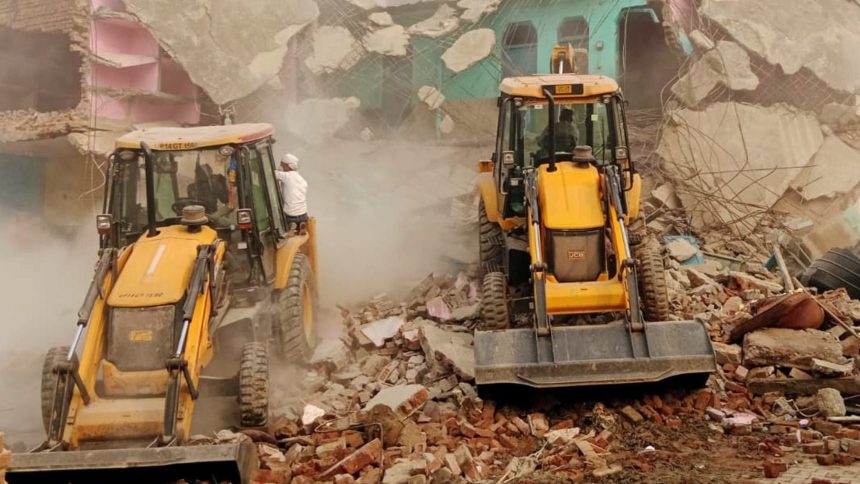
In Assam, Muslim madrassas and mosques have come under increasing government scrutiny. Between November 2023 and July 2025, many such institutions were reportedly targeted during a series of state-led eviction drives.
Assam’s Chief Minister, Himanta Biswa Sarma, has been an outspoken critic of madrassas and has often been accused of making inflammatory remarks about Muslims. In one of his statements, he said, “The word ‘madrassa’ itself should be erased, because as long as children think of madrassas, they will never become doctors or engineers.”
Ground reporting from across Assam reveals a sharp decline in the presence of Islamic educational institutions. Official figures suggest that around 130 madrassas and maktabs have been demolished so far, while all 1,281 government-run madrassas have been converted into regular public schools.
Assam’s Madrassas: History and Law
Madrassas have a long and established history in Assam. Islamic education was formally incorporated into the state’s curriculum in 1934, the same year the Assam Madrassa Board was founded. The curriculum underwent its first major revision in 1977, and in 1995, the state government granted official recognition to madrassas, categorizing them into three levels: Pre-senior (grades 6–8), Senior (grades 8–12), and Title madrassas (undergraduate and postgraduate levels).
In addition, four Arabic colleges were established, offering education from the middle-school level through to postgraduate studies.
In 2018, Assam’s then Education Minister, Himanta Biswa Sarma, restructured the state’s Madrassa Board and introduced further changes to its curriculum. But just two years later, the government took a sharp turn.
On 13 November 2020, the state cabinet decided to convert all government and state-aided madrassas into regular public schools and to remove religious subjects from their syllabi. The state assembly formally approved the move in January 2021, and on 27 January, the governor repealed both the Assam Madrassa Education Act (1995) and the Assam Madrassa Education Act (2018).
By 12 February, the Madrassa Board itself had been dissolved — a decision that effectively transformed hundreds of government-run madrassas and Arabic colleges across the state.
According to a BBC report, 1281 madrassas in Assam were reclassified as English-medium schools under a single government order. These institutions were spread across 19 districts, with the highest numbers recorded in Dhubri (269), Nagaon (165), and Barpeta (158).
Assam’s Education Minister, Ranoj Pegu, confirmed the decision on social media, while Himanta Biswa Sarma has repeatedly stated, “We have closed down 800 madrassas in Assam so far, and we are keeping an eye on the rest.”
The state government argues that public funds should not be used for religious education, noting that an estimated 30 to 40 million rupees (approximately $350,000–$460,000) were being spent annually on these institutions.
No Government-Run Madrassas Remain
There are now no government-run madrassas left in Assam. All have been converted into regular public schools. The only madrassas that continue to operate are privately funded institutions run by the Muslim community. Their total number is estimated at around 3,000.
According to various reports, 2250 private madrassas operate under seven different boards, including 1569 affiliated with the All Assam Tanzeem Madaris-e-Qawmia (Association of Community Madrassas).
In the district of Nagaon, local resident Mohammad Hood told this correspondent that the transformation of state madrassas into ordinary schools has drastically changed their curriculum.
“Earlier, these madrassas followed a structured syllabus based on Islamic studies. Now, only a partial version of the general education curriculum remains,” he said.
Hood added that following these changes, many students withdrew from government schools and enrolled in private religious institutions to continue their religious education. Another local resident noted that many maulvis who once taught in government madrassas have now lost their positions.
Maulana Ruhul Amin Qasmi, secretary of the All Assam Tanzeem Madaris-e-Qawmia, described the current situation, “There are no government madrassas left — all have been turned into schools. What remains are community-run institutions, managed and financed by Muslims themselves. These include madrassas from different Islamic schools of thought — Ahl-e-Hadith, Jamiat, Barelvi, and Nadvi — together numbering more than three thousand.”
On the question of the government’s stance toward private madrassas, Qasmi said, “At times, the government says private madrassas will continue; at other times, it insists that they must include mainstream subjects. For now, there isn’t an atmosphere of fear, but there are certainly concerns.”
He added, “Our elders had long decided that madrassas should run on the community’s funds, not on government money — and we continue to uphold that principle.”
Assam is one of the few Indian states with a significant Muslim population. Out of a total of 35 million people, roughly 40 percent — about 14 million — are Muslims. In at least nine of the state’s 31 districts, Muslims make up more than half of the population.
Eviction Drive: Figures and Impact
The Jamiat-e-Ulema Hind (Meem) General Secretary, Maulana Hakimuddin Qasmi, along with Assam’s Maulana Abdul Qadir Qasmi, provided a report detailing the total number of mosques and madrassas affected in the state. According to their account, large numbers of religious institutions were targeted during an official eviction drive in Assam between November 2023 and July 2025.
During this period, Muslim settlements across multiple districts were subjected to large-scale demolitions. Official data indicates that 11,183 families were displaced, representing a total population of 77,389 people.
The operations extended beyond homes. Mosques, madrassas, schools, Eidgahs, and graveyards were also damaged. In the two years, 48 mosques, 75 schools, 11 madrassas, 22 Eidgahs, and 15 graveyards were reported demolished or otherwise affected.
The largest crackdowns occurred in Goalpara, Dhubri, and Golaghat districts, where thousands of families were evicted and dozens of religious institutions destroyed. Hundreds of additional families were affected in Nalbari and Vishwanath, with their associated mosques and madrassas demolished. Reports indicate that most targeted institutions were located in Muslim-majority areas, particularly settlements of Bengali Muslims. Some locals allege that the demolitions were discriminatory, noting that settlements of other communities were largely left untouched.
Chief Minister Himanta Biswa Sarma officially confirmed that 4,449 bighas of land belonging to mosques, schools, and madrassas have been cleared across the state. He described the operations as part of a campaign against what he termed “land jihad.”
A New Struggle for Identity
The removal of government recognition for madrassas in Assam marks a reversal of a long-standing historical tradition. What began with their inclusion in the state curriculum, followed by official recognition and curriculum reforms, has now culminated in the abolition of formal religious education through legislation. Today, 1281 former madrassas are classified as “Middle English Schools,” although locals report that the quality of education in many of these institutions remains poor.
The de-recognition of madrassas in Assam is more than an educational policy shift. It reflects a deeper, ongoing social and political debate, where religion, politics, and identity intersect in increasingly complex ways.
Over the past two years, evictions and demolitions have unfolded as a systematic campaign, displacing thousands of families and inflicting severe damage on both their religious and social identity. The developments raise pressing questions about the future of Assam’s Muslim community and the protection of their fundamental rights.