


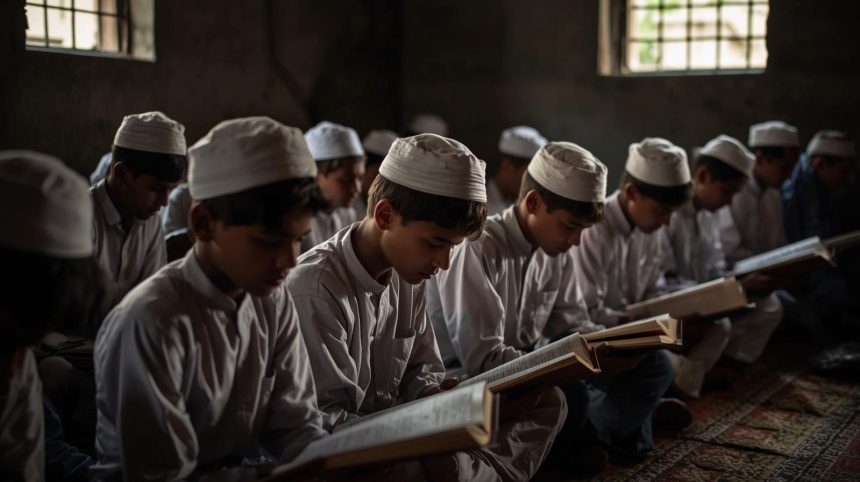
Government crackdowns on madrassas in Uttar Pradesh, Uttarakhand, and Assam have sparked nationwide debate in India. But the situation in Bihar stands in stark contrast. Here, there are no demolitions, no closures, and no laws directly targeting madrassas. They remain open, and classes continue — yet a quiet crisis is unfolding within. This decline is not marked by protest or politics, but by a slow, almost invisible erosion. It stems from a mix of government neglect, financial hardship, and administrative interference that is gradually hollowing out the system from within.
A Century-Old but Fragile System
Nearly 4,000 madrassas operate under the Bihar State Madrasa Education Board, serving around 800,000 students and employing some 15,000 teachers. With a legacy spanning over a century, the system appears well-organized on the surface. In reality, however, deep cracks have begun to show. Funding has stalled, teachers face uncertainty over salaries, and unaided institutions are struggling for survival.
The Board was established in 1922 and gained legal recognition under the 1981 Act. When it marked its centenary, the government celebrated the achievements of the madrasa system in a grand ceremony. Yet, after the celebrations ended, the ground reality remained unchanged: the Board still operates from a rented building on Vidyapati Marg in Patna, while the construction of its permanent headquarters—budgeted at ₹9 crore—has been stalled for years. It stands as a symbol of a system that is undeniably historic, yet still unable to stand firmly on its own feet.
Aid Stopped, System Frozen
Bihar is one of the few Indian states with a vast network of Urdu-medium schools and madrasas. According to a 2015 Milli Gazette report, India had 28,276 Urdu-medium schools, of which 3,624 were in Bihar. Among these, 2,597 were government-run. The Bihar State Madrasa Education Board oversees 3,588 affiliated madrasas, and 1,942 of them receive government aid.
According to Mufti Sana-ul-Huda Qasmi, the head (Nazim) of the Wafaq Madaris Islamia Bihar, this number has since grown to around 2,200. But, as he puts it, “the crisis begins where the aid ends.”
He explains, “There are about 1,646 madrasas that have been recognized by the government but do not receive any grants. When Bihar Madrasa Education Board Chairman Dr. Saleem Parvez organized a ‘Centenary Meeting,’ he announced that all these madrasas would soon be approved for funding. But Chief Minister Nitish Kumar made no such announcement, and Dr. Parvez was unable to follow through. The meeting turned chaotic — officials walked out, followed by Parvez and others leaving the stage. Out of these 1,600 institutions, the documents of 600 have been sent to the secretariat, but no action has been taken. Authorities say the election code of conduct is in effect, yet nothing has changed. And realistically, there seems little hope — neither the NDA nor the Grand Alliance has included any commitments for madrasas in their election manifestos.”
Administrative Interference and a Blow to Autonomy
A climate of official silence has cast uncertainty over the future of Bihar’s madrassas. While religious education has a nominal place in government policy, it receives little real respect or support. Promised funding remains unfulfilled, and recent administrative moves have further eroded the system’s autonomy.
According to Mufti Sana-ul-Huda Qasmi, “The greatest challenge facing Bihar’s madrassas today is that the government has issued three new notifications. These have changed the management councils, appointments, and teaching structures in ways that have not only weakened but nearly erased their minority character.”
These notifications function as internal regulations that have stripped madrassas of their administrative independence. Authority over hiring, transfers, and approvals has been centralized under departmental offices. There may be no explicit “black law,” but an intricate web of bureaucracy has been spun—one that is steadily constraining the spirit of the madrassa system from within.
Internal Corruption and Government Indifference
A teacher and principal associated with the Bihar Madrasa Education Board, speaking on condition of anonymity, said that the collapse of the system stems largely from the government’s careless interference. According to them, chairpersons are often appointed for political reasons rather than educational merit, prioritizing proximity to power over academic reform. “The current chairman is busy with elections and treats Nitish Kumar like a god,” the teacher said. “Before him, the board had no chairman for three and a half years, during which all files remained pending.”
The principal added that around fifty madrasas have no teachers and remain closed, while many others operate with only two or three teachers, where six to eight are required. “The government provides facilities to schools, but nothing to madrasas,” he said. “As a result, parents are increasingly sending their children to regular schools.”
The teacher further alleged that corruption has become institutionalized within the system. “Inspections by the Madrasa Board or government occur two to four times a year,” he said. “Even when reports are in order, officials must be paid ₹1.5 to ₹2 lakh. Financial corruption and bribery are routine, adding to teachers’ mental stress and diverting their focus from education.”
He concluded that meaningful reform is only possible if the board’s leadership is both honest and academically competent—but, under the current structure, that hope remains slim.
Protests and Demands
In September of the same year, teachers and non-teaching staff under the banner of the Madrasa Development Organization (MDO) held demonstrations across several districts of Bihar — including Kishanganj, Madhubani, and Sitamarhi — to press for long-standing demands. The protests came after years of government neglect, with participants accusing authorities of ignoring their grievances and pushing thousands of families into financial distress.
The protesters called for amendments to the Madrasa Rules 2022 to grant minority status to all government-aided madrasas in the state, a move they said would restore both autonomy and transparency. They also demanded salary revisions, annual increments, medical and housing allowances, pension provisions, and the release of pending dues.
According to the protesters, audit reports from 1,637 madrasas have already been submitted to the board, yet payments remain withheld. They further alleged that newly appointed JIT teachers, as well as Huffaz and science instructors in 1,128 madrasas, earn salaries lower than those of office attendants — a stark reflection of the system’s decline.
MDO Sitamarhi spokesperson Muhammad Munazirul Islam told BeyondHeadlines, “There has been no progress on most of the demands we presented to the government. There have been discussions, but no action. Political parties don’t even mention madrasas in their manifestos. In Bihar, pressure is being increased on madrasas not through law but through silent policy measures. This threat extends beyond government-aided institutions to private ones as well. Many private madrasas are still unregistered, which could allow the government to exploit the situation. We are demanding an amendment to the Madrasa Rules and minority status for aided madrasas. A case is pending in court, but all proceedings have stalled since the election code of conduct came into effect.”
Educational Quality Crisis
A severe shortage of qualified teachers and confusion over classification have deeply affected the quality of education in Bihar’s madrassas. Mufti Sana-ul-Huda Qasmi explains, “Each madrasa up to the Maulvi level is allotted only three teaching positions — one for a Hafiz (Qur’an teacher) and two for general instruction — along with three non-teaching staff, including a clerk and two peons. Now, if someone who has completed an Aalim or Fazil degree wants to teach at the nursery level, they must accept a downgrade in their grade and salary. Many of the teachers currently serving in affiliated madrasas are only Huffaz (memorization specialists). Naturally, how can educational standards improve when there are no qualified subject teachers?”
He adds that the system is becoming increasingly distorted, “A new trend has emerged — divisions like Maulvi Arts, Maulvi Commerce, and Maulvi Science are being introduced. But with new departments come new teaching needs. No one has considered increasing the number of teachers accordingly. It’s as if the system is expanding on paper while shrinking in quality.”
Silent Decline
The state of Bihar’s madrassas is no longer merely a story of educational decline, but a reflection of administrative apathy and political indifference. The system still stands, yet its foundations are crumbling from within. The buildings remain, but the spirit of learning inside them is fading. Financial strain, a deteriorating curriculum, and chronic government neglect have turned the once-vibrant network into a half-living institution — surviving, but barely.
This crisis did not arrive with bulldozers or new laws. It has grown quietly, through years of silent policy, inaction, and institutional decay. If this trajectory continues, Bihar’s century-old madrasa system could face the same quiet collapse witnessed elsewhere — stability on the surface, but disintegration beneath.
As Bihar approaches elections, the question has never been more urgent: will education — particularly the madrasa system that shapes the futures of thousands of underprivileged Muslim children — finally find a place in the state’s political agenda? Or will this decline continue, silently and unseen, in the years to come?