

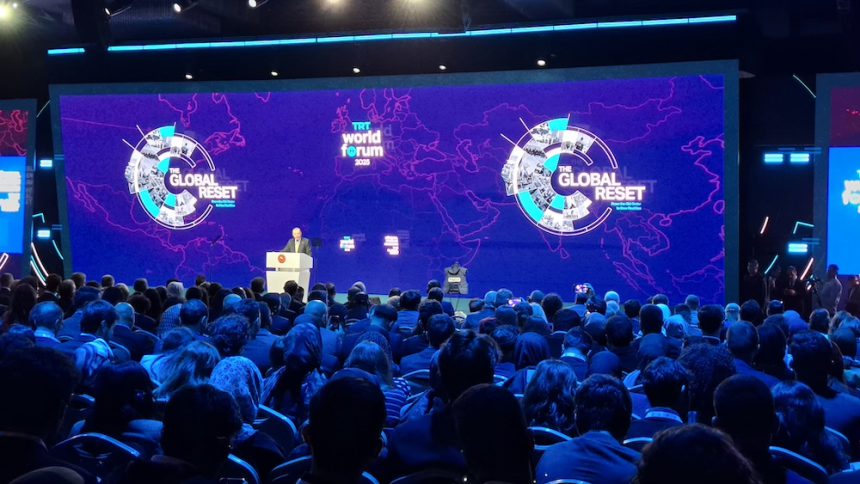
October 31, 2025 – Istanbul: At the Hilton Istanbul Bomonti Hotel’s conference hall in the Şişli district, every seat was already taken when I arrived at the scheduled time. The room was packed, leaving little space to move. It was clear that the crowd at the TRT World Forum had grown larger with each passing year. This was the forum’s ninth edition, held under the theme: “The Global Reset: From the Old Order to New Realities.”
The organizers kept announcing that anyone without a seat should go to the M1 Hall upstairs, where the event was being broadcast live on a big screen. For a moment, I thought I might have to head up there myself. But then I wondered—what would be the point of watching it on a screen upstairs? You could just as easily stream it on your phone from anywhere.
I was still deciding what to do when a woman offered me her seat and motioned for me to sit down. Perhaps she thought I was a foreign guest, or maybe it was simply an act of Turkish hospitality. I gratefully accepted and told her that I, too, lived in Istanbul.
Meanwhile, it was announced that the President of Türkiye, Recep Tayyip Erdoğan, would be visiting the hall as the forum’s special guest of honor. The announcement had barely ended when the entire audience rose to their feet—young and old, men and women alike, all faces turned in the same direction. Scenes of President Erdoğan’s arrival began to play on the screen, but my mind was focused elsewhere: Will this forum, organized by a media organization, acknowledge the journalists who were martyred in Gaza? The question kept echoing in my thoughts.
At that moment, the screen showed that President Erdoğan had inaugurated the installation “3,925 Lost Futures” by Norwegian artist Vibeke Harper inside the hotel—an artwork created to honor the Palestinian youth who lost their lives in Israeli attacks. A profound silence fell over the hall, as if everyone had collectively held their breath.
A few moments later, President Erdoğan entered the hall. As he walked toward the stage, the audience erupted into thunderous applause—a powerful mixture of respect, devotion, and hope.
The opening session officially began with speeches by TRT Director General Mehmet Zahid Sobaci and Türkiye’s Head of Communications, Burhanettin Duran. As I listened, a thought crossed my mind: Have the brave journalists of Gaza been forgotten? Would this gathering be complete without acknowledging their sacrifices?
But as soon as Burhanettin Duran concluded, the lights in the hall dimmed and a short video appeared on the screen—brief, yet powerful enough to transform the entire atmosphere. It paid tribute to the journalists in Gaza who lost their lives simply for reporting the truth. As the names Anas Jamal al-Sharif, Maryam Abu Daqqa, Ashraf Shannon, Yahya Barzaq, and others appeared on the screen, a heavy silence enveloped the hall. In that moment, the meaning of journalism, its sacrifices, and the price of truth came together in a profound, almost tangible way.
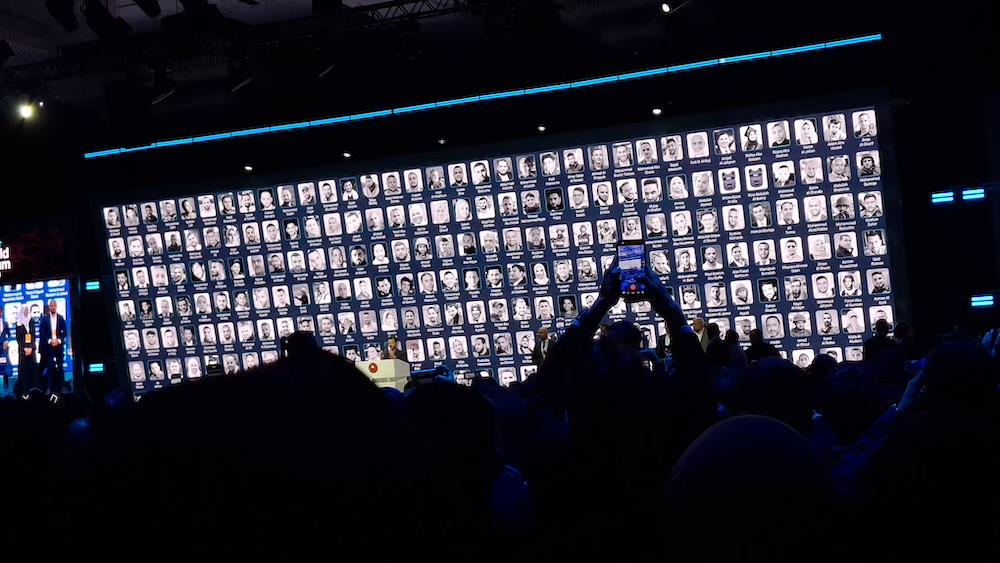
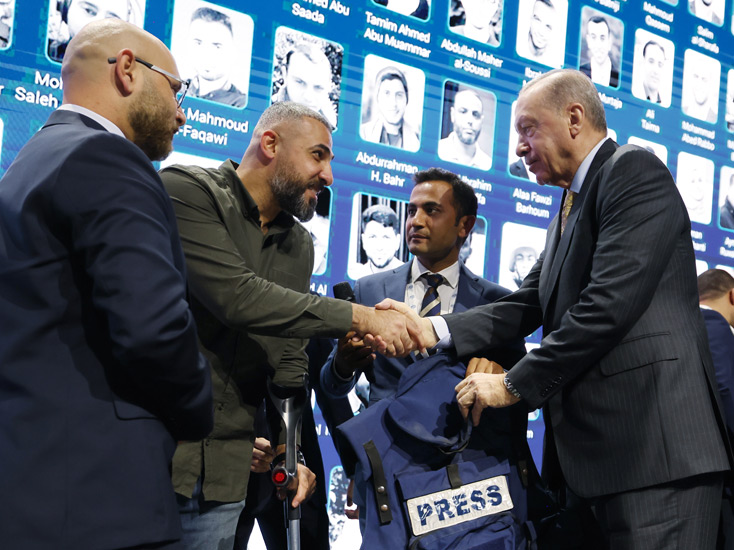
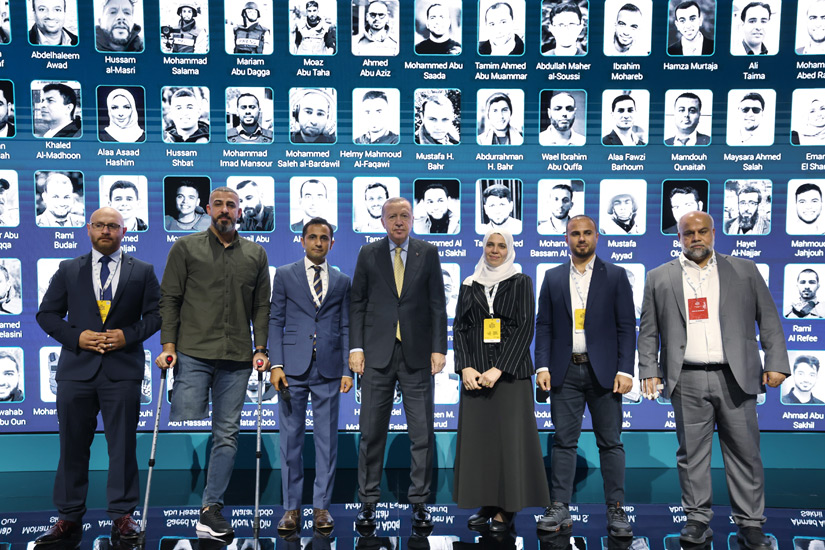
After the video, images of journalists who had been martyred in Gaza were displayed on the stage. President Erdoğan was now present as well, and six journalists from Gaza, in a symbolic gesture, presented him with their press jackets to honor the memory of their martyred colleagues. The act underscored the courage and dedication of journalists reporting under war and extreme conditions.
Erdoğan paid tribute to these journalists, and once again, everyone in the hall stood in respect. The journalists from Gaza included Sami Shehada, Sami Barhoum, Wael Al-Dahdouh, Mahmoud Nizar Al-Saadawi, Mücahit Aydemir, and a courageous female journalist whose name I was unable to remember.
Following this, President Erdoğan delivered his keynote speech. He honored journalists who had “given their lives to tell the truth” and sharply criticized the international community’s silence regarding Israel’s actions in Gaza.
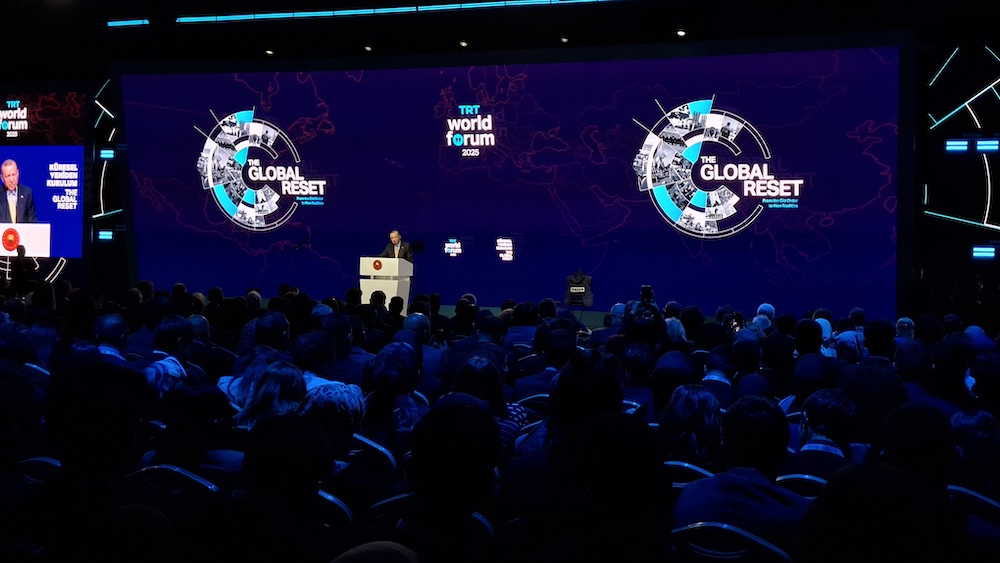
During his speech, President Erdoğan also criticized the international media, including outlets that had established camps in Istanbul during the Gezi events, saying that they had “failed miserably” on the issue of Gaza. He emphasized that, aside from a few courageous journalists and a handful of media organizations, few had tried to convey the voice of Gaza’s oppressed to the world. Erdoğan expressed confidence that, even if delayed, the international journalistic community would one day hold this failure accountable.
He went further, stressing the importance of exposing the true identities of embedded journalists who, he said, use their pens, cameras, screens, and columns to conceal the genocide in Gaza—a matter critical to media credibility. Throughout his speech, he honored the journalists martyred in Israeli attacks, stating that 270 journalists who risked their lives to report the truth had been killed. Palestinian journalists had lost not only their lives but also their children and families. One colleague recounted surviving while his wife and children were killed, and many others had lost parents in the same attacks.
President Erdoğan lamented that these atrocities continued, yet the institutions tasked with maintaining international peace and stability had neither taken steps to stop the massacres nor made serious efforts to end the violence or protect the lives of children.
In his speech, President Erdoğan singled out the martyred TRT photojournalist Yahya Barzaq — a young reporter who kept his camera running even amid the bombing. His final frame, Erdoğan said, captured smoke rising over Gaza’s sky; Barzaq himself vanished into that smoke. Erdoğan’s voice was heavy but steady as he explained that Barzaq was killed in an Israeli airstrike while documenting the war’s effects in the Deir al‑Balah area of central Gaza; an attack struck the café where he was filming. “His sacrifice reminds us that journalism is not just a profession, but a moral duty,” Erdoğan said. “God willing, on the Day of Judgment, the collective conscience of humanity will keep alive the memory of Yahya Barzaq and the other 270 journalists who were martyred, and, in light of the evidence they gathered at the cost of their lives, the perpetrators of these crimes will be held accountable before the law.”
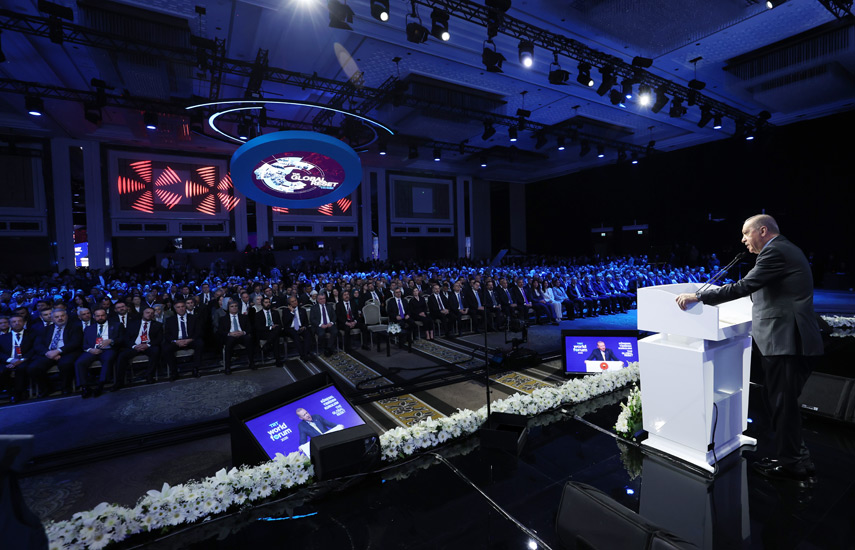
President Erdoğan went on to say, “Türkiye is ready to put not just its hand but its whole being into the mission of helping Gaza recover. We have never abandoned our Palestinian brothers — yesterday, today, or tomorrow. We will continue to support a two‑state solution. The recent decisions by many countries to recognize Palestine are of great importance. I call on those nations that have not yet done so to recognize the Palestinian state without further delay.”
He also referenced the crisis in Sudan, saying he was sure attendees had seen the horrific images coming from the country. “No person with a conscience can accept the massacre of civilians in Al-Fashir (El Fasher), North Darfur, or remain silent about it,” he said. “As Türkiye, we strongly condemn, in the strongest terms, the atrocities committed against civilians in the city of El Fasher. The attacks carried out in El Fasher and its surrounding must be brought to an end, and the atrocities against innocent civilians must stop immediately. We are ready to do sincerely whatever our brotherly bonds necessitate on this issue. Our only wish is that the infighting stops and innocent children, women, and civilians are not killed.”
Sudan’s mention was something that I had not expected, but was happy to hear because I knew very well that bringing such a critical issue to an international stage from a position of authority can truly make a difference. I wish that more journalists would cover the crisis in Sudan and bring the issue to the public.
Thus ended the opening session of the TRT World Forum 2025. But for me, as a journalist, it was more than the close of an event — it was a moment of reflection, a lesson, and a commitment. My only wish was to meet Sami Shehada—and, fortunately, that wish came true. My only regret was that I wasn’t able to get his contact information. In speaking with him, I was glad to learn that Momen Faiz is his friend. Yet the tragedy of it all struck me deeply: journalists like them cannot even feel safe in their own bodies. Some have lost limbs, others face constant danger.
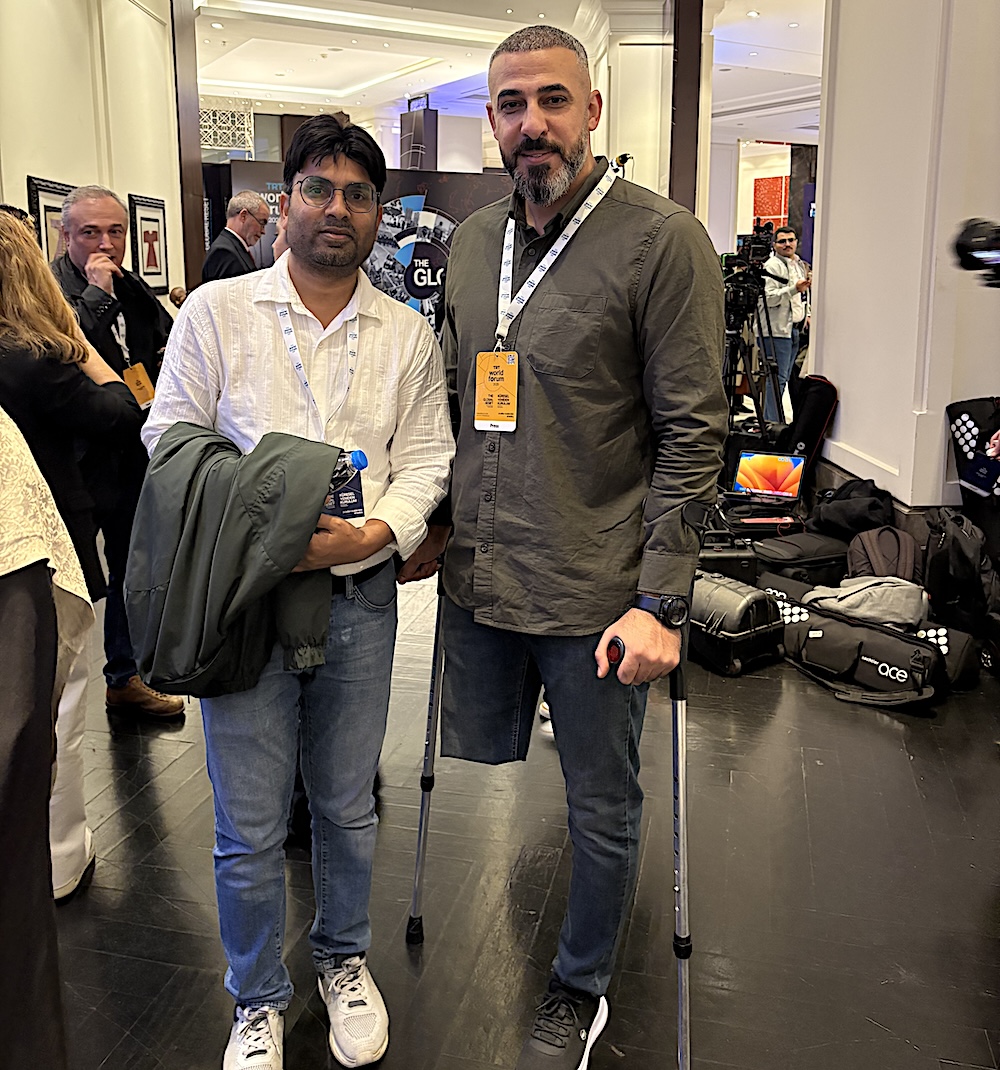
Sami Shehada is the photojournalist whose leg was severely injured during an Israeli attack in central Gaza last April, and later had to be amputated. Yet, remarkably, as soon as he recovered, he picked up his camera again — a tool that, for him, is no less than a weapon. He returned to the very streets where danger lurks at every turn, determined to show the world the true cost of reporting from Gaza.
Sami Shehada was greeted like a celebrity by those around him, but I kept thinking: journalists like him are a lesson for the world. Over the past two years, they have shown that journalism is not merely about reporting events — it is the echo of human conscience. And one thought kept returning to me: in this era of misinformation, revealing and documenting the truth is never easy. But if no one dares to show it, oppression will always prevail.
Afroz Alam Sahil is a journalist and author. He can be contacted at @afrozsahil on X.