


It is nearly 4:30 in the morning. Outside, the temperature hovers around freezing. Despite the bitter cold, a lone drummer moves through the streets of Istanbul, steadily beating his drum to wake residents for the suhoor.
This is no ordinary scene, but a glimpse into a centuries-old living tradition. In Istanbul, the custom of waking people for the suhoor during Ramadan continues with remarkable resilience. Known as Ramadan drummers, these individuals play an essential role in community life, preserving a practice that dates back to the Ottoman era.
Today, the tradition is not only maintained by local communities but also supported by municipal authorities. Drummers often coordinate with neighborhood leaders, known as muhtars, to serve specific areas. According to media reports, approximately 3,000 officially registered Ramadan drummers are active this year, covering 961 neighborhoods across the city.
Many of these drummers come from families for whom this is more than just a job—it is a cultural inheritance passed down through generations. The tradition is believed to date back to the Ottoman era and remains an integral part of Ramadan in Istanbul today. Moving through the streets before dawn, the drummers perform set rhythms and recite traditional verses, adding a distinctive cultural texture to the suhoor.
Beyond simply waking people, the practice carries a strong social dimension. It fosters a sense of connection within neighborhoods, reinforcing community bonds, inclusivity, and shared identity. In this way, the tradition helps keep the cultural spirit of Ramadan alive and meaningful in modern urban life.
Perhaps that is why the sound of the drum suddenly carried me back to the streets of the past. For a moment, I was lost in memory, as if time itself had taken a U-turn. In the city of my childhood, Bettiah—where I spent my earliest years—there was a similar and beautiful tradition known as Kafila-e-Ramazan.
Although similar traditions once existed in many cities across India, they largely disappeared from major urban centers about a decade or two ago. Even in historic cultural hubs such as Delhi and Lucknow, the practice now survives only in memory.
What is heartening, however, is that my hometown, Bettiah has followed a different path. In today’s fast-paced, technology-driven world—where many traditions are fading—the younger generation in Bettiah has not only embraced Kafila-e-Ramazan but has also kept it alive to this day.
I remember clearly that in 2017, I wrote a detailed piece on this very subject, titled “Kafila-e-Ramazan: A Living Tradition in a Small City.” Through it, I tried to illustrate how a small town can hold tightly to its cultural heritage.
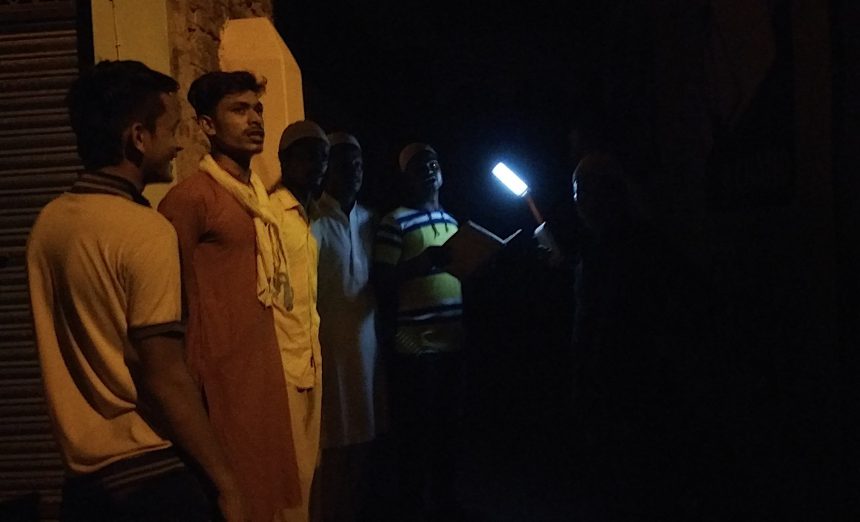
During the holy nights of Ramadan, as the time for suhoor approaches, groups of people move through the streets, waking residents with poetic verses and melodious calls. What makes these groups especially unique is their diversity—bringing together people of all ages, from children to the elderly. Each neighborhood has its own group, with its own identity, rhythm, and style.
The Kafila-e-Ramazan follows a well-organized routine. Around midnight, participants gather in a common place, share tea, and rehearse kalam—devotional songs and poems. Then, at about 2:30 or 3:00 a.m., they set out in their respective groups to move through the neighborhoods.
I recall members of local group of my neighborhood sharing something particularly meaningful. Because the town is home to both Hindus and Muslims, they are careful to ensure that their activities do not disturb others. When passing through predominantly Hindu areas, they lower their voices or remain silent. This practice reflects more than tradition—it is a thoughtful expression of mutual respect and communal harmony.
Within the Kafila-e-Ramazan, participants recite poems centered on the spirit of Ramadan, often composed by different poets. At the beginning of the month, verses welcoming Ramadan are performed, while toward the end, farewell poems mark its departure. When the moon signaling Eid al-Fitr is sighted, the same Kafila moves through the city, reciting celebratory verses—continuing even on the day of Eid itself.
People warmly welcome the groups, offering small gifts, sweets, or simply exchanging prayers and good wishes. While the style has evolved over time—shifting from traditional recitation to, at times, adaptations set to popular film melodies—the essence of the tradition remains unchanged. Its spirit continues to reflect joy, devotion, and community connection.
The Kafila-e-Ramazan also features the poetry of the city’s renowned poet MM Wafa. For me, this connection has always felt especially personal—his home stood just across the road from my home. While working on the story mentioned above, I once had the opportunity to speak with him. He shared that he had been observing this tradition since childhood and had actively participated in it for many years. Over time, his interest deepened, and he began composing poems dedicated to Ramadan—hundreds of which have since been recited by different Kafila.
He once spoke with a sense of nostalgia about how different things were in the past. The older generations, he said, were more deeply involved. There were no mobile phones, and mosques did not rely on loudspeakers or sirens, so the importance of this tradition was felt more strongly. Much has changed today, yet it is heartening that the younger generation has continued to keep it alive.
Still, there is a sense of loss that remains—Mr. MM Wafa is no longer with us. He passed away on August 9, 2018. And yet, do such people ever truly leave? He lives on through his words, his legacy, and the echoing voices of the Kafila-e-Ramazan.
I also recall a long conversation I once had with another senior poet of the city, Abul Khair Nishtar, about this tradition. He shared that it was first established in 1938 by Muhammad Shakir Ali Bastavi in my neighborhood, Nazni Chowk. Its original purpose was simple: to wake people for suhoor. Over time, however, verses by various poets were incorporated, gradually transforming it into a rich cultural and literary tradition.
According to Nishtar, the practice took on a new dimension in 1965 when the noted poet Nazim Bharti visited Bettiah. During this period, a group known as “Kafila Sada-e-Momin” was formed, helping to organize the tradition and infuse it with a stronger literary character. Nazim Bharti’s poetry, marked by its distinctive thought and individuality, played a key role in shaping the identity and voice of this Kafila.
He often described the period from 1966 to 1986 as the golden age of this tradition. During those years, there were regular competitions, and the Bettiah kafilas would even travel to other cities to showcase their skills. While public interest gradually declined over time, one thing remained clear in the voices of the participants: a deep commitment to keeping this tradition alive.
Abul Khair Nishtar himself was very much a living part of this legacy. In his youth, he traveled with the Kafila and composed beautiful poems in praise of the month of Ramadan. His collection, Alfaaz Ki Khushboo, was first published in 1985 and later republished in 2021 under the title Roshantar Alfaaz. Sadly, he passed away on February 12 of the same year, leaving behind a lasting imprint on the city’s cultural heritage.
Amid these memories, I suddenly noticed the clock striking 5:30 a.m. The time for suhoor was nearly over. I hurriedly finished my meal, yet in the quiet corners of my mind, the Kafila-e-Ramazan still seemed alive.
Later that day, I spoke with my elder brother. One statement he made shook me profoundly: he said that the tradition of the Kafila-e-Ramazan had nearly disappeared in the city of Bettiah this year. I could hardly believe it. To confirm, I called a senior journalist in the my city—and his response was the same. The tradition that had once felt so vivid in my memories had, in reality, fallen silent.
In such a moment, hearing the drumbeats echoing through the streets of Istanbul no longer feels like just a cultural ritual. It is a reminder that cultures and traditions endure not merely through memory, but through action. Perhaps the question is not why this beautiful tradition faded, but what we did—or failed to do—to preserve it.