

Recently, I was speaking with an old friend who now lives in London and has a deep passion for reading and writing. During our long conversation, we ended up discussing the “importance of writing,” and he shared his concern that the younger generation is gradually drifting away from both reading and writing.
As he spoke, I suddenly remembered meeting a professor from Jordan about four years ago at a conference. I recalled how he had explained the importance of writing in depth and emphasized that we must learn to document our experiences and the oppression we face, taking lessons in particular from the Jewish community.
After hearing what I said, my friend from London suggested that I should write more about this topic. At that moment, I couldn’t help laughing at myself. There I was, talking about the importance of writing and documenting, yet I couldn’t even remember the name or contact details of that professor, even though he had given me his visiting card. Still, some of his words have stayed with me. I’m trying to write them down now, together with what I’ve learned through my own research, so I can share with my dear readers why writing matters so much.
Some of you may be surprised to learn that between 1933 and 1945, Jewish communities lived under extremely harsh and inhumane conditions, where even attempting to document the atrocities they faced could endanger their lives. Despite this, in many places, Jewish individuals showed remarkable courage by recording the crimes committed by the Nazi regime.
Today, these documents are preserved in archives around the world and are recognized as vital historical evidence at the international level. The Ringelblum Archive has even been included in UNESCO’s “Memory of the World” list.
In Warsaw, Poland, a group led by historian Emanuel Ringelblum collected detailed records of Nazi atrocities. His collection included reports, letters, diaries, memoirs, sketches, records of daily life in the ghetto, children’s drawings, newspaper clippings, and more. This archive came to be known as “Oneg Shabbat.” The brutality they endured can be understood from the fact that they were forced to hide these materials in milk cans and metal boxes to prevent their destruction. After the war, many of these containers were recovered, and today they stand as some of the most authentic evidence of the Holocaust.
Beyond Warsaw, some Jewish individuals managed to escape from ghettos or camps and delivered firsthand reports to Britain, the United States, and the Polish government-in-exile. One of the most significant examples came in April 1944, when two Slovak Jewish prisoners— Rudolf Vrba and Alfred Wetzler, escaped from the Auschwitz-Birkenau camp and revealed its horrifying conditions to the world.
Between April 25 and 27, 1944, they produced a detailed handwritten report describing the camp’s layout, gas chambers, prisoner numbers and identities, and the systematic brutality carried out there. The document was later typed in German and English and circulated internationally in mid-1944. The Vrba–Wetzler Report became one of the first reliable eyewitness accounts of Auschwitz and played a crucial role in informing the world about the reality of the Holocaust.
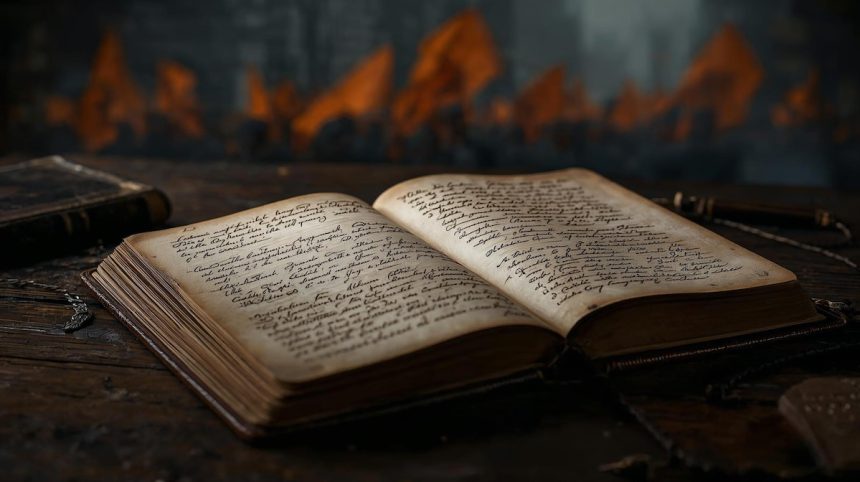
Most importantly, people living in ghettos and camps continued to write diaries. Many even began autobiographies while imprisoned. This was far from easy: they had to hide their writings, taking notes in secret whenever they found a safe moment. Some wrote quietly in their diaries, while others recorded their thoughts on scraps of cloth, walls, or pieces of clothing.
A large number of those who kept diaries were children and young people. The most well-known example is Anne Frank, whose diary—written while she was in hiding in Amsterdam—captured her fears, hopes, and everyday experiences during the Holocaust. It was later published and has become one of the most widely recognized symbols of that period.
Other young writers also left powerful records. Moshe Ze’ev Flinker, a Jewish teenager, began his diary in 1941, describing the spiritual and physical suffering he endured in Nazi-occupied Europe. Petr Ginz, only thirteen, wrote about his education in the ghetto, his love of science, his dreams of space travel, and his daily challenges. Daniela Briccoux kept a diary that reveals the terrifying realities of a young Jewish girl living in hiding.
Rutka Laskier kept a diary from January 19 to April 24, 1943, in which she reflected on life in the ghetto, her fears, and the constant pressure of Nazi oppression. Tragically, Rutka was later killed in Auschwitz, but her diary was eventually published and is now regarded, much like Anne Frank’s, as an important testimony from a young person living through the Holocaust.
Other Jewish writers, including Dawid Sierakowiak, documented their experiences in what are known as the Łódź Ghetto Diaries. The Łódź Ghetto was one of the largest in Europe, and these diaries describe in vivid detail the hunger, disease, executions, and harsh policies imposed by the Nazis. Today, they are considered some of the most authentic records of daily life inside the ghetto.
Countless such diaries have been published, yet many of them remain unfamiliar to global audiences simply because they were never translated into English. Even more importantly, thousands of additional diaries are still stored in archives around the world and have not yet been published. Over time, various historical institutions have worked to translate and preserve many of these writings so that the atrocities they describe are never forgotten.
The United States Holocaust Memorial Museum (USHMM), for example, includes a section in its Holocaust Encyclopedia titled “Children’s Diaries During the Holocaust.” There, you can find many personal diaries, letters, notes, and other firsthand accounts written during that period. Unlike official documents or Nazi records, these personal writings reflect the direct voices of ordinary people, revealing their fear, hope, shock, and moments of resistance.
Just imagine, without these documents, much of what we know about the Holocaust would rely solely on official Nazi records or later reports by the Allied forces, and countless human stories would have been lost forever. The reality is that millions of victims had no power, no weapons, and no freedom, but they had words. And those words survived.
The Nazi regime burned cities, destroyed homes, and erased generations, yet a small diary written by a trembling hand still has the power to shake the conscience of the world. History teaches us something profound: when cruelty reaches its deepest depths, the written word becomes a flame that cuts through even the darkest of nights.
In conclusion, I would like to say that writing is not just a form of expression; it is a declaration that a person is still alive, still thinking, and that no power can silence the human spirit. The pen is a weapon that fears no army, bows to no dictator, and serves no ideology; it simply bears witness to the truth.
Anne Frank wrote her diary in a small hidden room, yet its echoes reached the entire world. Rutka Laskier wrote for only three months in the shadow of death, yet her words speak across generations. The lines written by children in the ghettos, amid hunger, terror, and destruction, remain some of the strongest proofs of our shared humanity, showing that even under the harshest oppression, truth still finds a way to survive.
The greatest writings in history are often those created by people who had nothing but their courage, when writing itself was an act of rebellion, an act of resistance, a truth recorded at the cost of a single breath. Writing remains just as essential today because words endure, and in enduring, they bear witness to injustice, keeping oppression from taking root again.
If you write today, you are not merely putting words on a page; you are confronting injustice in the eye and declaring, “I see you, and I will leave a witness behind.” Writing is a way of telling the world: I have not vanished. I am not lost. I saw, I suffered, and I recorded it so that future generations will never be silenced.
Afroz Alam Sahil is a journalist and author. He can be contacted at @afrozsahil on X.