
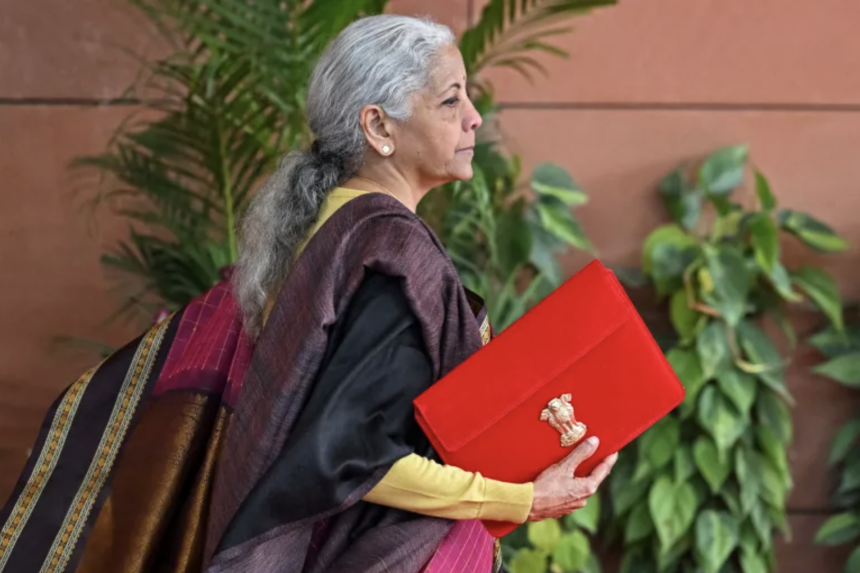
Every year on February 1, Budget Day in India follows a familiar pattern. A modest increase in funding for the Ministry of Minority Affairs is announced, headlines quickly follow, and the government’s slogan “Sabka Saath, Sabka Vikas” (“Together with all, development for all”) is revived. This year was no different. The allocation of ₹3,400 crore was presented as evidence of the government’s commitment to minority communities, creating the impression that their concerns are being taken seriously.
However, the real question is not what was announced, but what followed the announcement. It is here that the government’s official claims begin to unravel.
In reality, the Ministry of Minority Affairs’ budget has followed a predictable pattern for years: an initial announcement, followed by downward revisions, and ultimately either minimal spending or complete silence on implementation. For the 2024–25 fiscal year, an allocation of ₹3,183 crore was announced, later reduced to ₹1,868 crore, with actual expenditure amounting to just ₹714 crore. In 2023–24, ₹3,097 crore was allocated, but only ₹154 crore was ultimately spent. Now, ₹3,400 crore has been announced for 2026–27. Experience suggests, however, that the true picture will only emerge months after the announcement.

Most concerning is that these reductions consistently target schemes intended to promote self-reliance among minority communities through education. The Merit-cum-Means Scholarship—once the most substantial support for students pursuing professional and technical education—is now being effectively dismantled. Similarly, the Maulana Azad National Fellowship, which enabled thousands of Muslim students to pursue MPhil and PhD degrees, has been formally discontinued, and even pending payments have become uncertain in practice.
The situation with pre-matric and post-matric scholarships is no different. The numbers make it clear that these schemes exist largely on paper rather than in practice. When allocations worth hundreds of millions of rupees are announced for scholarships, but actual spending is limited to only a few million, this cannot be dismissed as an administrative lapse; it reflects a deliberate policy choice.
This is not merely a financial decision; it is a political one. Educated young people tend to ask questions, demand employment, and insist on equality. It is perhaps for this reason that public spending on minority education appears particularly inconvenient for the government. The near-elimination of funding for education-related schemes linked to madrassas reflects the same underlying mindset.
If the Modi government’s approach toward minorities were to be summed up in a single sentence, it might be this: minorities are expected to be “developed” to the point where they no longer require government support. In official rhetoric, this is framed as sab ka saath (“together with all”); in practice, it has translated into the quiet dismantling of schemes specifically designed for minority welfare.
This is not a matter of perception alone. A decade-long record of policy decisions bears this out. Since coming to power, the Modi government has either abolished or steadily weakened several key minority-focused programmes, often reducing them to little more than budgetary placeholders. The Maulana Azad Medical Aid Scheme, commonly referred to as the “Health Scheme,” was completely discontinued. The Cycle Yojana, introduced to encourage minority girls to continue their education beyond middle school, was shut down as early as 2014—despite well-documented gender disparities in education.
A similar pattern is visible in the education sector. Several programmes run by the Maulana Azad Education Foundation were first withdrawn, and the foundation itself has now been closed, despite repeated public assurances about its importance. Initiatives such as the Skill Development Programme, Nai Manzil (an integrated education-and-employment scheme), traditional skills and crafts training under USTTAD, leadership development programmes for minority women, and cultural heritage initiatives like Hamari Dharohar were all dismantled one after another.
The direction of policy is especially evident in the withdrawal of support schemes that helped minority students prepare for India’s most competitive civil service and public-sector examinations, including the UPSC, SSC, and state-level public service commissions. The National Minorities Development and Finance Corporation (NMDFC) is also on the brink of closure. Although a token allocation of ₹5 crore has been made this year, it amounts more to symbolic survival than genuine revival.
The same pattern applies to the Interest Subsidy on Educational Loans scheme for students pursuing higher education abroad. In the 2025–26 financial year, ₹8.16 crore was initially allocated, only to be slashed to ₹0.01 crore during budget revisions. Data from previous years indicate that the scheme has seen virtually no real expenditure. While ₹6.50 crore has been announced again this year, past experience raises a fundamental question: will the money reach its intended beneficiaries, or will it remain confined to official documents?
Taken together, these decisions point to a larger and more troubling issue. Is the welfare of minorities still a priority for the state, or has the prevailing model of “development” become a systematic retreat from responsibility? This question is not merely about minority rights; it is a test of the moral and democratic conscience of the state—and one in which the government increasingly finds itself under scrutiny.
It is worth recalling that India’s Ministry of Minority Affairs was established in 2006, following official recognition that Muslims constituted one of the country’s most socio-economically disadvantaged communities and that the state had a responsibility to address this gap. Today, however, repeated budget cuts, the withdrawal of key programmes, and large amounts of unspent funds raise a fundamental question: does the government genuinely intend to sustain this ministry, or is it merely preserving its institutional form while retreating from its obligations?
The harsher reality is that in the current political climate, hostility toward Muslims is no longer confined to the fringes of public discourse; it increasingly finds expression in policy choices, official language, and budgetary priorities. In such circumstances, it would be self-deception to view allocations for minority welfare as a purely technical or arithmetic exercise. The real issue is whether these budgets are framed with a genuine intent to promote welfare, or merely to maintain appearances—echoing the words of poet Kaleem Aajiz: “dāman pe koī chhīñT na ḳhanjar pe koī daaġh, tum qatl karo ho ki karāmāt karo ho” (“Not a stain on the robe, not a mark on the dagger, are you committing murder, or performing a miracle?”).
Afroz Alam Sahil is a journalist and author. He can be contacted at @afrozsahil on X.