

The future of madrasas and minority educational institutions in the Indian state of Uttarakhand now appears headed toward a major legal and political confrontation, as tensions grow between government-led “reforms” and the preservation of minority identity.
On April 19, 2026, in the city of Haridwar, Chief Minister Pushkar Singh Dhami announced the abolition of the Madrasa Board and said that all madrasas would be required to adopt the state education curriculum beginning in July 2026.
The move is being described by the government as an effort to modernize the education system and bring students into the “national mainstream.” However, many Muslim scholars and madrasa representatives view the decision differently. They argue that it marks the beginning of increased state control over minority educational institutions and threatens their educational autonomy and cultural identity.
Speaking at the event in Haridwar, the Chief Minister stated that institutions failing to follow the state education board’s curriculum after July 2026 would face closure.
The announcement was welcomed by several Hindutva religious leaders present at the gathering, who described the decision as a step toward integrating madrasas into the national mainstream.
Claim of “Equality” or Something Else?
Despite the government’s assurances, many madrasa administrators remain skeptical about the entire process. In Uttarakhand, madrasa administrators and social activist Taufiq Elahi Qasmi described the move as a “political deception.”
“The claim that Muslims are being brought to a level of equality is misleading,” he said. “Under the new system, a madrasa seeking official recognition must first obtain approval from the education department and then register with the new authority. But there is a clear contradiction here. According to Section 1, Sub-section 4 of the Act, certificates issued by madrasas will still not be considered equivalent to those issued by regular schools.”
He questioned the government’s intentions, asking, “If the goal is truly progress and equality, then why are madrasa certificates not being granted the same status as school certificates?”
Legal Contradictions and the Right to Education Act
Another major concern being raised within madrasa circles is the implementation of India’s Right to Education (RTE) Act.
According to Taufiq Elahi Qasmi, there is a legal contradiction in the government’s approach.
“The government is pressuring madrasas to come under the education department,” he said. “However, the 2012 amendment to the RTE Act clearly states that the law does not apply to madrasas or Vedic schools. If the law itself is not applicable to these institutions, then how can authorities operating under that law require us to seek approval from them?”
New Authority Raises Concerns Over Lack of Religious Representation
The government of Uttarakhand has established the “Uttarakhand State Authority for Minority Education” under the Minority Education Act 2025, transferring to it broad administrative and curriculum-related powers over minority educational institutions.
However, the structure of the new authority has drawn criticism from madrasa circles. The body includes experts from fields such as psychology, law, economics, and literature, led by Chairman Dr. Surjit Singh Gandhi. Critics point out that no Islamic scholars, religious education specialists, or experienced madrasa teachers have been included in the authority.
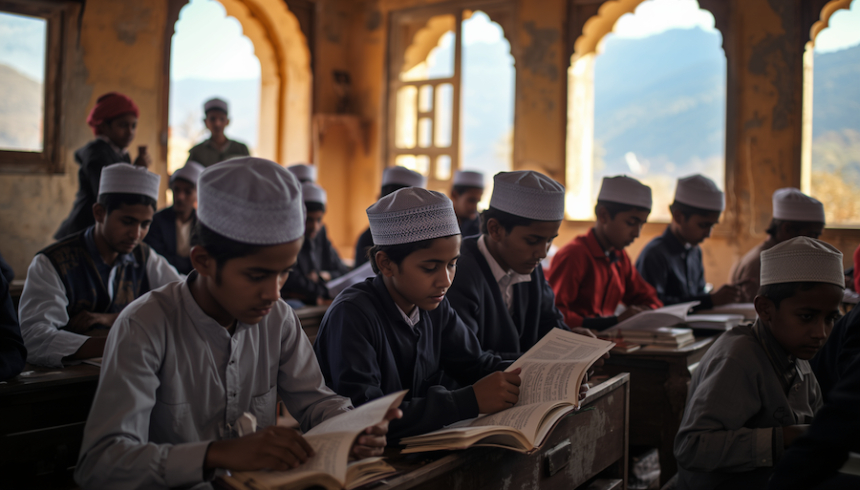
Madrasa education is deeply rooted in a centuries-old academic tradition that includes Islamic jurisprudence, Hadith studies, Quranic commentary, and the Arabic language. Many educators argue that any attempt to redesign the curriculum without understanding this historical and intellectual foundation risks weakening the distinct identity of madrasas.
Minority Welfare Secretary Prag Madhokar Dhakate has stated that experts from all communities are involved in developing the curriculum. However, critics say the absence of direct madrasa representation undermines that claim in practice.
Crackdown on Madrasas
The introduction of this new legal framework comes amid an ongoing crackdown on madrasas in Uttarakhand. Earlier reports highlighted action taken against 217 madrasas across the state.
According to information obtained through the Right to Information (RTI) Act, many of these institutions were reportedly shut down without a clear legal basis. Critics now argue that the new law is being used to provide legal justification for those earlier actions while also increasing government control over the remaining madrasa institutions.
Strict Surveillance and Verification Drive
The government has ordered a “mass verification” exercise for madrasa students across the plains of four districts in Uttarakhand —Dehradun, Haridwar, Udham Singh Nagar, and Nainital.
While authorities describe the initiative as a major enforcement and monitoring drive, local madrasa administrators view it differently, calling it a politically driven exercise.
A local scholar criticized the move, saying, “The government is exaggerating these measures to create the impression that Muslims are being placed under stricter control. In reality, madrasas already submit detailed student records — including names, addresses, Aadhaar numbers, and mobile numbers — to the local administration at the beginning of every academic year. This is a routine process, but it is now being portrayed as a special campaign.”
Amid ongoing administrative and legal tensions, on April 27, 2026, several major national Muslim organizations in India — including the All India Muslim Personal Law Board — strongly rejected the Uttarakhand government’s newly formed “Minority Education Authority” and the requirement for mandatory affiliation of madrasas. They argue that the move violates Article 30 of the Constitution of India, which protects the rights of minorities to establish and manage their own educational institutions.
In a joint statement, prominent religious leaders such as Maulana Khalid Saifullah Rahmani, Maulana Arshad Madani, Maulana Mahmood Madani, and Syed Sadatullah Hussaini advised madrasa administrators to refrain from affiliating with the new authority for the time being. They expressed concern that increased state control over curriculum and religious instruction could undermine the identity and autonomy of madrasas.
Taufiq Elahi Qasmi also described the legislation as an attempt to “administratively weaken and paralyze” madrasa institutions.
Meanwhile, state officials maintain that the reforms are intended to improve “transparency” and promote “modernization” in the education system. National-level leadership, however, has indicated that the matter will be challenged in the High Court and, if necessary, the Supreme Court, calling it a violation of constitutional rights.
The recent developments in Uttarakhand suggest a major shift toward stronger state oversight of minority educational institutions. The planned repeal of the Madrasa Education Board Act, 2016, set to take effect on July 1, 2026, is being described by critics as a decisive turning point.
The government has framed these reforms as steps toward “standardization” and “innovation” in education. However, many minority groups see them very differently, viewing the changes as a challenge to their educational autonomy and religious identity.
Ultimately, it will become clearer in the coming years whether these reforms genuinely improve learning outcomes for students or whether they serve broader political objectives.