


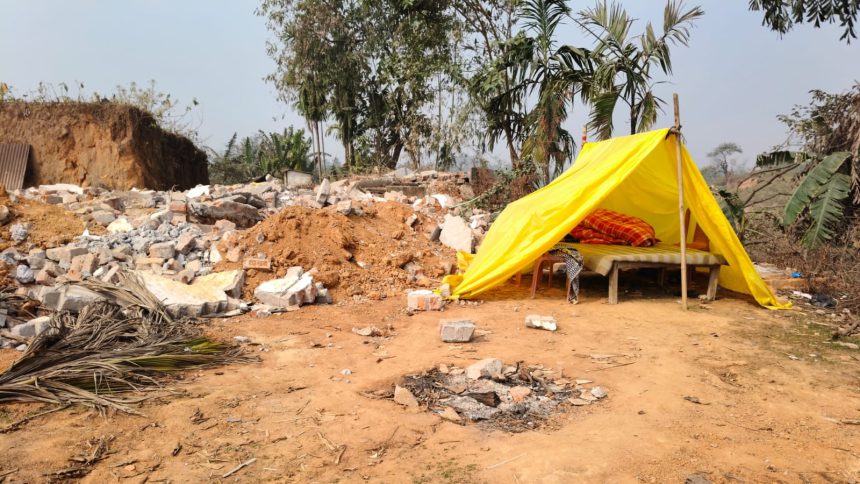
Sitting in the rubble, the woman repeatedly looked at the broken bricks, as if she might find some remnant of her life among them. A few steps away, her daughter Yasmin (name changed) stood silently. Her dream was to become a doctor. Today, she has neither a desk, nor a room, nor the house where she used to dream about her future.
“My daughter wanted to become a doctor, but now she doesn’t even have a place to study.”
These are the words of a homeless mother from Bandar Matha in Assam’s Goalpara district, whose house was demolished in a recent administrative action. Today, this Muslim-majority settlement presents a scene of ruin. Broken walls, scattered belongings, and families immersed in uncertainty testify to the fact that the administration’s action, carried out in the name of an “anti-encroachment campaign,” has left thousands homeless and hundreds of students deprived of education.
The story of Goalpara is not just the story of one hamlet. It reflects a larger and more complex crisis in Assam over citizenship, land rights, and the exercise of state power. At a time when the state is grappling with controversial issues such as the National Register of Citizens (NRC) and the “de-voter” (doubtful voter) category, these land clearance campaigns are not merely administrative actions in the eyes of human rights activists and observers. According to them, these measures have specifically affected the educational, social, and religious structures of a particular community, with far-reaching consequences for an entire generation.
Questions of Double Standards
The most striking thing about entering Bandar Matha was the apparent disparity in law enforcement. In one part of the settlement, the houses of the majority Hindu community stood intact, while the homes of several Muslim families nearby had been completely razed to the ground.
An elderly woman stood holding tattered citizenship and land documents in her hands. Local translator Maqbool Hussain Qasmi translated her words, saying that she was asking, “If this land is illegal, how did my neighbor’s house become legal and mine illegal?”
Maqbool Hussain also pointed to an educational tragedy hidden behind the devastation. A daughter from the same demolished household had been preparing for the National Eligibility-cum-Entrance Test (NEET), India’s medical entrance examination. The family’s only source of income was her father’s small shop, which was bulldozed along with the house. Apart from losing access to coaching resources, the student is now forced to search for her textbooks among the rubble of collapsed walls alongside her father.
Legal Requirements and Ground Realities
The administration claims these operations are legal under the Assam Land and Revenue Regulation, 1886, and the Indian Forest Act, 1927, but legal experts and human rights activists are raising serious questions about the process.
According to a report by Land Conflict Watch, on December 13, 2024, 44 families were evicted from the Panchartan area of the Balijana Revenue Circle in the presence of heavy machinery and security forces. Under Section 165(3) of the Assam Land and Revenue Regulation and Rule 18(3) of the Settlement Rules, at least 15 to 30 days’ notice must be given before an eviction so that affected people can pursue legal remedies or make alternative arrangements.
But the facts on the ground suggest that notices are either not issued at all or are delivered just 24 hours before the action. A 65-year-old local resident claims that he has lived there for three generations and has been paying land tax since the 1970s. According to the report of the UN Special Rapporteur on Adequate Housing (A/HRC/RES/43/14, dated 6 July 2020), governments are obliged to provide evicted people with adequate compensation, alternative housing, and basic necessities such as food. However, Goalpara appears to be in blatant violation of these international norms.
Educational and Religious Institutions Also Under Attack
The most worrying aspect of my field reporting was the allegations regarding the demolition of educational and religious institutions. Girls from poor families used to study at the “Madrasat al-Banat Bidya Para Krishnai” adjacent to Bandar Matha. Today, only piles of bricks remain. The head of the madrasa, Mufti Muqibur Rehman, said that the demolition has affected the education of about 400 girls, as there is no other educational institution for girls in the entire area.
The administration claims that the madrasa was built on land belonging to the Forest Department. However, on the same disputed land, there is a large temple spread across several acres adjacent to the madrasa, against which no action has been taken. The same alleged double standard was also seen in the Panj Ratna area, where half of an old mosque was demolished while the construction of a new temple continues uninterrupted right next to it.
According to documents provided by Jamiat Ulema-e-Hind General Secretary Maulana Hakimuddin Qasmi and Assam-based cleric Maulana Abdul Qadir Qasmi, a total of 11,183 families were evicted in Assam between November 2023 and July 2025, directly affecting 77,379 people. During this period, 48 mosques, 86 educational institutions (including 75 schools and 11 madrasas), and 37 other sites (including 22 Eidgahs and 15 graveyards) were demolished. The state’s Chief Minister, Himanta Biswa Sarma, himself confirmed in the Assembly that 4,449 bighas of land occupied by mosques, schools, and madrasas had been cleared so far.
This alleged administrative arbitrariness also includes what critics describe as a blatant violation of court orders. Local resident Chafa Begum had filed a petition in the Gauhati High Court before the evictions. The court did not completely halt the eviction process, but declared the notice issued by the Balijana Revenue Circle null and void because it did not clearly identify the disputed land and because the officer concerned lacked the authority to issue the notice. Despite these court observations, forest officials carried out the operation using bulldozers.
According to Animul Haque, president of the All Assam Minority Students’ Organisation (AAMSU), the Balijana Circle Officer had assured residents that there would be no action in the revenue areas, but the Divisional Forest Officer proceeded with the operation.
The State’s Position and Contradictions on the Ground
The state government and the Forest Department defend all these actions in the name of environmental protection. In July 2025, Goalpara District Forest Officer (DFO) Tejas Mariswamy told NDTV about the operation in the Paikan Reserve Forest: “Goalpara district has recorded the highest number of incidents of human-elephant conflict. That is why the High Court has ordered the removal of all encroachments from forest land.”
However, the district administration has yet to provide any official explanation for the alleged double standards in the demolition of religious structures, the lack of rehabilitation measures, and the disregard for court orders. Hafiz Rafiqul Islam, a legislator from the opposition All India United Democratic Front (AIUDF), rejects the claim that these areas constitute “forest land,” saying: “These villages are listed in the 1951 Assam NRC. There are electricity connections, roads, water projects, and government schools here. If this is forest land, then how did the state government provide all these facilities?”
According to Wajid Ali, a lawyer with the Goalpara Lawyers Association, only 25.67% of the district’s forest area is under encroachment, including by tribal communities engaged in rubber and tea cultivation. However, he argues that the recent operations have targeted only settlements inhabited by Bengali Muslims.
Hasilapara: A Story Beyond the Rubble
Hasilapara, one of the affected areas in Goalpara, presents perhaps the most heartbreaking picture of the crisis. Here, families displaced from Panj Ratna are living in makeshift shelters made of tarpaulin, bamboo, and plastic sheets. It was here that I met Ayesha, a Class 10 student. One cold evening, she sat inside her temporary shelter. Fear and uncertainty were evident in her eyes. Crying, she said, “All my books got soaked in the rain. How will I study now? How will I take my exams?”
This question is not Ayesha’s alone. It is the question of hundreds of children whose education has been directly affected by the evictions. And in these questions lies the full weight of the structural violence that Assam’s minority community says it is experiencing today.
This educational crisis is not limited to the loss of books. Following the eviction in the Jaleswar Betbari area, the existing government school building was converted into an office of the Forest Department. Converting schools into administrative offices is, critics argue, a clear violation of the state’s constitutional obligations under the Right to Education (RTE) Act. When alternative avenues of education are blocked for children in affected areas, it effectively means that the state is cutting off an entire generation from the path of social progress.
The reporting for the story was supported by a grant from the Human Rights and Religious Freedom Journalism Grant Program.