


Mental illness is one of India’s most serious yet overlooked public health challenges. Nearly one in seven Indians lives with a mental health condition, but stigma, limited awareness, and inadequate access to care mean that many suffer in silence. Urban stress, academic pressure, financial insecurity, and social media comparisons have intensified anxiety—particularly among young people—while digital life has often deepened loneliness and emotional detachment.
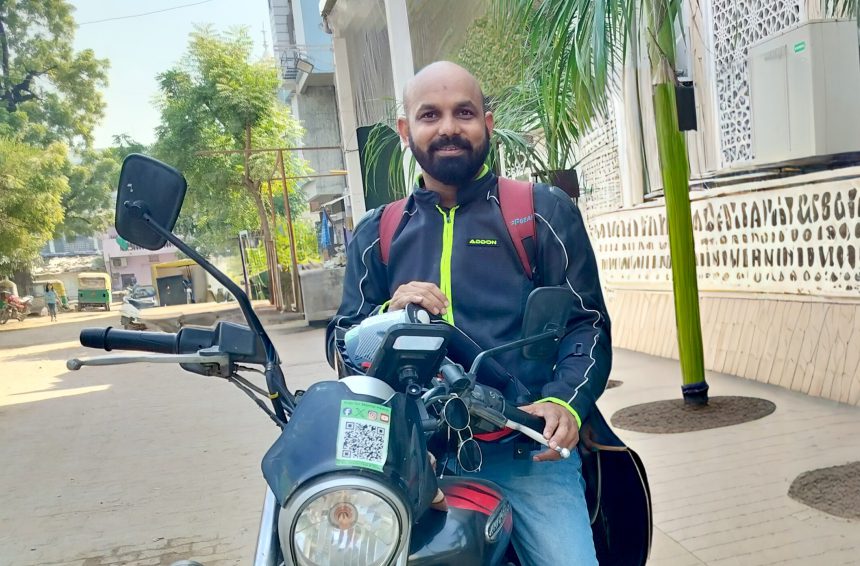
Against this backdrop, Dr. Istikhar Ali, a sociologist and public health researcher, undertook a 3,200-kilometre solo motorcycle journey from Delhi to Kerala.
Dr. Istikhar holds an MPhil and a PhD in Social Medicine and Community Health from Jawaharlal Nehru University (JNU). His work focuses on ageing, social exclusion, and mental health, with particular attention to the social determinants that shape psychological well-being.
His campaign, Ride Beyond the Stigma, began on World Mental Health Day (October 10) and concluded in Kerala on November 6, 2025. More than a physical journey, it aimed to translate research and lived experience into public awareness and dialogue. As Dr. Istikhar explains, “Ride Beyond the Stigma is not just a road trip—it is a journey into India’s mental landscape.”
Sugandha Priya spoke to Dr. Istikhar exclusively for BeyondHeadlines. She had also interviewed him when he first set out on this journey. Here are some key insights from their latest conversation:
What is the most significant truth about mental health in India that your 3,500-km journey revealed? Did you observe differences across states?
The most significant truth my journey revealed is that mental health in India is not primarily a medical issue—it is a social condition produced by how people live, work, fear, and survive. Across states, distress was widespread, but it wore different faces.
In Delhi, people spoke of speed and pressure—long work hours, constant competition, and a sense of falling behind. In Rajasthan and Gujarat, the stress felt heavier and quieter, shaped by economic precarity and social control. Maharashtra showed exhaustion masked as productivity, especially in cities. Karnataka and Kerala, despite better institutions, revealed anxiety rooted in hyper-competition and fractured family lives.
What differed was not the presence of distress, but how openly it could be named. In some places, people talked freely. In others, even admitting fatigue felt risky. Mental health followed the contours of inequality, not state boundaries.
How does the public understand mental health—illness or weakness?
Most people do not reject mental health outright—but they rarely see it as illness either. It is still framed through ideas of endurance, fate, family honour, or moral failure.
I often heard phrases like, “This is life,” or “Everyone has problems.” Seeking help was seen less as care and more as exposure. Many worried less about diagnosis and more about who might find out. Mental health was something to manage privately, quietly, without disturbing the family’s image.
Awareness exists, but acceptance is fragile.
What stories revealed gaps in India’s mental health system?
The gaps became visible not inside hospitals, but outside them. I met doctors who were overburdened, counsellors working in isolation without referral networks, and families who simply did not know where to go after a crisis.
In one town, a father shared that he had taken his son to three different facilities, each redirecting him elsewhere. “I felt like I was running in circles,” he said, staring at the floor. For nearly two years, he moved between clinics and psychiatrists, unable to find sustained relief for his son’s mental health condition. Eventually, after multiple referrals and delays, his son was admitted to NIMHANS. He stayed there for two months and showed significant improvement.
Today, the family is trying to rebuild emotional connection and trust with their child. Their experience highlights a deeper issue: while India has some mental health infrastructure, access to timely, continuous, and compassionate care remains limited. Treatment often focuses narrowly on clinical symptoms, overlooking long-term emotional support and family involvement.
The system is structured to respond to breakdowns—but not to the slow, invisible erosion of mental health that leads people there in the first place.
What is the government doing right—and where is it failing?
The government has taken steps—district mental health programmes, helplines, and policy documents. These matter. But they remain disconnected from people’s lived realities.
The biggest failure is treating mental health as an individual issue divorced from livelihood, housing, discrimination, and insecurity. If I had authority, my first step would be integrating mental health with employment, education, and social welfare—because distress does not arrive alone.
You cannot counsel people out of structural harm.
Is India’s mental health crisis medical or social?
It is overwhelmingly social. Poverty, unemployment, gendered expectations, caste hierarchies, communal tension—these are not background factors; they are central.
Medical care becomes necessary when the social fabric has already failed. Treating anxiety without addressing precarity is like prescribing rest to someone who cannot afford to stop working.
What did this solo journey teach you about your own resilience?
This journey taught me that resilience is not about strength; it is about adaptation. There were days when I rode for hours without speaking to anyone, and nights when exhaustion felt heavier than the bike itself. At times, I questioned why I was doing this at all. I remember moments when I felt completely broken and unsure. I called a few close friends, not always knowing what to say myself, and they simply listened—without judgment, without solutions.
Because of this emotional fatigue, I even postponed a few planned sessions at institutions like TISS and IIPS. But with time, I realised that resilience is not about pushing through every situation. It is a process. Sometimes you don’t need to be strong; you just need time to pause, reflect, talk, and then show up again the next day. That, too, is resilience.
What surprised me most was how porous one becomes as a listener. You absorb people’s stories; you carry them with you. This journey taught me that resilience is not about holding firm all the time—it is about knowing when to slow down, when to stop, and when to admit that you are tired.
How would you describe your own mental health after returning?
I returned quieter. Not lighter—just more aware. The journey gave me clarity, but not closure. There was relief in completing the ride, yet also a strange emptiness, like walking away from a long, intense conversation that is still echoing inside you.
I felt more grounded, but also more unsettled in a reflective way. The road stripped away urgency and noise, and what remained was a sharper awareness of my own limits—physical, emotional, and mental. I became less convinced that constant movement or productivity equals purpose. Some days, simply pausing felt more honest than pushing forward.
I also realised that listening so deeply to others had changed me. I carried their stories back with me, and that weight doesn’t disappear just because the ride ends. My mental health now feels more fragile, but also more truthful. I am learning that healing is not a finish line—it is an ongoing negotiation with oneself, marked by attentiveness, rest, and the willingness to sit with unanswered questions.
Why was studying others’ mental health emotionally difficult for you?
Because I was not standing outside the system I was studying. The same uncertainties—fatigue, doubt, political anxiety—were shaping me as well. I was listening to people speak about exhaustion, fear, and vulnerability while carrying many of those feelings myself.
Listening deeply does not leave you untouched. Some days, I realised I was asking others questions that I had not fully answered for myself. That tension stayed with me, and I think it should. Research that does not disturb the researcher risks becoming hollow, detached from the realities it seeks to understand.
What did you observe among Muslim youth, especially madrasa students?
What struck me most was restraint. Many madrasa students were thoughtful, curious, and deeply aware of the world—but careful, even cautious, about how they expressed themselves.
They spoke confidently about education and faith, yet beneath those conversations was a quiet anxiety about belonging. One student asked me softly, “Will education protect us when our very existence is questioned?” That question stayed with me. Their distress was not loud or confrontational—it was disciplined, contained, and deeply internalised.
Who bears responsibility for rising communal tension—and how does it affect mental health?
Political leadership, media ecosystems, and social media platforms bear immense responsibility. Hostility does not emerge on its own; it is produced, circulated, and normalised. I remember a consultant telling me, “There isn’t a single Muslim household in my village, yet people here hate Muslims because of what they see online.”
For ordinary people, especially minorities, this climate translates into constant alertness—measuring words, movements, and silences. Social media accelerates this by turning fear into spectacle and outrage into routine. The psychological cost is enormous: chronic anxiety, mistrust, emotional withdrawal, and exhaustion.
If you could convey one truth about mental health to the country, what would it be?
Mental health is not about fixing broken individuals.
It is about asking why so many people are breaking in similar ways.
If we refuse to ask that question—if we keep treating distress as a personal failure rather than a social signal—then no number of counsellors, apps, or clinics will ever be enough.