


BeyondHeadlines News Desk
“People of both countries consider each other as an enemy and assume that the people of the other country do not want peace. But this is a misconception. People of both countries desire peace and friendship.”
Relation between India and Pakistan is bad because of misconceptions and miscommunication, said students from both countries who participated in Aaghaz-e-Dosti, an Indo-Pak Friendship initiative of India-based Mission Bhartiyam and Pakistan-based The Catalyst – TC.
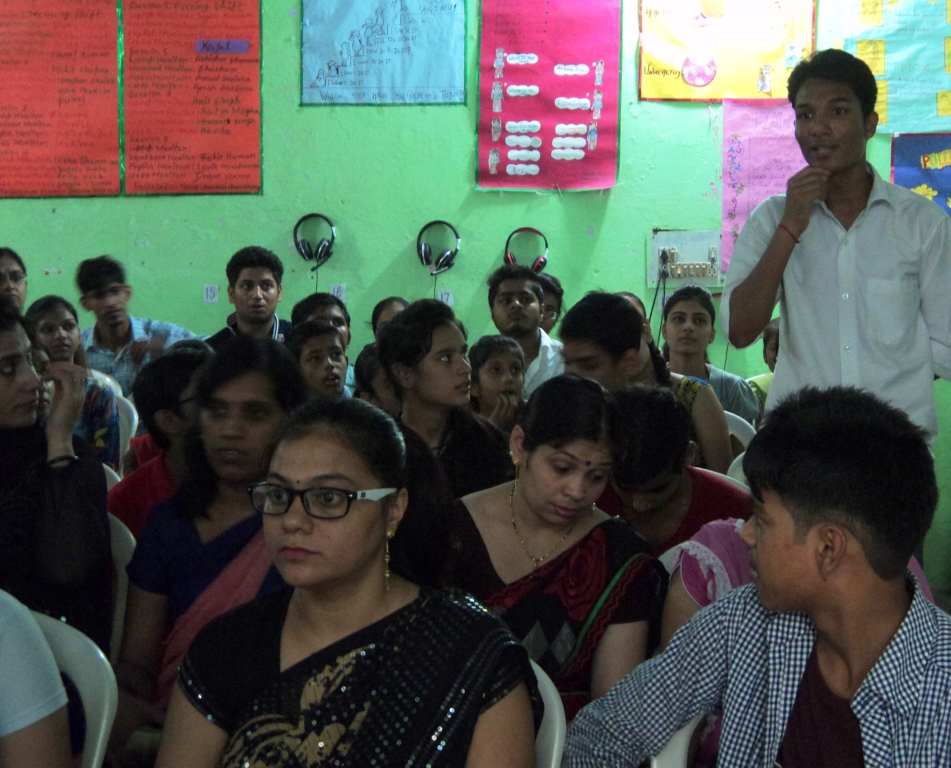
The event was organized Aman Chaupal on 4th October at two centers – Hastal Village and Jeevan Park, of AAM Foundation, an NGO that provides free English classes. It was their eighth and ninth Aman Chaupal.
In Aman Chaupal, someone from Pakistan interacts with students in a school or college in India, with an objective to counter stereotypes and misconceptions. This time, the guests were two Pakistani students studying in India, Ms. Fatima Parveen and Mr. Poonamchand Chauhan. Both are students of South Asian University, studying sociology at post graduate level.
They shared their experience of having lived in India for more than a year now, and narrated how their perceptions had changed. They stated that people in India would not know that they are Pakistanis and not Indians, unless they told them.
According to Fatima, this was because of the language. She shared that her first interaction was with an auto person. He had not thought that she is a non-Indian and when she told him, he was very surprised but thereafter, talked a lot with her.
Poonamchand also shared a similar spirit that he had experienced when he came through train from Rajasthan. People in the train had assumed him to be an Indian but when he told them, they were shocked because they found no difference in his talk.
In the interactive session, mixed-group of students, young professionals and housewives participated actively. A student asked: “Why is the relationship between India and Pakistan bad”? Then he answer came: “this is because of misconceptions and miscommunication.”
People of both countries consider each other as an enemy and assume that the people of the other country do not want peace. But this is a misconception. People of both countries desire peace and friendship.
When asked about status of religious minorities in Pakistan, Poonamchand told that Pakistan is home to many religions. Population of Hindus is largest in the Sindh Province, while in his city they constitute 50% of the total population. On communal harmony, he said that Holi, Diwali, Dusshera and all Hindu festivals are celebrated in Pakistan, and Muslims also participate in those festivals.
Fatima informed the audience that the white portion in Pakistan flag is for the religious minorities. Constitutionally, people are free to practice and propagate their own religion. When asked about how Pakistanis think about India, both answered that people of India and Pakistan are very similar. But like people in India have many misconceptions, so do people in Pakistan.
Poonamchand, when asked if Indians are welcomed in Pakistan, said that the people in Pakistan are as hospitable as people in India. He shared that if someone takes a visa for 30 days for different places, one does not get time to visit all of them because they end up going to everyone’s house, irrespective of whether they know the person or not. When people get to know that an Indian has come, people don’t mind travelling even for a hundred kilometer to meet him.
The discussion also addressed the politics of media, how it highlights only the negative, the visa restrictions and status of women. In the second session, there were similar questions. There were several questions on the status of women in Pakistan.
“Why is burqa compulsory for women in Pakistan?” To this, Fatima replied that it is not compulsory. Women in Pakistan wear all kinds of cloth. There are some areas wherein women wear burqa but this is not true for all areas.
Another question was on the education of women. To this, Fatima informed that there is no ban on education for women. There are some conservative views about women’s access to education but that is restricted only to some areas. The Government encourages equal access to education. There are also policies and reservation for women in educational institutions. She talked about her own region, Hunza. She narrated that even though it is a remote area, both men and women are educated.
Other questions were on movies, serials, food and festivals of Pakistan. In both sessions, the program was concluded by planting a “Harmony Tree” dedicated for Indo-Pak Friendship.
(Aman Chaupal was coordinated by Devika Mittal, Convenor (India) of Aaghaz-e-Dosti and Madhuri Mittal, Aaghaz-e-Dosti team member. The coordinator from AAM Foundation was Pushkar Ranjan.)