


BeyondHeadlines News Desk
The Right to Water Campaign organised a press conference in Delhi on Tuesday to discuss the drinking water crisis in the national capital.
The press conference was attended by eminent activists who highlighted the need of equal water distribution system in India.
They unitedly raised their voice against the privatisation of water supply in the country.
Here is the press statement:
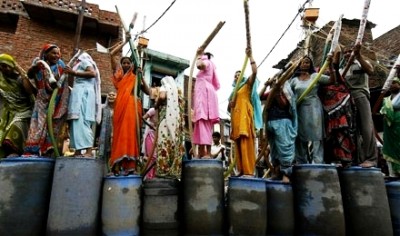
Bhagwan Das had migrated to Delhi a decade ago and settled in what the Govt. calls an ‘unauthorised colony’ of Delhi near Sangam Vihar. Today with wife and 3 children the migrant labour is a Rickshaw puller with an income of nearly five thousand per month spends his earning like this : he pays Rs 800 jhuggi rent to a local neta, spends Rs two thousand five hundred on ration from the open bazar, and one thousand eight hundred to buy water per month.
And Das is not alone, most of the residents of the 1639 unauthorised colonies of the capital spend their earning in the same way, with no other facility such as education for their children.
As the Rio +20 starts to discuss the environment and water issues,one may wonder why people have to buy water from the contractor in a place like Delhi where the government claim that they have double the amount of water what is required for people residing in Delhi.
World Health Organisation has set a minimum consumption level at 120 litres per capita which is a far dream for Delhi’s 90 percent population. Ironically the Lutyens Delhi consume 80 percent of the total supply of water. .
Colin Gonsalves, a popular human rights lawyer expressed his concern on the lack of a Water Security Act that ensures universal water distribution, in India.
Magsaysay Award winner, Rajendra Singh , who was on a sit-in protest in Delhi till Monday, questioned the intention of policy makers in India. Rajendra singh, better known as ‘The water man – Jal Purush’ is known for restoring the traditional water sources in Alwar district of Rajasthan, making the area self dependent.
Himanshu Thakkar, a noted water researcher and campaigner, found major loopholes in the National Water Policy 2012 and demanded a citizen and climate friendly water policy. He said that “the crisis portrayed by the government is artificial”.
Kavita Krushnan, leader of CPIML – Liberation, claimed that the “government is blindly following the conditions of World Bank and IMF without considering citizen’s concerns.”
Azad, a full time activist with slum dwellers in Delhi, civic facilities for the slum dwellers including water, said that “it is a shame that after 65 years of Independence people have to buy water from the mafia and Jal Board is hardly concerned about water problem faced by the poor people.”
The Right to Water Campaign believes that it is not surprising that the Union Water Resources Minister Pawan Kumar Bansal gave a statement in the Parliament on May 7, 2012 stating, “In the new proposed water policy, we have taken care to emphasize that the State should be encouraged to go in for public private partnership… public private partnership does not mean that you are privatizing the water sector. We are not privatising the water sector.”
He even mentioned names of cities like Tirpur, Salt Lake Kolkata, Chennai, Nagpur, Hyderabad, Hubli, Dharwad, Belgaum, Gulbarga, Latoor, Mysore, Haldia, Dewas, Khandwa, Shivpuri, Raipur, Kolhapur, etc. He argued “So many places for one purpose or the other public private partnership model has been utilised, and it would be the policy of the Government to encourage that.”
Bansal’s statement in the Parliament completely misrepresents the facts and misleads the parliament and people as well.The cities which were mentioned by the minister are cases of failed PPP projects. Votaries of privatisation argue that they are not privatizing water, but only involving private parties in managing it. The fact is no private operator undertakes a project unless it is assured of its raw material i.e. water.
Right to Water Campaign conducted a study in Delhi and found how the PPP business deprives people of their fundamental right to water.
The members of the campaign filed a few RTI applications and with that thread researched the PPP moves by the Delhi government and the findings are shocking.
The Delhi government is about to start three PPP projects in three areas namely Malviya Nagar, Vasant Vihar and Nangloi.Each project will cost 173 crore (1730 million INR) where water distribution system will be privatised in phases.